
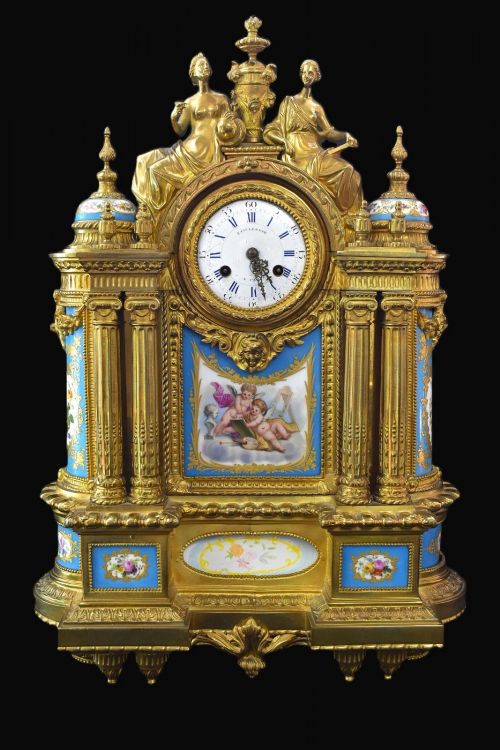


Napoleon III Mantle Clock
A Napoleon III mantle clock brings French Second Empire presence to a room, combining heavy gilt bronze and porcelain.
Napoleon III Mantle Clock
A Napoleon III mantle clock is a French timepiece dating primarily from the nineteenth century, spanning periods from the eighteen-sixties to eighteen-eighties. These items include mantel clocks, clock garnitures, and portico clocks originating from French workshops during the Victorian era.
The version most commonly met on this page is the French mantel clock rendered in ormolu and porcelain, often accompanied by enamel dials or Boullework. Such pieces reflect styles such as French Rococo Revival, Louis XVI Revival, and French Empire Revival.
Buyers encounter various formats, from large drum head clocks and solid brass designs to intricate marble and bronze assemblies. These objects served as domestic timekeepers and decorative centrepieces in nineteenth-century interiors.
How they were made
Makers utilised cast ormolu, gilt bronze, and solid brass to form the structural bodies of these timepieces, frequently combining them with natural materials like marble, slate, and figured walnut. Enamel and porcelain components provide contrasting textures on dials and inset panels.
Surfaces often feature intricate detailing, including hand-blown glass domes protecting the clockwork, tortoiseshell inlays in Boullework, and champleve enamel work. The mechanical movements typically operate on an eight-day striking system.
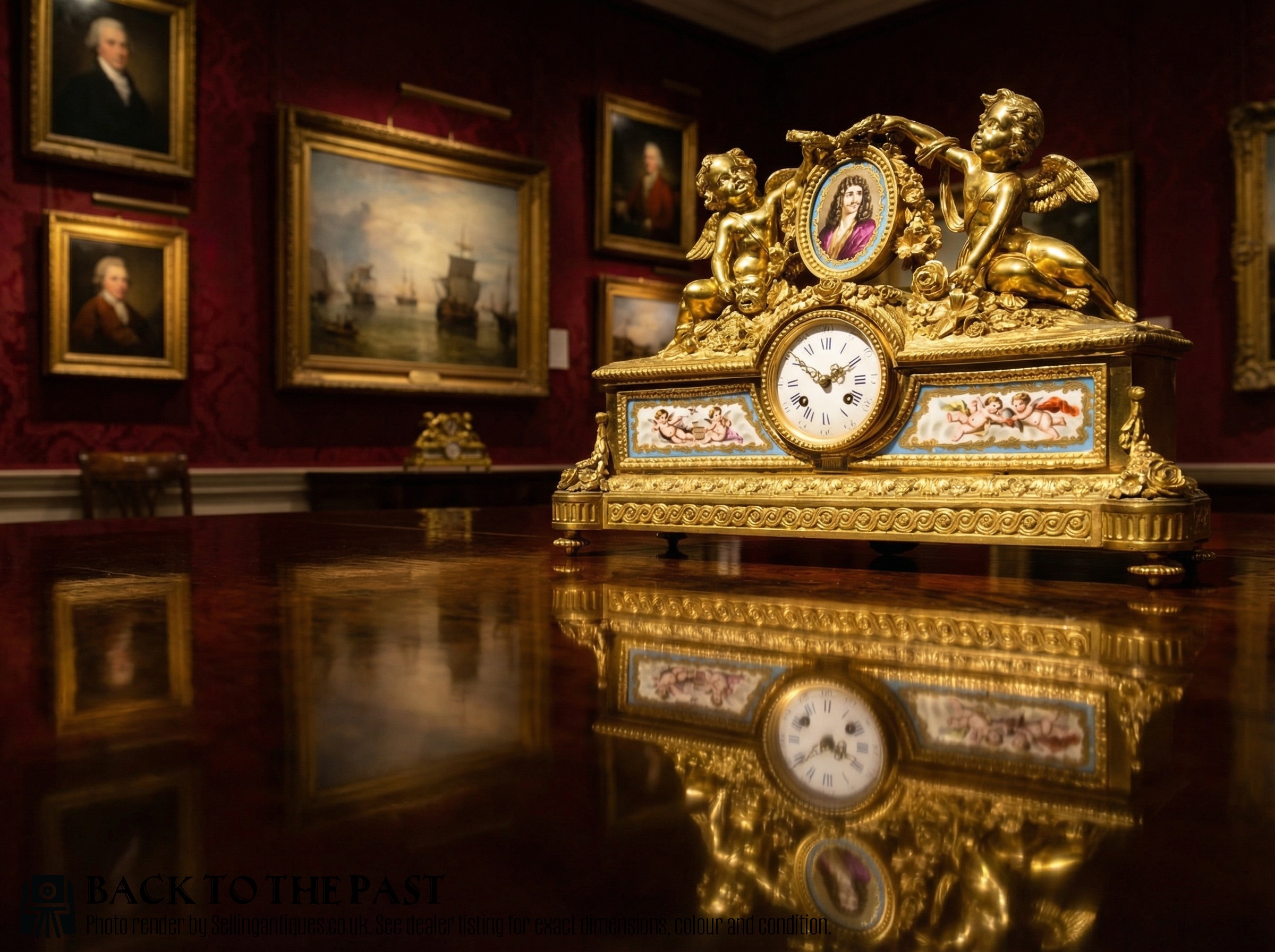
Moliere makes a quiet appearance cast in portrait plaque form upon a gilt bronze clock.
What varies in quality
Quality depends upon the crispness of the ormolu casting and the precision of the gilt bronze work, where finer pieces exhibit sharp relief and deep chasing rather than soft contours. The integration of high-grade Sevres porcelain panels and hand-painted enamel details distinguishes superior examples.
The presence of maker signatures from notable horological workshops, alongside complex movements such as perpetual calendars or equation of time complications, elevates a piece. Original components like hand-blown glass domes and matching clock garnitures further define the upper tier of the range.
Etienne Lenoir·Japy Freres·Leroy and Fils·Phillipe H Mourey·Brocot
The Napoleon III Mantle Clock Glossary
- Ormolu
- Gilt bronze mounted onto the bronze or brass body of the clock. This technique creates a bright golden finish characteristic of French nineteenth-century decorative arts.
- Boulle
- A form of marquetry utilising brass and tortoiseshell inlaid into wood. It appears frequently on nineteenth-century French cases.
- Champleve
- An enamelling technique where troughs are dug into a metal surface and filled with vitreous enamel. These coloured sections add pattern to the clock body.
- Garniture
- A set comprising a central clock accompanied by matching side ornaments or vases. These sets were designed to sit together on a mantelpiece.
- Portico clock
- A architectural clock style supported by columns. They often feature a suspended pendulum swinging within the central open space.
Napoleon III Mantle Clock: Frequently Asked Questions
How do I wind a Napoleon III mantle clock?
Most pieces operate on an eight-day movement requiring a key to tension the springs through winding holes on the dial. Care must be taken not to overwind the mechanism.
Moving the hands should be done following the correct clockwise rotation to avoid damaging the striking gear train inside the movement.
What is a clock garniture set?
A clock garniture consists of a central timekeeper flanked by matching decorative objects such as urns or candelabras. They were manufactured as a cohesive suite to decorate a mantelpiece.
These sets repeat the materials and motifs of the main clock, such as ormolu, marble, or porcelain panels.
How do I identify a Boulle clock case?
Boulle cases feature distinct tortoiseshell and brass marquetry patterns inlaid into dark wood surfaces. This decorative technique creates a contrasting metallic and dark patterned finish.
Such cases often appear alongside gilt bronze mounts typical of the Napoleon III period.
Are glass domes original to these clocks?
Hand-blown glass domes frequently accompany nineteenth-century French clocks to protect the gilt bronze and ormolu surfaces from dust. Surviving original domes are thick and contain minor imperfections from period manufacturing techniques.
They rest upon matching wooden or ormolu bases designed specifically for the clock.