



Napoleon III Boulle Table
A napoleon iii boulle table brings dramatic brass marquetry and rich tortoiseshell into a room, offering grand French revival surface work.
Construction and Materials
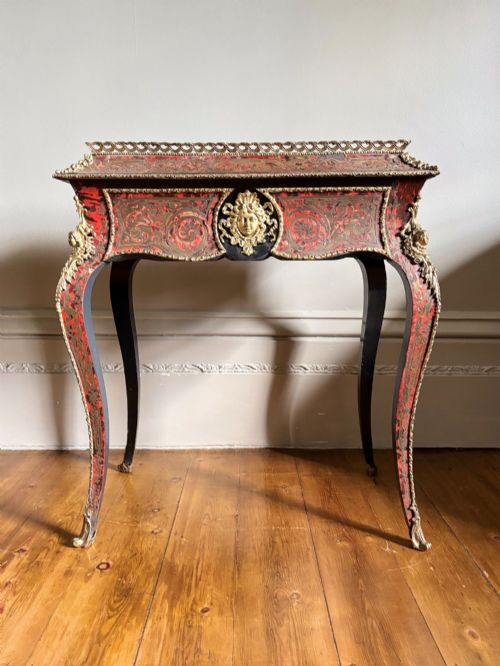
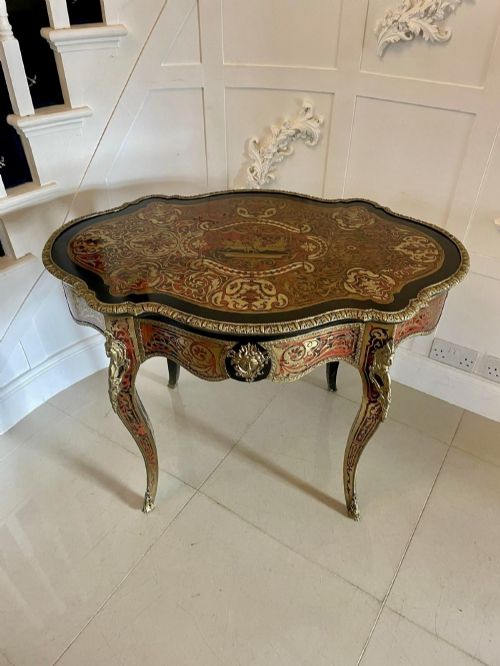
Craftsmen utilised the traditional Boulle technique, cutting sheets of brass and tortoiseshell simultaneously to create matching positive and negative marquetry panels known as première partie and contre-partie. These intricate patterns were then set into ebonised wood carcases.
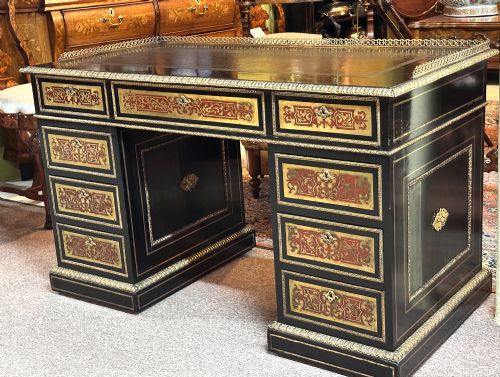
Gilded bronze or ormolu mounts typically accentuate the corners, feet, and edges, providing a bright metallic contrast to the dark wood and warm amber tones of the tortoiseshell. Leather inserts sometimes feature on the writing surfaces of desks and tables.
Evaluating Quality and Craftsmanship
Quality rests primarily in the precision of the brass marquetry and the crispness of the chased ormolu mounts rather than mere age. Finer examples display tight, seamless joints in the metal inlay without excessive filler.
The choice of tortoiseshell significantly impacts value, with rich red tortoiseshell creating a more vibrant effect than standard dark varieties. Superior pieces also maintain balanced proportions and retaining original patination on the ebonised surfaces.
Napoleon III Boulle Table Retail Price Guide 2026
Typical asking prices for napoleon iii boulle table among the pieces listed under this phrase on Sellingantiques today, from the lower quarter to the upper quarter. They describe what is for sale here now, not the wider market.
The archive includes games tables and serpentine centre tables showcasing Louis XV revival aesthetics.
Maison Millet
The Napoleon III Boulle Table Glossary
- Boulle work
- A method of marquetry using contrasting sheets of brass and tortoiseshell, named after the famed cabinetmaker André-Charles Boulle. It defines the rich decorative surface seen on these tables and clocks.
- Ormolu
- Gilded bronze mounts applied to furniture and clocks for ornamental effect. The finish provides a bright, durable golden accent against dark woods.
- Ebonised wood
- Timber treated to resemble ebony, providing a dark, uniform background that makes the bright brass inlay stand out.
- Serpentine
- A curved line or shape featuring alternating convex and concave sections. It gives nineteenth-century French tables a fluid, organic silhouette.
Napoleon III Boulle Table: Frequently Asked Questions
Where should I place a boulle table?
These tables suit principal reception rooms or studies where their reflective brass surfaces catch natural light. They work well away from direct sunlight to protect the tortoiseshell.
Keep them in stable environments away from extreme heat fluctuations to prevent the delicate marquetry from lifting over time.
How do I clean tortoiseshell and brass?
Dust the surface gently with a dry, soft microfiber cloth to prevent scratching the polished materials. Avoid harsh chemical cleaners or excess moisture.
Consult a professional restorer if the marquetry loosens rather than attempting domestic adhesives.
Are these tables sturdy enough for daily use?
Most centre and games tables were built for formal display and light entertaining rather than heavy domestic loads. Treat writing desks with care to preserve the leather and inlaid tops.
Place protective felt under items placed on the surface to prevent scratching the polished finish.
How do I distinguish nineteenth-century revival styles?
Look at the structural joinery and internal secondary woods, which typically reveal nineteenth-century manufacturing methods beneath the seventeenth-century design inspiration. Louis XV revival pieces feature flowing cabriole legs, while Louis XVI versions show straighter, tapered supports.
Examine the quality of the brass cutting and the patination on the ormolu mounts to confirm the nineteenth-century Victorian period.