


Muted Grey Watercolour
Muted grey watercolour works bring quiet atmospheric depth to a room through delicate washes on paper.
Muted Grey Watercolour
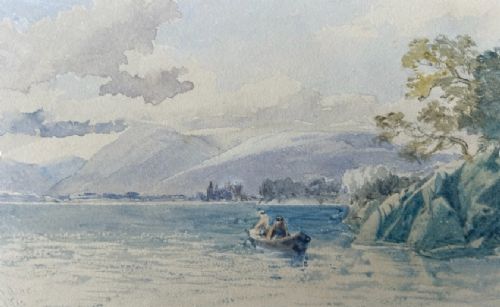
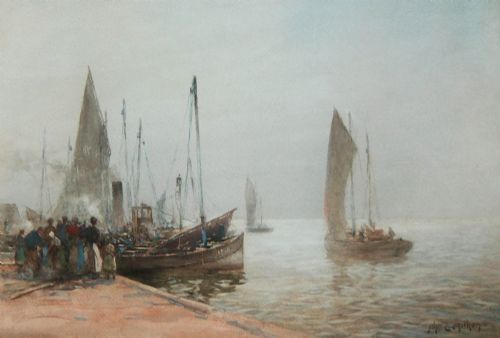
A muted grey watercolour piece captures subtle tonal shifts, often depicting British landscapes, coastal scenes, and townscapes from the nineteenth and twentieth centuries. These works rely on restrained palettes of subdued greys, duns, and pale washes to evoke overcast skies and quiet waters.
Most examples originate from periods spanning the Victorian era through to the mid twentieth century, encompassing movements such as British Impressionism and Early Twentieth Century British art. Buyers encounter works featuring paper supports framed alongside ink and wood elements.
Subjects range from Yorkshire harbours and Scottish coasts to London river views, reflecting the observational approaches of regional and metropolitan artists working in paint and pigment.
Materials and technique
Artists applied watercolour pigment suspended in water directly onto paper supports, often combining fluid washes with precise ink lines to define architectural and natural details. The absorbency of the paper determined how the grey tones settled and bled during the painting process.
Wood framing protected these delicate paper works, while the restrained use of pigment allowed the natural tone of the ground to act as a light source within the composition.
Several artists braved freezing northern winters with frozen fingers just to capture an accurate grey Yorkshire snow scene.
Distinctions in quality
Quality rests upon the artist's control of wash density and the economy of line, where subtle tonal gradations create genuine atmospheric weight rather than flat grey obscuration. Stronger compositions demonstrate a sure handling of perspective and light across difficult weather conditions.
Condition plays a central role, distinguishing works that retain their original tonal subtlety from those faded by excessive light exposure or discoloured by acidic mounts.
Thomas Miles Richardson Jnr·James E Aitken·Albert Ludovici Jnr·Fred Lawson·Arthur Reginald Smith
The Muted Grey Watercolour Glossary
- Watercolour paint
- A medium consisting of coloured pigments suspended in a water-soluble vehicle, applied to paper to achieve translucent effects.
- Wash
- A thin, fluid layer of diluted pigment spread across paper to create smooth background tones or skies.
- Pigment
- The finely ground natural or synthetic coloured powder that gives watercolour its tint.
- Monogram
- A motif made by overlapping two or more letters to form a signature on a painting.
- Ground
- The initial prepared surface of the paper or support upon which the watercolour pigments are applied.
Muted Grey Watercolour: Frequently Asked Questions
How should I hang a watercolour?
Watercolours require placement away from direct sunlight to prevent the pigments and paper from fading over time.
Using conservation-grade UV-filtering glass provides an extra layer of protection against environmental damage.
What subjects are common in these paintings?
The works frequently depict British coastal harbours, northern landscapes, rural lanes, and London street scenes.
Artists often focused on overcast weather, snow, and twilight to explore subdued tonal palettes.
How do I date an antique watercolour?
Dating relies on stylistic clues, framing methods, artist signatures, and inscriptions recorded on the reverse of the work.
Examine the paper type and any visible watermark for further clues regarding the period of production.
Are these works always signed?
Many pieces carry full signatures, initials, or monograms applied by the artist directly onto the lower sections of the paper.
Unsigned works still appear frequently, attributed through stylistic similarities and historical gallery labels.