


Mottled Glass Lamp
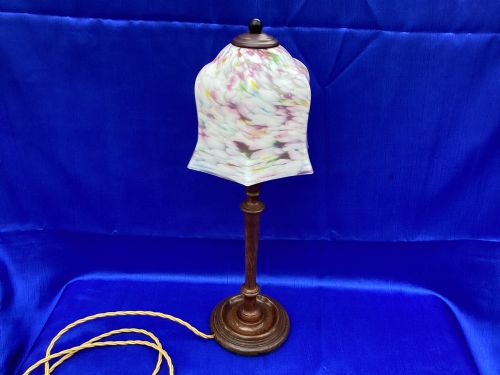
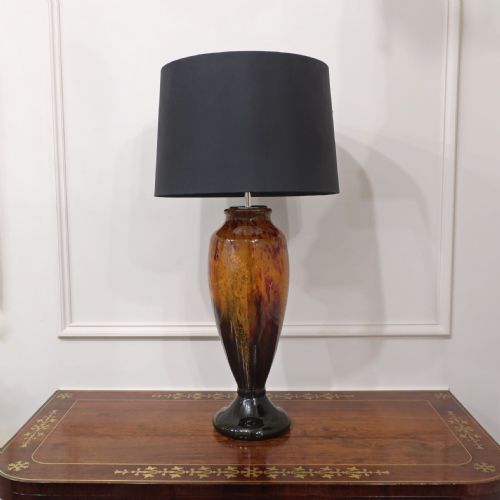
These mottled glass lamp designs combine coloured or opaline glass shades with metal bases, offering a warm and distinctive glow.
Mottled Glass Lamp
A mottled glass lamp brings together textured glass shades and structural stands from the early twentieth century. The selection on this page centres on table lamps, wall lights, and chandeliers from the Art Deco, Art Nouveau, and Arts and Crafts periods.
Most examples you encounter date from the nineteen twenties and nineteen thirties, featuring heavy glass shades paired with wrought iron, brass, marble, or oak bases. These pieces reflect the French and British decorative movements of their respective eras.
Materials and construction methods
The shades are formed from mottled glass or pate de verre, often created by layering different coloured powders and minerals within the molten material before blowing or moulding. This technique produces the characteristic swirling patterns and variegated colours unique to each piece.
Support structures utilise durable materials such as forged wrought iron, cast brass, polished marble, and solid oak. Metal components are frequently patinated or patinised to complement the rich tones of the glass.
The listings span four distinct periods: the nineteenth century, nineteen hundred, nineteen twenty, and nineteen thirty.
Judging the quality of the work
Distinction in these pieces rests upon the complexity of the glass coloration and the fineness of the metalwork. Superior examples display subtle gradients within the glass and deliberate, hand-forged detailing in the iron or brass mounts.
The integration between shade and base also indicates standard of manufacture, where custom-fitted hardware secures the heavy glass without obscuring its mottled surface. Simpler forms rely on standard commercial mountings rather than bespoke artistic frames.
Charles Schneider·Daum·Degue·Muller Freres
The Mottled Glass Lamp Glossary
- Mottled glass
- Glass featuring irregular patches or streaks of colour, created during the melting process. This finish diffuses light evenly while adding visual texture.
- Pate de verre
- A glass-working technique involving the packing of finely crushed glass into a mould and fusing it in a kiln. The resulting object has a dense, sugary translucence.
- Art Deco
- A design style dominant in the nineteen twenties and nineteen thirties characterised by geometric shapes, stylised motifs, and modern industrial materials. It succeeded Art Nouveau.
- Wrought iron
- Iron that is heated and hammered into shape by hand, known for its fibrous texture and strength. It frequently forms the bases and stems of French lighting pieces.
- Opaline glass
- A semi-opaque glass with a milky appearance, sometimes tinted with various minerals. It scatters light softly across the room.
Mottled Glass Lamp: Frequently Asked Questions
What periods do these lamps come from?
The available pieces primarily date from the early twentieth century, spanning the nineteen hundreds through to the nineteen thirties. This era encompasses the transition from organic Art Nouveau styles to geometric Art Deco designs.
Earlier nineteenth-century examples also appear, often presenting different structural characteristics compared to the interwar period pieces.
How were these lamps originally used?
Table lamps and night lights served as task or ambient lighting in domestic interiors, placed on desks, sideboards, or bedside tables. Wall lights and chandeliers provided overarching illumination for reception rooms and hallways.
Due to the density of the mottled glass, the light emitted is generally subdued and decorative rather than bright.
How do I identify Art Deco versus Art Nouveau?
Art Nouveau pieces, typically from around nineteen hundred, favour flowing lines, floral motifs, and organic shapes inspired by nature. You see this in the work of makers like Muller Freres.
Art Deco items from the nineteen twenties and thirties lean towards clean geometric lines, stylised forms, and industrial materials such as chrome and wrought iron.
Can modern bulbs be used safely?
Many vintage lamps have been rewired with modern fabric flex to meet contemporary safety standards while retaining their period appearance. It is advisable to check the internal wiring and consult an electrician regarding suitable bulb wattages.
LED bulbs are often recommended because they generate less heat, protecting the historic glass and metal components.