


Mother of Pearl Knives
Mother of pearl knives bring lustrous handle materials and silver or silverplate blades to the dining table, prized for setting dessert or fruit courses with period elegance.
Identifying mother of pearl knives
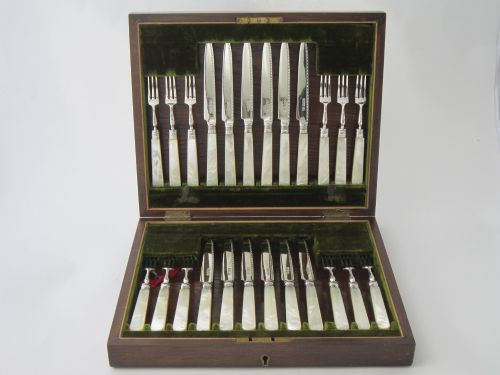
When you search for mother of pearl knives, you encounter cutlery sets designed primarily for dessert, fruit, butter, or fish courses, often housed in fitted boxes lined with velvet or leatherette. These pieces emerge from the nineteenth and early twentieth centuries, spanning Victorian, Edwardian, and George V periods.
The most common formats on this page are sets of six or twelve matching knives, sometimes paired with matching forks. Individual pairs and butter knives also appear, reflecting formal dining customs where specific cutlery accompanied distinct courses.
Origins include English workshops, particularly Sheffield makers, alongside continental European examples such as Dutch pieces. The construction combines natural nacre handles with metal blades, ferrules, and occasionally decorative terminals.
Materials and construction
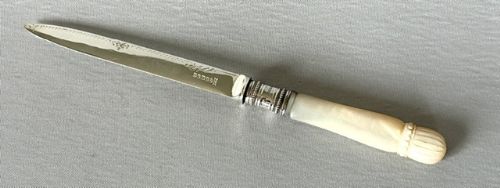
Handles utilise natural mother of pearl, harvested from shell nacre to provide an iridescent, smooth grip. These pieces are shaped and pinned to tangs using small metal rivets.
Blades and ferrules are formed from sterling silver, silver gilt, or silverplate. Metals are often engraved or polished to complement the shimmering quality of the shell handles.
Storage containers incorporate wood, leatherette, and velvet linings to protect the delicate surface sheen of the cutlery during storage and transport.
Listings span the nineteenth century through the George V period, incorporating materials like velvet, leatherette, and wood alongside silver and pearl.
Evaluating quality and execution
The standard of a set rests upon the depth of the nacre and the uniformity of the shell handles across every piece in the box. Thicker, highly iridescent pearl sections command greater visual weight than thin or flat panels.
Engraving detail on the silver or silverplated blades and the crispness of decorative terminals indicate the skill of the silversmith or manufacturer. Matching sets where every handle shares identical grain and tone demonstrate superior initial selection.
James Deakin·Levesley Brothers·Robert Fead Mosley·Watson and Gillot·Fattorini and Sons
The Mother of Pearl Knives Glossary
- Mother of Pearl
- An iridescent inner layer of mollusc shell used for knife handles. It provides a smooth, shimmering surface that catches light differently from bone or ivory.
- Ferrule
- The small metal collar joining the knife blade to the handle. It secures the construction and often bears engraved decoration.
- Silver Gilt
- Silver covered with a thin layer of gold. This treatment adds a warm yellow tone to the metal components of the cutlery.
- Dessert Set
- A matched collection of knives and forks intended for the final course of a meal. These sets frequently arrive in dedicated wooden presentation boxes.
- Terminal
- The decorative end of a knife handle or fork. It can be plain, engraved, or shaped into specific architectural or floral motifs.
Frequently Asked Questions
What were mother of pearl knives used for?
These utensils served formal dining purposes, specifically for fruit, dessert, butter, or fish courses during the nineteenth and early twentieth centuries. The pearl material resisted fruit acids that would otherwise tarnish standard steel blades.
Such cutlery remained part of affluent household dining habits, brought out for special courses and stored securely in fitted presentation boxes when not in use.
How can I tell Victorian sets from later periods?
Victorian sets often date from the late nineteenth century and feature heavier hand-engraved blade decoration or ornate terminals. Documentation or registration marks stamped onto the metal can confirm the exact decade of manufacture.
Edwardian and George V sets tend to display cleaner lines, reflecting changing design aesthetics while retaining the traditional combination of nacre and silver.
Are these knives made of solid silver?
Blade materials vary between solid sterling silver, silver gilt, and silverplate depending on the specific set. Hallmarks stamped onto the metal components indicate whether the piece is solid sterling or plated over a base metal.
Handles are consistently formed from natural mother of pearl shell across both silver and silverplated configurations.