


Monochrome Figure Drawing
Monochrome figure drawing works the human form in charcoal, pencil, chalk and ink across centuries of academic study.
Monochrome Figure Drawing
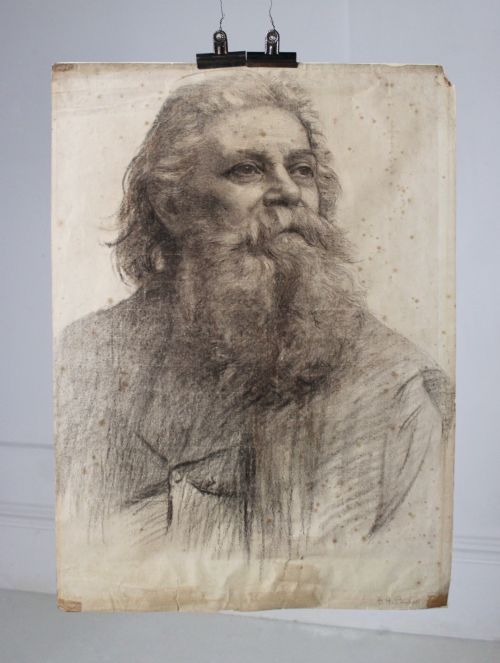
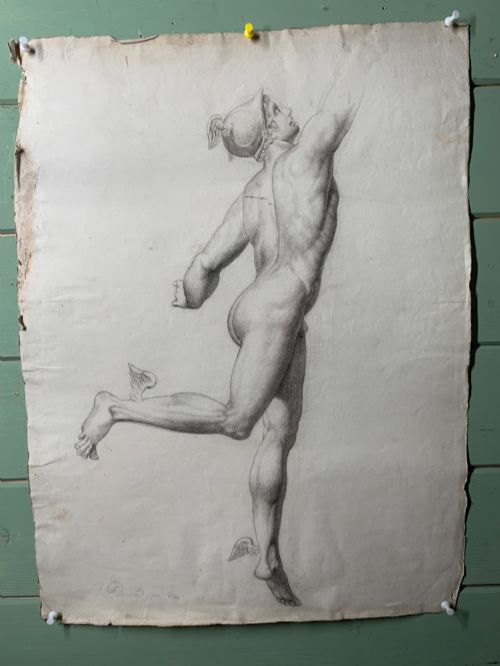
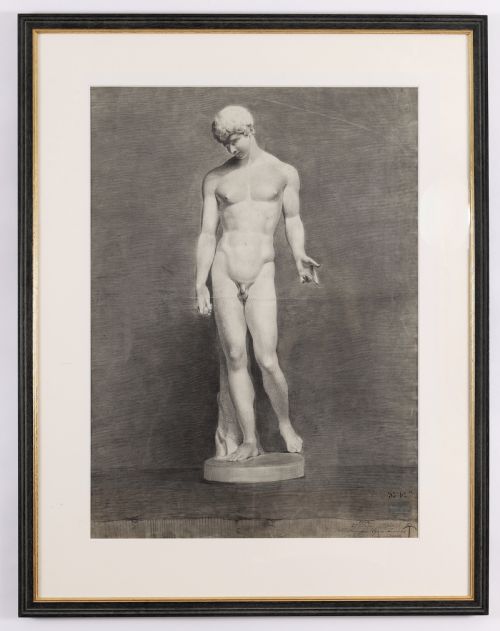
A monochrome figure drawing isolates the human form through single-colour media on paper, avoiding colour to focus entirely on line, tone and anatomy. These works range from formal academic life studies of nudes to intimate portraits and narrative sketches.
The versions most commonly found here date from the Georgian era through the nineteenth and twentieth centuries, encompassing academic realism, neoclassical works, art deco period pieces and modernist interpretations.
Framed artwork and original drawings make up the bulk of these listings, presented either as single sheets or paired studies from art schools and artists' studios.
Materials and technique
Artists relied primarily on paper supports, applying charcoal, graphite, chalk, pencil and ink to build form through tone and line. These dry and wet media allowed for rapid studio sketches as well as highly finished academic submissions.
Works from the academic tradition often began with precise pencil construction lines before building deep shadows in charcoal or ink wash, capturing muscular tension and drapery with strict adherence to proportion.
The listings span works created across the eighteenth, nineteenth and twentieth centuries using paper supports with charcoal, graphite, chalk, ink and pencil.
Judgement of quality
Quality rests upon the sureness of the draughtsmanship, where confident line weight and accurate anatomical proportion separate accomplished studio studies from hesitant beginner exercises. The handling of shadow and light defines the volume of the figure.
Provenance and context elevate certain works, particularly those bearing direct links to art schools, grand prix submissions, or identified artists working within recognised nineteenth and twentieth-century French, British and international schools.
Pierre-Paul Prud'hon·Augustus Edwin John·Winifred Eugene Ballard·John Hoppner·Faeq Hassan·Francis Dodd
The Monochrome Figure Drawing Glossary
- Academic Realism
- A style of painting and drawing produced under the influence of European academies of art, maintaining strict standards of composition and anatomical study.
- Life Study
- A drawing executed directly from a live nude or clothed model, forming the core of traditional art school training.
- Charcoal
- A dry drawing medium made from slowly burned wood, prized by draughtsmans for deep blacks and broad tonal blending.
- Graphite
- A crystalline form of carbon used in pencils, allowing for fine line work as well as smooth metallic tonal gradients.
Monochrome Figure Drawing: Frequently Asked Questions
What is an academic life study?
An academic life study is a detailed drawing of a human model produced within a formal art school or studio setting to master anatomy and proportion.
These pieces often show careful attention to musculature and lighting, serving as foundational training for painters and sculptors.
How should I frame an antique drawing?
Antique drawings on paper require conservation-grade mounting to prevent acid transfer from backing boards and mats. Keeping the paper distanced from the glass stops humidity damage.
Ultraviolet-filtering glass protects fugitive media like charcoal and pencil from fading under ambient light.
How do I distinguish nineteenth-century drawings?
Nineteenth-century drawings frequently display academic neoclassical influences, focusing on mythological subjects, classical casts or vigorous life studies of nudes.
Paper stocks from this period often exhibit watermarks and handmade textures distinct from modern wood-pulp sheets.
What distinguishes charcoal from graphite?
Charcoal produces a deep, matte black mark that easily smudges for dramatic tonal transitions and heavy shadows. It requires fixative to prevent further transfer.
Graphite yields a reflective grey line capable of sharper detail and finer cross-hatching without the same powdery residue.