
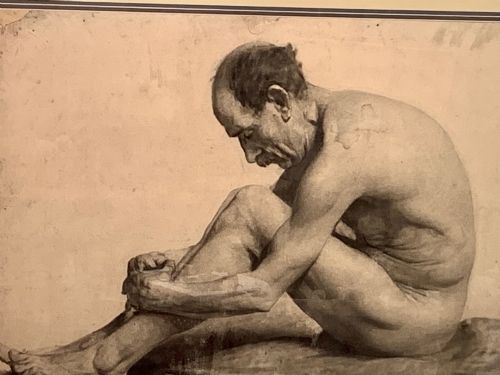
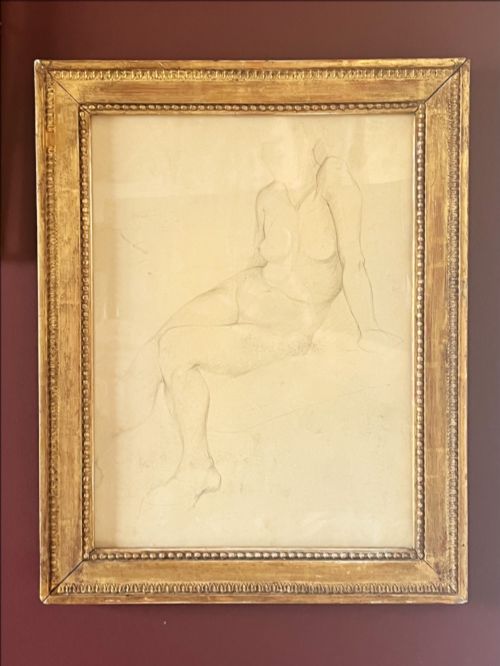
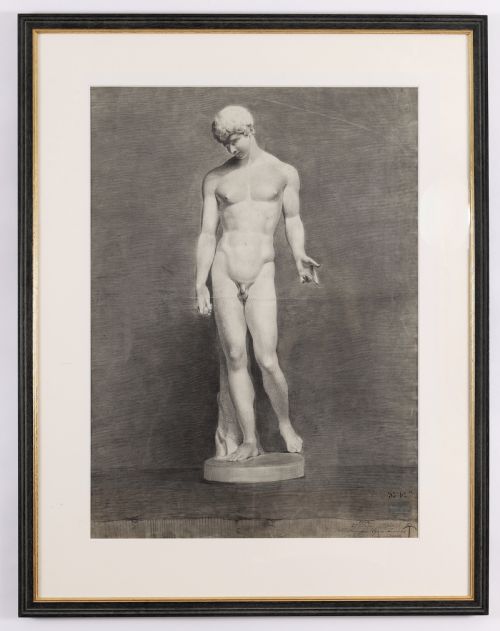
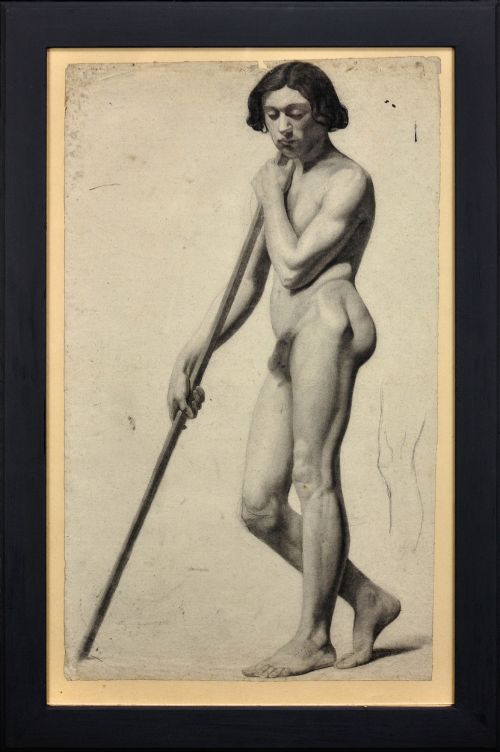


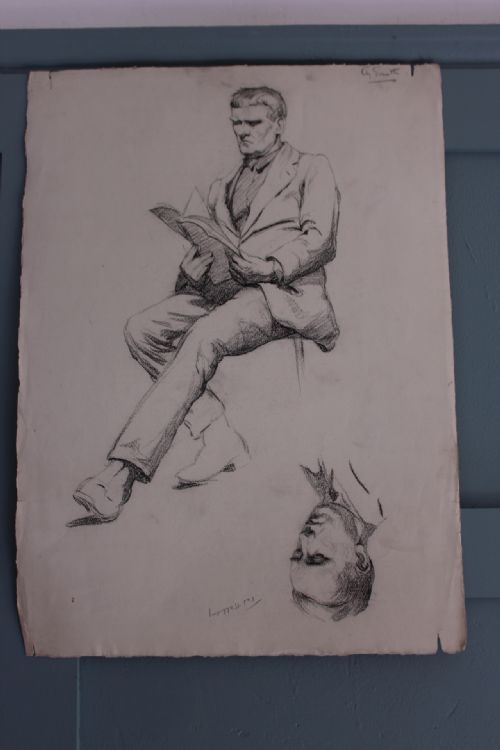

Framed Charcoal Life Drawing
These framed charcoal life drawing pieces offer expressive studies of the human form, prized for their direct draftsmanship and raw monochrome tonal range.
Framed Charcoal Life Drawing
A framed charcoal life drawing captures the human figure directly from a model, ranging from nineteenth century academic studies to mid-century modern interpretations. You will most frequently encounter nineteenth century academic life studies and twentieth century works on paper.
The selections span styles from academic realism and neoclassical compositions to modern British interpretations. These framed artworks serve as striking wall art for collectors focused on figurative draughtsmanship.
How they were made
Artists utilised charcoal and chalk on paper or toned paper to build volume and shadow through expressive hatching and smudging. Graphite was frequently employed alongside charcoal to establish precise anatomical proportions before deepening the tonal contrasts.
Finished works are typically housed behind glass within wood or gilt wood frames that protect the delicate medium from atmospheric damage.
Listings feature paper, toned paper, glass, charcoal, chalk, wood, graphite, and gilt wood across multiple historical periods.
What varies in quality
The distinction between ordinary and exceptional works rests upon the surety of the line and the anatomical precision demonstrated by the artist. A master study reveals confident control over light and shadow, giving the figure genuine three-dimensional presence on the page.
The quality of the framing also dictates the overall character, with period gilt wood frames offering significantly more visual weight and historic harmony than plain modern mouldings.
Henry Arthur Roberts·Winifred Eugene Ballard·Frank Dobson
The Framed Charcoal Life Drawing Glossary
- Academic realism
- A style of painting and drawing produced under the influence of European academies of art, prioritising strict adherence to classical anatomy and technique.
- Charcoal
- A dry drawing medium made from finely ground organic materials held together by a gum or wax binder, creating deep blacks and soft smudged gradients.
- Toned paper
- Paper that possesses a natural colour such as grey, tan, or buff rather than a stark white surface, allowing artists to apply highlights in white chalk directly.
- Life study
- A drawing or painting executed directly from a live nude or clothed model, traditionally utilised within art schools to train students in human anatomy.
- Neoclassical
- An artistic movement drawing inspiration from the classical art and culture of ancient Greece and Rome, prioritising clarity, proportion, and restrained emotion.
Framed Charcoal Life Drawing: Frequently Asked Questions
What is a life study?
A life study is an artwork created by observing a live model directly, serving as a fundamental exercise in capturing human anatomy and proportion.
These pieces were traditionally produced in formal art academies and studios to build technical skill in draughtsmanship before undertaking larger painted compositions.
How should I hang these drawings?
Charcoal and paper are sensitive to direct sunlight, so these artworks require placement on interior walls away from harsh windows.
Pairing the piece with subdued lighting protects the paper and charcoal pigments while accentuating the subtle tonal variations across the toned paper.
How do I identify academic style?
Academic style drawings are characterised by meticulous attention to anatomical accuracy, structured shading, and traditional neoclassical poses.
These works often originate from formal art school sessions where artists spent many hours refining the musculature and proportions of the human figure.
Are these works original art?
The pieces available are original hand-drawn works on paper rather than mechanical reproductions or prints.
Each drawing exhibits the physical texture of charcoal, chalk, or graphite directly applied to the surface by the artist's hand.