


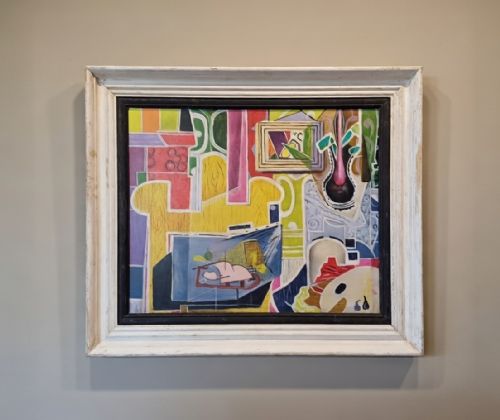


Modernist Still Life Art
Modernist still life art brings together bold geometric forms and striking domestic compositions from the early to mid-twentieth century.
Modernist Still Life Art
When you search for modernist still life art, you encounter oil paintings, gouache on board, and drawings created across several decades from the 1920s to the 1960s. These works capture domestic interiors, fruit on tables, floral arrangements, and geometric kitchen scenes through radical new lenses.
The pieces on this page frequently originate from French workshops and British studios, reflecting international shifts in artistic vision. You will meet French modernist floral arrangements alongside British St Ives school compositions and avant-garde continental interpretations.
The most common formats on display are oil paintings on canvas and board, mapping the progression from early cubist and fauve influences through to mid-century abstract expressions.
Materials and Technique
Artists working in this genre predominantly utilised oil paint applied to canvas or wood board, building rich textures and flat planes of pigment. Some compositions incorporate gold leaf or employ wax-based encaustics to achieve distinct surface qualities.
Works on paper employ media such as gouache and conté crayon, allowing for rapid execution and sharp graphic clarity. Supports range from stretched canvas to sturdy wooden boards and heavy paper.
The listings span five decades from the 1920s to the 1960s, executed in oil, gouache, and conté crayon on canvas, wood, and paper.
Assessing Quality
Quality rests in the confidence of the brushwork and the structural rigour of the composition. Stronger examples demonstrate a sophisticated command of geometry and colour relationships that hold the viewer's eye across the entire surface.
The significance of the artist's hand and documented provenance elevate certain pieces above anonymous studio output. The best works balance avant-garde abstraction with a coherent spatial arrangement.
The Modernist Still Life Art Glossary
- Cubism
- An early twentieth-century art movement that breaks subjects down into geometric shapes and multiple viewpoints. This approach dominates many of the domestic interiors and still life arrangements seen here.
- Fauvism
- A style characterised by vibrant, unnatural colours and bold brushstrokes rather than realistic representation. Master practitioners applied this liberated palette to still life subjects.
- Gouache
- An opaque watercolour medium consisting of pigment mixed with a water-binding agent. It dries to a flat, matte finish well suited to graphic modernist compositions on board or paper.
- St Ives School
- A group of artists based in Cornwall associated with progressive British modernism from the 1940s onward. Their output bridged local coastal landscapes and international abstract movements.
- Encaustic
- A painting technique involving heated beeswax mixed with coloured pigments. The molten mixture is applied to a surface and fixed with heat.
Modernist Still Life Art: Frequently Asked Questions
What is modernist still life art?
It is a category of painting and drawing produced during the twentieth century that reimagines traditional domestic objects, fruit, and flowers through non-naturalistic styles. Artists moved away from strict academic realism in favour of abstraction, flattened perspective, and bold colour.
These works reflect the shifting philosophies of decades such as the 1920s and 1950s, where form and structure took precedence over mere imitation of the physical world.
How do I date a modernist painting?
Dating relies on stylistic markers, materials, and documented artist signatures or exhibition labels. Early twentieth-century pieces often lean towards strict cubist geometry or fauvist palette choices, whereas 1950s and 1960s examples tend toward looser mid-century abstraction.
Examining the stretcher frames, canvas type, and backing boards provides further physical clues to the era of creation.
Where were these pieces made?
The works originate from various artistic centres across Europe and America, with a strong representation of French modernism and British regional art. Studios in Paris and Cornwall served as major hubs for the development of these avant-garde compositions.
Provenance notes and artist biographies often trace the specific cultural environment in which each piece was painted.
How should I display them at home?
These works suit both contemporary interiors and traditional spaces, provided they receive balanced lighting away from direct, harsh sunlight. Simple framing allows the bold colours and geometric planes of the composition to command attention without distraction.
Matching the scale of the canvas to your wall space ensures the piece anchors the room effectively.