



Mirrored Top Writing Desk
A mirrored top writing desk brings together a practical writing surface and a reflective glass panel, offering a refined piece for daily correspondence.
Mirrored Top Writing Desk
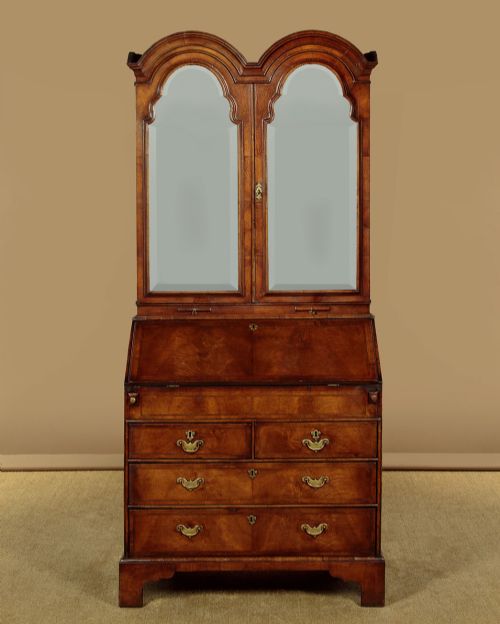
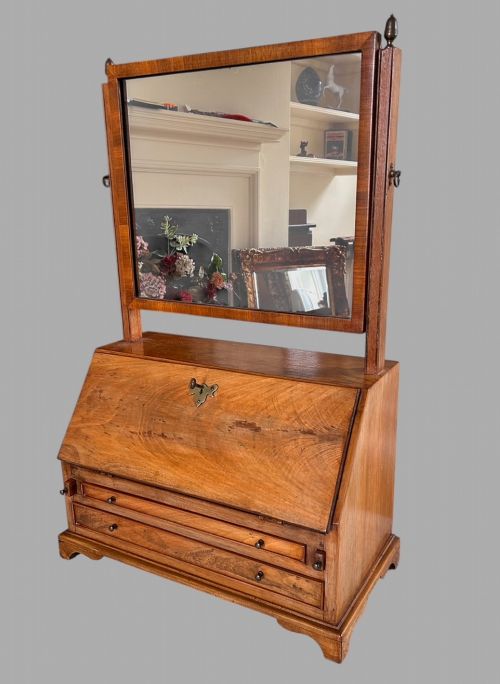
A mirrored top writing desk combines a dedicated writing surface with integrated mirror glass, spanning forms from compact tabletop bureaux to substantial bureau bookcases. The selection draws on periods ranging from the early eighteenth century through the Georgian and Victorian eras up to nineteen hundred.
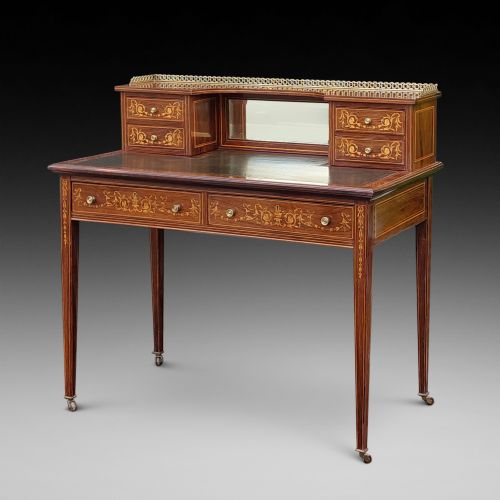
Makers such as Maple and Company and Jas Shoolbred contributed to the variety of styles, which include Edwardian, Queen Anne, George III, and Louis XVI designs. Pieces manifest as ladies writing desks, bureau bookcases, and bonheur du jour variants.
The buyer encounters items constructed in walnut, mahogany, satinwood, and rosewood, often featuring inlaid decoration and brass fittings alongside the central glass element.
Judging quality and execution
The calibre of a mirrored top writing desk rests upon the selection of timber veneers, such as figured walnut or satinwood, and the precision of the inlaid details. Superior examples exhibit harmonious proportions between the writing compartment and the upper mirrored or shelved section.
The integration of original brass hardware and the clarity of the mirror glass distinguish finer specimens from standard production. Cabinetmaking execution, seen in the internal drawer construction and the fit of fall-front desks, defines the upper tier of the range.
Mirrored Top Writing Desk Retail Price Guide 2026
Typical asking prices for mirrored top writing desk among the pieces listed under this phrase on Sellingantiques today, from the lower quarter to the upper quarter. They describe what is for sale here now, not the wider market.
Listings feature walnut, mahogany, satinwood, and rosewood, spanning the Georgian, Victorian, and Edwardian eras.
Maple and Co·Jas Shoolbred
The Mirrored Top Writing Desk Glossary
- Bureau bookcase
- A writing cabinet featuring a fall-front desk compartment below enclosed shelving or cabinet doors. This form provides both workspace and storage for books or papers.
- Bonheur du jour
- A light lady's writing desk originating in France, usually fitted with small drawers, shelves, or a mirror on the upper surface. The style gained popularity during the nineteenth century.
- Inlay
- A decorative technique where pieces of contrasting wood, such as satinwood or lighter veneers, are inserted into the primary timber surface to form patterns. This adornment appears on late Victorian and Edwardian pieces.
- Fall-front
- A hinged writing flap that drops down to create a horizontal desk surface, concealing internal pigeonholes and small drawers when closed. It forms the central working area of a bureau.
Mirrored Top Writing Desk: Frequently Asked Questions
What periods do these desks date from?
The pieces span from the early eighteenth century through the Georgian and Victorian eras, extending to around nineteen hundred. Styles range from George the First and George the Third to Edwardian and Louis the Sixteenth designs.
Craftsmen working across these periods utilised distinct woods and construction methods, allowing collectors to trace the evolution of the writing desk form.
How were these desks used originally?
They served as private writing stations for correspondence, record keeping, and reading, often kept in parlours or private chambers. The incorporation of a mirror glass panel assisted with grooming or reflected light within the room.
Larger bureau bookcases combined this writing function with library storage for bound volumes and documents behind glass doors.
What woods are commonly found?
Construction relies heavily on dense cabinet timbers such as walnut, mahogany, rosewood, and satinwood. Solid walnut appears frequently in pieces from the early eighteenth century.
Later Victorian and Edwardian examples often employ mahogany and satinwood, frequently enhanced with contrasting inlay work and brass fittings.
How do tabletop bureaux differ?
Tabletop bureaux are compact units designed to sit upon an existing table or chest rather than standing independently on the floor. They retain the internal pigeonholes and fall-front writing flap of larger desks.
Some variants include an attached dressing mirror, combining desk space with a vanity function in a portable format.