
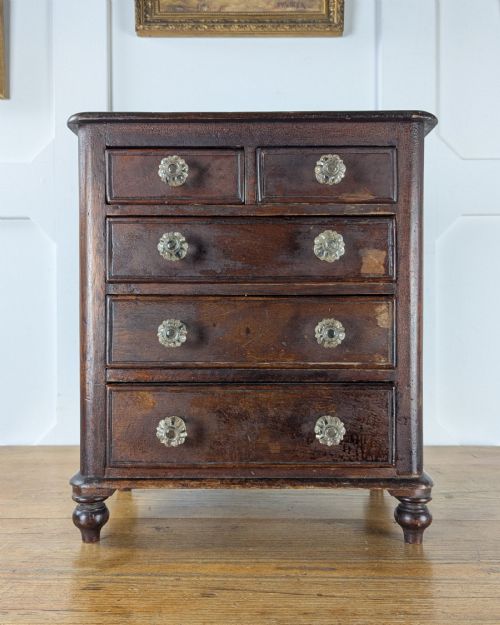
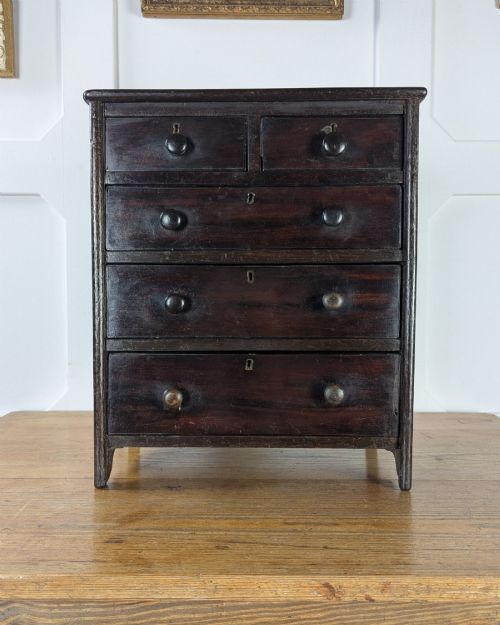
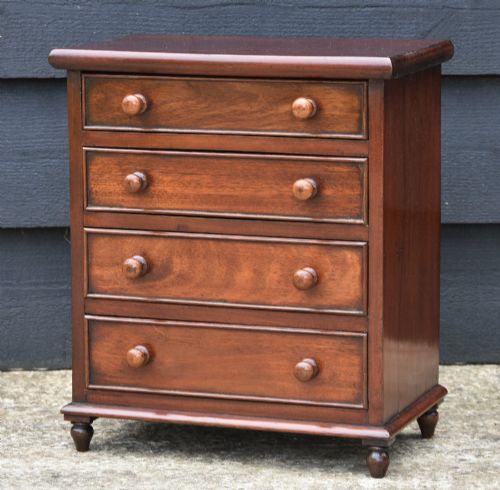

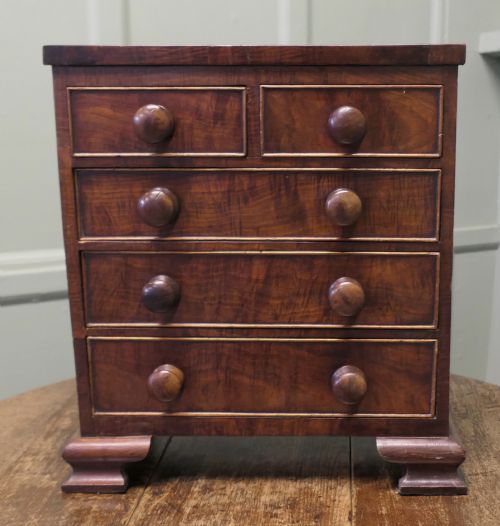
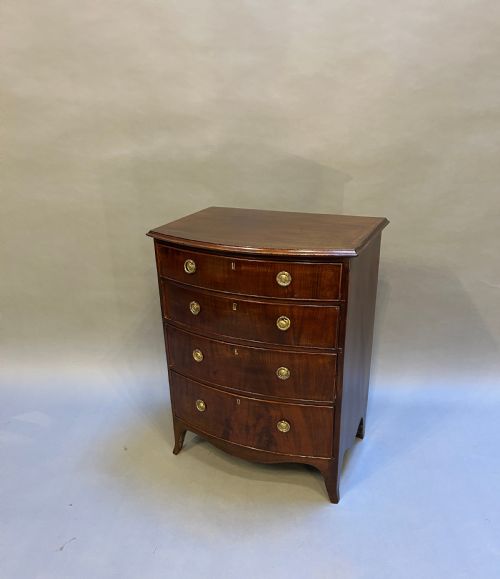


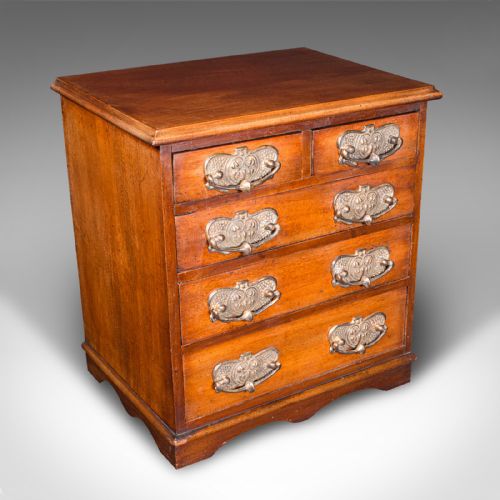


Mini Mahogany Drawers
Mini mahogany drawers are small-scale case pieces crafted for samples, travel, or desktop storage, offering the charm of full-size cabinetry in miniature.
Mini Mahogany Drawers
Mini mahogany drawers appear primarily as miniature chests, apprentice pieces, and collectors cabinets dating from the 18th century through the Edwardian period. These items replicate the proportions and architectural details of larger case furniture, adapted for use as desktop specimen cases, jewellery boxes, or salesman samples.
The majority of pieces encountered on this page originate from the Georgian, Regency, and Victorian eras, rendered in traditional mahogany timber. Forms range from straight-front designs to bowfront chests and campaign-style cabinets fitted with multiple small drawers.
Makers and makers' workshops produced these scaled-down items to demonstrate joinery skills, showcase furniture designs to prospective clients, or provide compact storage for precious items. Their survival reflects sustained demand for portable cabinetry over successive centuries.
Materials and Construction
Mahogany forms the primary structural timber across these pieces, frequently chosen for its grain stability and rich surface finish, occasionally supplemented by secondary woods such as oak and boxwood for stringing and interior linings.
Joinery methods follow full-size cabinetmaking standards, utilising dovetail joints for drawer construction and precise mortise and tenon framing for the carcase.
Hardware consists of brass drop handles, knobs, and escutcheons scaled down to match the diminutive proportions of each cabinet.
Some miniature drawers contain secret compartments cunningly hidden behind removable panels for storing tiny treasures.
Judging Quality
Quality in mini mahogany drawers depends on the fidelity of the miniature proportions relative to full-size furniture and the crispness of the drawer dovetailing. Finer examples display carefully selected timber grain on the drawer fronts and well-fitted internal components without excessive adaptation.
The degree of decorative detail, such as fine wood inlay, cockbeading around drawer edges, and original brass hardware, elevates certain pieces above utilitarian workshop samples.
Condition and surface patination play a role, with untouched aged finishes and original secondary timbers marking out superior survivals from later alterations.
The Mini Mahogany Drawers Glossary
- Apprentice piece
- A small-scale furniture item made by a trainee craftsman to demonstrate mastery of joinery skills before admission to a guild.
- Bowfront
- A curved cabinet front that swells outward in the centre, frequently found on Regency and Georgian miniature chests.
- Cockbeading
- A narrow projecting wooden moulding fixed around the edges of drawer openings to conceal joints and provide a finished border.
- Campaign style
- Portable furniture designed for travel, typically featuring brass corner braces, inset side handles, and compact drawer arrangements.
- Patina
- The surface sheen and coloration developed by wood and metal over decades of handling, exposure, and polishing.
Mini Mahogany Drawers: Frequently Asked Questions
What were mini mahogany drawers used for?
These small chests served multiple purposes, including salesman samples shown to clients, apprentice demonstration pieces, and desktop storage for jewellery, coins, or botanical specimens.
Their portable size allowed owners to keep valuable personal items secure and organised on tables or desks.
How do I tell an 18th century piece from a Victorian one?
Eighteenth-century examples often exhibit Georgian proportions, subtle bracket feet, and hand-cut dovetails with oak or pine secondary woods. Victorian pieces frequently feature turned feet, applied mouldings, and slightly heavier mahogany framing.
Examine the construction methods inside the drawers and the style of the brass hardware to determine the period of manufacture.
Are these pieces actually miniature furniture or jewellery boxes?
Many items were built precisely like full-size chests of drawers on a reduced scale, functioning as miniature furniture or apprentice pieces. Some were specifically designed or later adapted to serve as jewellery chests and specimen cases.
Internal partitions, velvet linings, or compartments often indicate whether a piece was intended for general storage or specific collections.
How should I care for antique mahogany miniature chests?
Keep wooden pieces away from direct sunlight and steady heat sources to prevent the mahogany from drying out or splitting. Dust gently with a dry cloth and apply natural wax polish sparingly to maintain the surface finish.
Avoid commercial liquid cleaners that can strip the historic polish and accumulated surface patina.