
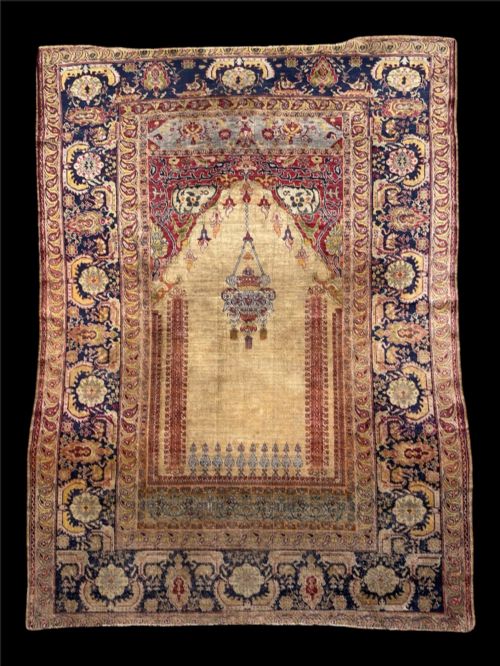
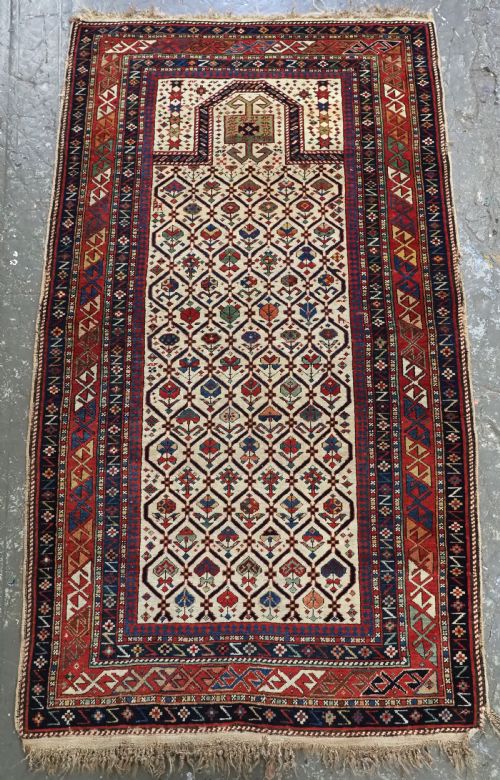


Mihrab Design Rug
A mihrab design rug centres on the pointed arch motif of the prayer niche, offering rich tribal and village weaving traditions for the floor.
Mihrab Design Rug
A mihrab design rug centres on the architectural arch of the prayer niche, a form rooted in Islamic tradition that directs the eye toward the upper apex. You will frequently encounter village and tribal pieces from Afghan, Persian, Caucasian and Turkish origins, mostly dating from the nineteenth and early twentieth centuries.
The format typically presents a single arch, though multi-nipped variations such as the seh mihrab or triple arch appear regularly in village weaving. These floor coverings function primarily as prayer rugs or small format tribal hangings, carrying motifs that range from geometric lattices to floral vases and lotus leaves.
How they were made
Weavers constructed these textiles using wool, hand-spun wool, cotton foundations and occasionally silk, dyed with natural colorants to achieve deep tones. The knotting and weaving techniques rely on traditional village methods passed down through nomadic and settled workshops in Anatolia, the Caucasus, Persia and Afghanistan.
The structural materials dictate the handling and drape of the textile, with cotton warps and wool piles creating durable surfaces that respond to traditional washing and maintenance methods.
Listings span nineteenth-century Turkish examples down to village and tribal pieces from the nineteen-twenties, utilising wool, cotton and natural dyes.
What varies in quality
The fineness of the knot count and the precision of the arch drawing distinguish standard village pieces from masterworks. Tighter construction allows intricate floral lattice and boteh motifs to maintain sharp definition along the borders.
The clarity and saturation of the natural dyes separate simpler work from pieces with exceptional depth of colour. Harmonious secondary shades and well-balanced border proportions indicate careful planning by the weaver.
The Mihrab Design Rug Glossary
- Mihrab
- The arched prayer niche pointing toward Mecca, forming the central visual focus of the rug.
- Seh mihrab
- A triple arch design featuring three distinct prayer niches grouped across the field.
- Boteh
- A stylised floral or almond-shaped motif representing a seed, palm leaf or flame.
- Kilim
- A flat-woven textile produced without a pile, often originating from Anatolian regions.
- Ghiordes
- A historic Turkish weaving centre known for classical prayer rug layouts and knotted structures.
Mihrab Design Rug: Frequently Asked Questions
What is a mihrab design rug?
These textiles feature the architectural arch of a prayer niche, historically used for daily prayers by directing the worshipper's attention toward Mecca.
The layout typically includes a central field beneath the pointed arch, often flanked by columns, lamps, or floral motifs depending on whether the piece originates from an Anatolian, Caucasian, Persian, or Afghan workshop.
How do I care for an old rug?
Vacuum gently without using a rotating brush roll to protect the wool pile and the fragile fringe ends. Keep the textile away from direct sunlight to prevent natural dyes from fading over time.
Rotate the piece periodically to ensure even foot traffic and wear across the surface, and consult a specialist in antique textiles for professional washing.
Where were these rugs made?
The pieces originate across a broad geographic range spanning Turkish village workshops, Caucasian tribal regions, Persian city and village looms, and Afghan or Turkmen settlements. Each region imparts distinct design traits, from the geometric stiffness of Caucasian pieces to the curving florals of Persian Kashan weaves.
Local materials and regional spinning methods further define the geographic origin of each individual weaving.
How do I distinguish regional styles?
Caucasian pieces tend to display crisp, geometric lattice patterns and saturated primary colours, whereas Anatolian rugs from centres like Ghiordes or Milas favour classical prayer arch formats and softer wool handling. Afghan and Baluch examples often incorporate darker palettes, repeat lotus leaves, and tribal motifs unique to nomadic production.
Examining the weave structure, fringe finish, and secondary border designs helps clarify the specific region of manufacture.