



Mid Century River Oil
Mid century river oil paintings capture the movement of water across canvas and board, bringing enduring pastoral calm into domestic spaces.
Mid Century River Oil
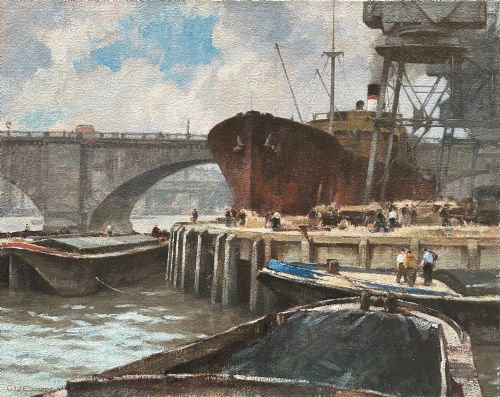
Mid century river oil works represent bodies of water, canals, and riverbanks painted primarily during the middle decades of the twentieth century. These pieces record maritime landscapes, city bridges, and rural streams through the lens of impressionism and post-impressionism.
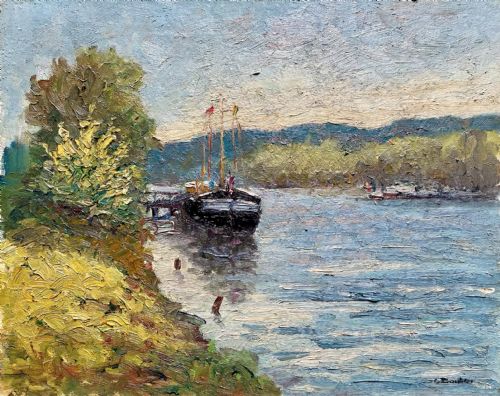
The version most commonly met on this page is the mid-century British or French riverscape, often rendered on canvas or board. Such works frequently depict barges, tugboats, or quiet stretches of water under the influence of impressionist brushwork.
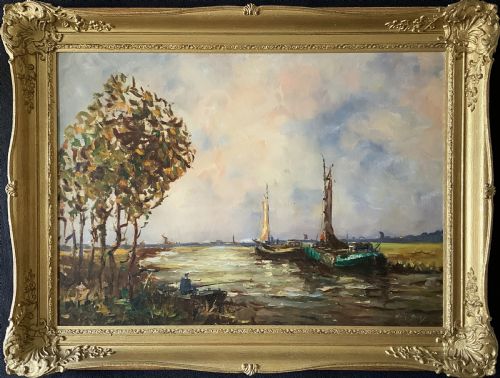
The inventory extends beyond the core twentieth-century dates to include nineteenth-century depictions and earlier Dutch school landscapes. These variations ground the subject in a longer tradition of topographical and pastoral painting.
Methods and materials
Artists painted these subjects using oil paint applied to prepared canvas, wooden board, or milk glass. The medium allowed for both smooth blending and thick, textured application.
Impasto techniques appear frequently across the period examples, building physical depth into the depiction of water and riverbanks. Brush and palette knife work together to capture light upon the surface of canals and rivers.
Many surviving works retain their original wood and carved gilded frames, which complement the painted surface and protect the edges of the canvas or board.
Styles represented include French post-impressionism, Dutch impressionism, and mid-century British school painting.
Assessing quality in river oils
Quality rests in the handling of light and space, where assured brushwork creates convincing atmospheric depth across the water. Weaker examples rely on formulaic repetition without observing how light plays upon the surface.
The relationship between the water, banks, and surrounding structures demonstrates the painter's command of composition. Stronger works balance the movement of the river with the architecture or foliage of the bank.
Kenneth Cozens·Willem Bos·Mario Pinetti·Gabriel Dauchot·Ron Folland·Phyllis Morgans·Gudrun Sibbons·Pauline Boumphrey·Henri Therme·Charles McAuley·G E Roberts·Claude Horsfall·William Burns·Owen Bowen·H Ibbotson·James Hardaker·Walter Cecil Horsnell·David Mead
The Mid Century River Oil Glossary
- Impasto
- Paint applied thickly to a canvas or board, standing out in relief from the surface. This technique allows the artist to build texture, often used to render light reflecting on water.
- Post-Impressionism
- An artistic movement developing roughly between the late nineteenth century and the mid twentieth century. It extends impressionism while rejecting its limitations, focusing on more symbolic content and heavier weight.
- Canvas
- A closely woven fabric used as a surface for oil painting. It is typically stretched across a wooden frame before the artist begins.
- Board
- A rigid wooden or composite panel used as a painting support instead of fabric. Many mid-century painters favoured this firm surface for outdoor work.
- Gilt
- A thin layer of gold leaf or gold paint applied to wooden frames. It adds a reflective border that frames the artwork.
Mid Century River Oil: Frequently Asked Questions
What periods do these river paintings cover?
The selection spans several centuries, with a heavy concentration in the middle decades of the twentieth century. Alongside these mid-century works, occasional pieces date back to the seventeenth, eighteenth, and nineteenth centuries.
This broad chronological range allows buyers to compare mid-century impressionism with earlier Victorian and Dutch approaches to landscape painting.
How should I hang an oil painting on board?
Paintings on board require secure wall fixings and a stable environment away from direct heat sources. Because wood and composite boards react to humidity changes, placing them on interior walls helps preserve the panel.
Ensure the frame is properly fitted with d-rings and picture wire rated to support the combined weight of the board and its frame.
Are these paintings signed by the artists?
Many of the works listed carry visible signatures, monograms, or studio attributions left by the original painter. Some pieces also feature inscriptions on the reverse detailing the specific river or location depicted.
Signatures help place the work within a specific artist's known output, though unsigned school pieces from various periods also appear frequently.
What is the difference between canvas and board supports?
Canvas provides a flexible, woven surface that is typically stretched over a wooden frame and yields slightly to the touch. Board offers a completely rigid foundation made of wood or compressed material that does not flex.
Both supports were widely used during the mid-century period, with board often preferred for smaller plein air works painted outdoors.