



Impressionist Sailing Artwork
Impressionist sailing artwork captures light and water on canvas or paper, offering buyers atmospheric maritime scenes from British and French traditions.
Impressionist Sailing Artwork
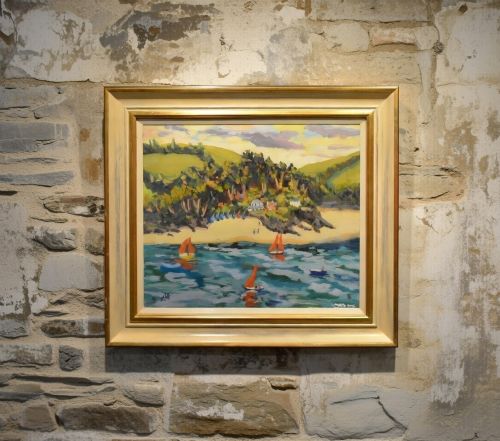
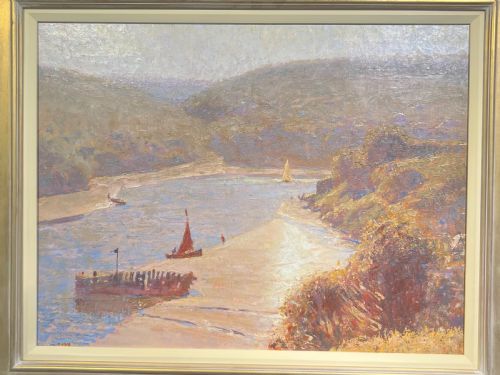
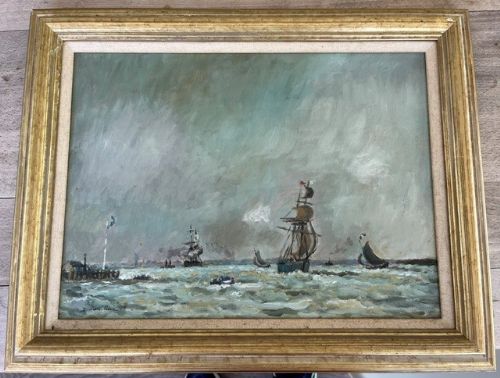
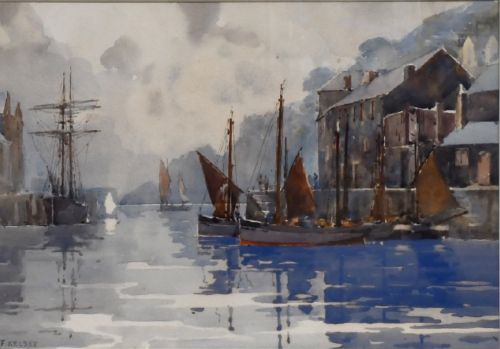
Impressionist sailing artwork brings together marine subjects and loose brushwork, focusing on the play of light over water and vessels. When exploring impressionist sailing artwork, buyers encounter various coastal scenes ranging from quiet estuaries to choppy seas.
Most examples on this page appear as paintings and watercolours created during the late nineteenth and twentieth centuries. These works span British Impressionism, Post-Impressionism, and mid-century styles, showing harbours, rivers, and open waters.
Motive and composition vary from coastal towns like St Ives and Salcombe to French ports and Venetian canals. The selection reflects both oil on canvas and paper works that capture the movement of wind and sail.
Materials and technique
Artists painted these scenes using oil paint or watercolour applied to canvas, board, or paper. Oil paintings often display impasto textures that build the form of sails and waves, while watercolours rely on fluid washes.
Gilt framing frequently accompanies the oil paintings on canvas and board, preserving the edges and enhancing the composition. Support materials range from stretched canvas to wood panels and heavy paper stock.
Listings feature oil on canvas, watercolour on paper, and oil on board across British Impressionism and Post-Impressionism.
What defines quality
Quality rests in the handling of light, atmosphere, and the convincing movement of water and craft. Stronger works demonstrate a confident command of medium, whether through thick oil application or transparent watercolour washes.
The distinction between standard examples and finer pieces lies in the articulation of space and the vitality of the brushwork. Successful compositions capture the essence of a harbour or open sea with economy and precision.
Lucy Pratt·Cecil Allan Mould·Elisabeth Bardon·Edward Seago·Owen Bowen·Clara Montalba·Ernest F Hill·Fred Mayor·Frank Myers Boggs·Bertram Priestman·J De Breanski·Charles Edward Wilson·Maurice Sijs·Edward Aubrey Hunt·Henry Scott Tuke
The Impressionist Sailing Artwork Glossary
- Impasto
- Paint applied thickly to a canvas or board, leaving visible brush or palette knife marks that catch the light. This technique adds tactile dimension to sailing vessels and churning water.
- Watercolour
- Pigment suspended in a water-soluble vehicle, typically applied to paper to achieve translucent effects. It allows for swift execution suited to changing coastal light.
- Seascape
- A work of art depicting the sea, coastlines, or marine vessels in motion. These subjects form the core of maritime impressionism.
- Post-Impressionism
- An art movement extending beyond impressionist methods, emphasising symbolic content and distinct structural brushwork. It builds upon earlier optical experiments with light.
Impressionist Sailing Artwork: Frequently Asked Questions
What periods do these paintings come from?
The works span from the late nineteenth century through the mid-twentieth century, including pieces from the 1900s, 1920s, and post-war decades.
This broad timeline shows the evolution of maritime impressionism across British and continental schools.
Are these works original paintings?
Yes, the selection consists of original oil paintings, watercolours, and works on board or paper rather than reproductions.
Each piece records the direct hand of the artist working in the studio or plein air.
How should I frame a watercolour?
Watercolours require conservation mounting under glass to protect the paper and pigments from atmospheric moisture and light damage.
Keeping the paper from direct contact with the glazing ensures the long-term stability of the work.
Where were these coastal scenes painted?
Locations range from British harbours like St Ives, Looe, and Salcombe to French ports, Venetian lagoons, and Dutch waterways.
Artists frequently travelled to working fishing towns to capture authentic maritime activity.