
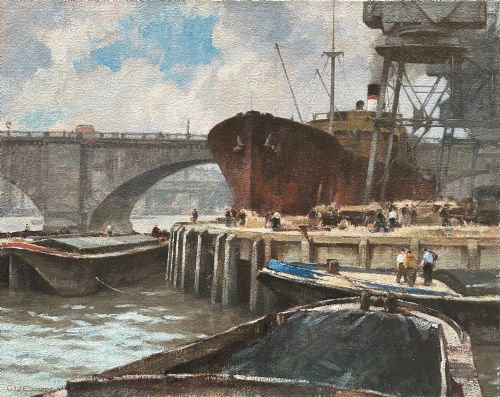
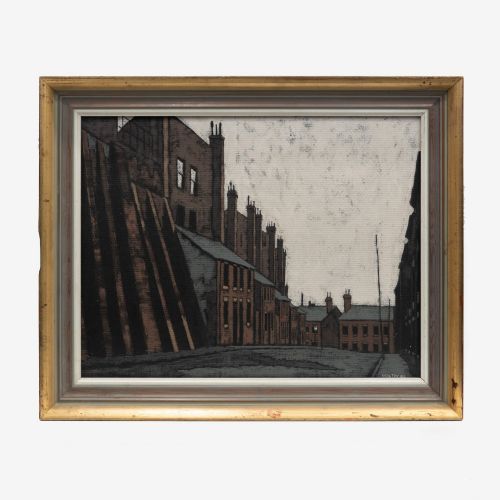
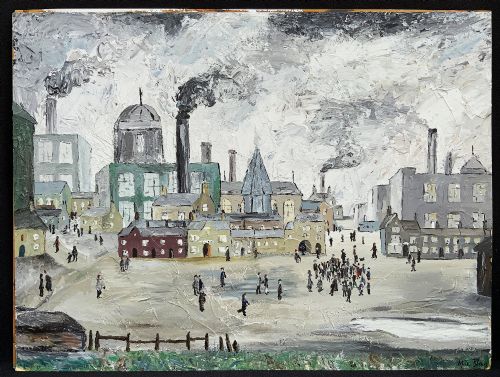


Mid Century Industrial Painting
These mid century industrial painting examples bring working landscapes and mechanical subjects directly to your wall with genuine twentieth-century grit.
Mid Century Industrial Painting
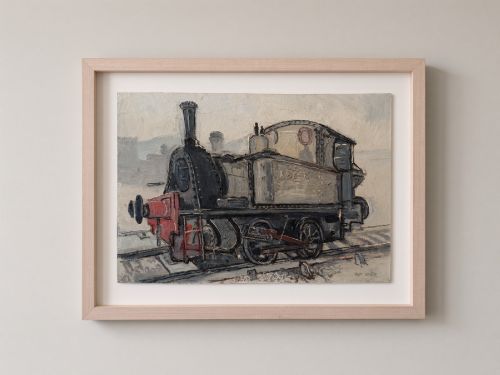
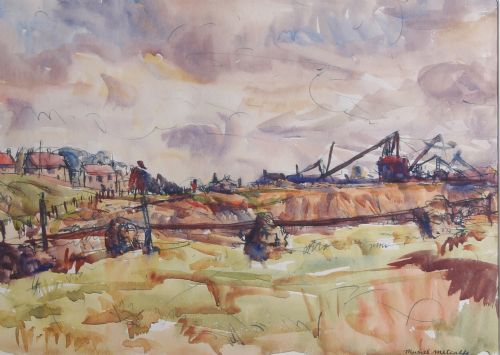
A mid century industrial painting captures the factories, docks, townscapes and machinery of the mid-twentieth century, often spanning the 1930s to the 1960s with occasional earlier roots. You will encounter oils on canvas and board, alongside watercolours that record the physical labour and urban expansion of the era.
The selection ranges from Constructivist factory scenes and Northern townscapes to maritime ports and railway stations. These works balance documentary record with artistic execution, reflecting the smoke and structure of industrial life.
Assessing quality
Quality rests upon the strength of composition and the artist's ability to render light, shadow and mass within a utilitarian subject. A successful piece uses brushwork or impasto to give weight to iron, brick and water rather than relying on flat representation.
Provenance and clear attribution to named painters elevate a canvas, distinguishing accomplished regional realism from anonymous decorative works.
Thomas Edison smiles down from a mid-century portrait alongside aircraft and dismantling railway stations.
Muriel Metcalfe·Cyril Walduck Edwards·Stuart Walton·David Shepherd·Frank Shenton·E.Elliot·J.M.Hastings·Henry J Neave·George R Havelka
The Mid Century Industrial Painting Glossary
- Oil on Canvas
- Pigment suspended in drying oil applied to stretched fabric. This medium allows for rich layering and varied texture.
- Oil on Board
- Pigment applied to a rigid wooden or composition panel. It offers a firm surface favoured for direct gestural marks.
- Impasto
- Paint laid thickly on a surface so that brush or palette-knife strokes stand out. It adds physical depth to industrial scenes.
- Constructivism
- An artistic approach emphasising abstract geometric forms and structural integration. It appears in works focused on factory architecture and machinery.
- Northern School
- A regional artistic movement depicting urban life and industrial landscapes in the North of England. It emphasises soot, community and brick.
Mid Century Industrial Painting: Frequently Asked Questions
What subjects appear in these paintings?
The canvases record factories, docks, railway stations, canals and urban townscapes from the mid-twentieth century and earlier. Artists focused on the physical structures of labour and transport.
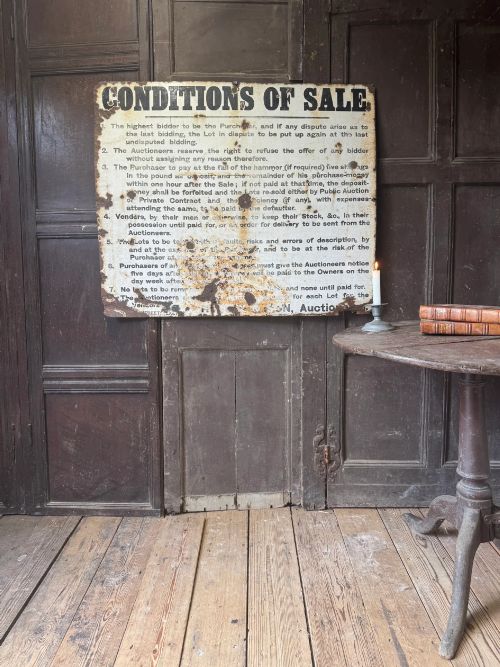
Alongside traditional canvases, you will find watercolours and painted metal signs that document industrial life.
How do I date a mid century industrial painting?
Dating relies on stylistic clues, clothing, transport types, and documented artist lifespans. Many works carry explicit dates or signatures pointing to the 1930s through the 1960s.
Framing materials and backing boards also offer helpful physical evidence of the period.
How should I hang and light these works?
Hang paintings at eye level on walls that complement their robust industrial palettes. Standard picture hooks suit the wood frames commonly found on these boards and canvases.
Position picture lights above to highlight heavy impasto and textured brushwork without creating excessive glare.
What is the Northern School style?
The Northern School captures the industrial towns and working-class communities of Northern England with gritty realism. These paintings utilise darker, atmospheric tones to portray mills, terraces and smoke.
Artists within this tradition emphasise everyday labour over idealized pastoral scenes.