
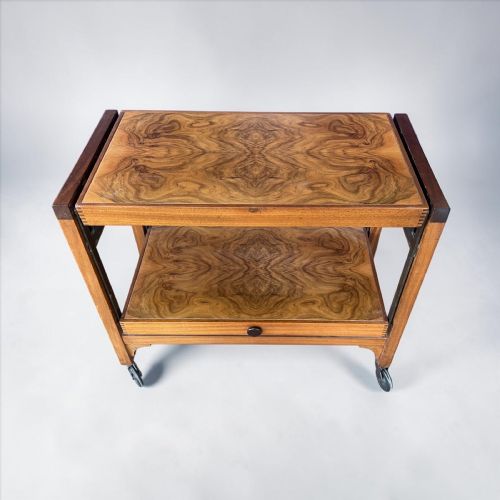
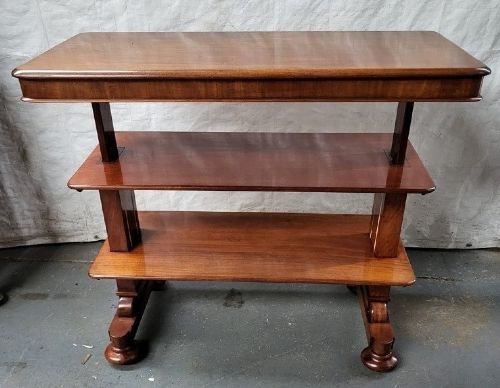
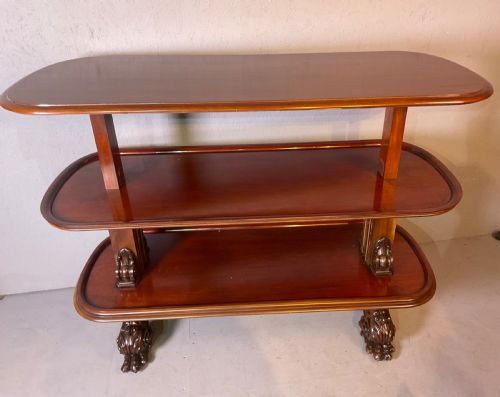


Metamorphic Server Table
These metamorphic server table pieces transform to suit the room, offering versatile function through clever mechanical adaptation.

Metamorphic Server Table
A metamorphic server table represents a clever fusion of utility and mechanical ingenuity, designed to adapt its form for dining or serving. When you search for a metamorphic server table, you encounter practical furniture that shifts between serving surfaces, dumb waiters, and consoles.
The versions most frequently met on this page span the Georgian, Regency, Victorian, and Edwardian periods, stretching into the Art Deco era. These pieces take the shape of serving tables, dumb waiters, drinks trolleys, buffets, and cellarette tables.
Makers across the nineteenth and twentieth centuries applied these transforming designs to solve space and service problems in dining rooms and halls. The resulting forms include multi-tiered dumb waiters and console tables that expand or alter their configuration.
How they were made
Cabinet makers constructed these transforming tables primarily in mahogany and walnut, frequently incorporating oak and marble elements. Timber selection ensured the structural integrity required for moving parts and folding leaves.
Makers integrated brass and other metal mechanisms to facilitate the smooth shifting action between tiers or surfaces. Joinery techniques united traditional cabinet-making with functional hardware to support the daily use of these versatile serving pieces.
Listings span multiple periods including Georgian, Regency, Victorian, Edwardian, and Art Deco, utilising mahogany, walnut, oak, brass, and marble.
What varies in quality
The standard of execution in the transforming mechanisms separates standard examples from finer works. Smooth operation of the moving parts reflects the precision of the original construction and the durability of the integrated metal and brass fittings.
Timber selection and cabinet work further define the hierarchy of these items, with finely figured mahogany or walnut and meticulous joinery marking out superior examples. The integrity of the marble tops and structural framing dictates the overall lasting standard.
The Metamorphic Server Table Glossary
- Dumb waiter
- A tiered serving stand or table designed to hold dishes and drinks without requiring a servant present. These pieces often feature pivoting or folding tiers.
- Cellarette
- A lockable container or table used for storing bottles of wine and spirits near the dining table. In metamorphic forms, these incorporate specialised compartments alongside transforming surfaces.
- Buffet
- A sideboard or serving table used for laying out food and tableware. Metamorphic versions add mechanical height or surface area adjustments.
- Console table
- A table designed to be fixed against a wall, sometimes featuring folding leaves to expand its surface area. Edwardian and Georgian examples often utilised this form for hall and serving use.
Metamorphic Server Table: Frequently Asked Questions
What is a metamorphic server table?
A metamorphic server table is a piece of furniture engineered with hinges, pivots, or rising tiers that alter its shape and function. These designs allowed dining rooms to adapt surface space for serving and entertaining.
Such pieces range from multi-tiered dumb waiters to console tables and cellarettes produced across the Georgian, Victorian, and Art Deco eras.
How were metamorphic tables used?
These tables served dining rooms and halls by providing expandable surfaces for food, drinks, and tableware during meals. Their transforming nature meant servants or hosts could adjust the furniture to suit the number of guests.
They functioned as sideboards, serving trolleys, and multi-level dumb waiters that could be folded or reconfigured when not in use.
What woods are typical for these tables?
Mahogany and walnut predominate among the surviving examples, supported by oak frames and occasional marble inserts. These dense hardwoods provided the strength necessary for moving parts and daily use.
Brass and other metals appear in the mechanisms that allow the tables to shift between different configurations.
How do I date a metamorphic table?
Dating relies on stylistic markers and materials, ranging from George III and Regency neo-classical lines to Victorian proportions and 1930s Art Deco forms. Cabinet-making techniques and secondary woods provide further clues to the period of origin.
Checking the style of the legs, handles, and mechanical fittings helps place the piece within the nineteenth or early twentieth century.