
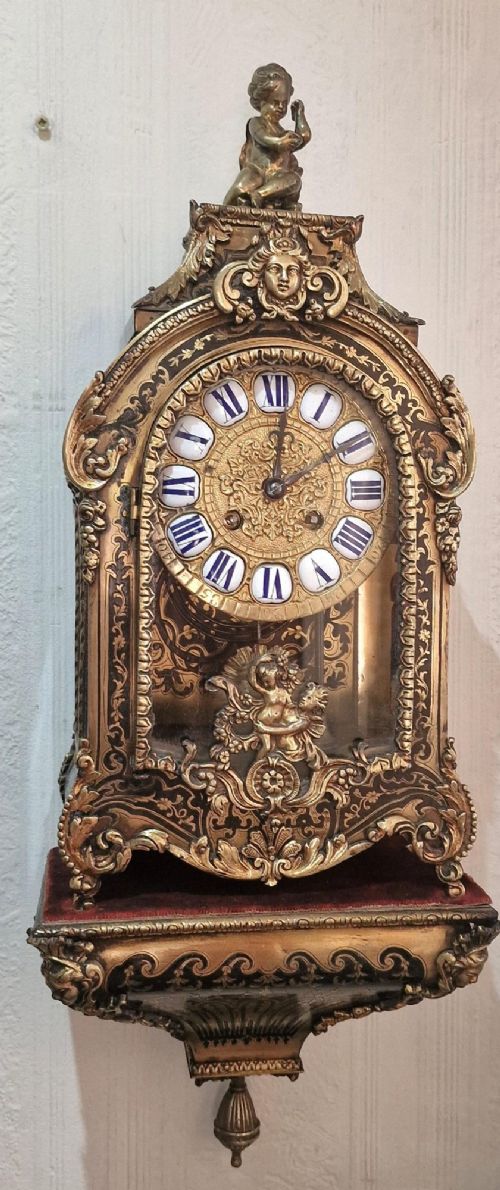


Marquetry Wall Clock
A marquetry wall clock brings rich timber patterns and precise timekeeping to a room, offering both decorative warmth and mechanical charm.
Marquetry Wall Clock
A marquetry wall clock is a timepiece designed to hang on a wall, decorated with intricate wood veneer patterns rather than plain painted timber. When searching for a marquetry wall clock, buyers encounter pieces originating from nineteenth-century France and England, alongside later twentieth-century examples.
The selection includes drop dial designs, bracket clocks with matching wall brackets, and octagonal faces. Rosewood and mahogany serve as common foundation timbers, enriched by brass, mother-of-pearl, and tortoise-shell detailing.
Victorian and Edwardian eras dominate the current selection, reflecting the popularity of ornate domestic timepieces during those periods. French Rococo revival and Napoleon III influences appear frequently among the continental items.
Materials and methods
Cabinetmakers constructed these timepieces using dense hardwoods such as rosewood and mahogany, often applying ebonised finishes to contrast with lighter inlays. Boulle work combined tortoiseshell with brass and metal wire inlay to create shimmering surface patterns across the wooden cases.
Dials incorporated brass bezels protecting glass faces, frequently paired with enamel numerals. Mother-of-pearl and contrasting wood veneers were meticulously cut and fitted into the timber surfaces to form decorative motifs.
Some clocks wear their French heritage proudly, ticking away behind tiny brass wire constellations embedded in tortoise shell.
Qualities that distinguish the best pieces
Quality rests in the precision of the veneer work and the integration of the decorative elements with the timber case. Superior examples display crisp brass inlay, tightly fitted tortoiseshell, and well-preserved rosewood grain without excessive restoration.
The mechanical movement inside dictates performance, with fusee movements representing reliable English engineering of the period. Original components, including matching wall brackets and undamaged enamel dials, elevate a piece above standard domestic timepieces.
Henri Marc of Paris·Hastings of Hay
The Marquetry Wall Clock Glossary
- Marquetry
- Decorative veneer applied to a wooden structure in patterns using contrasting woods, metals, or shell. This technique transforms a simple flat surface into a pictorial or geometric design.
- Boulle
- A method of marquetry using brass and tortoiseshell developed in France. It produces a rich, reflective surface pattern often seen on nineteenth-century bracket clocks.
- Fusee
- A conical pulley used in clock movements to maintain even tension on the chain as the mainspring unwinds. This mechanism ensures consistent timekeeping accuracy.
- Drop dial
- A clock design featuring a circular dial mounted above an extended wooden trunk. This drop case often houses a pendulum and displays matching inlay.
- Ormolu
- Gilded bronze used for decorative mounts and feet on French clock cases. It provides a bright metallic contrast to dark rosewood and ebonised timber.
Marquetry Wall Clock: Frequently Asked Questions
What is a fusee movement?
A fusee movement uses a conical pulley to equalise the power of the mainspring as it runs down. This mechanical arrangement helps the clock maintain steady timekeeping.
It is a sign of traditional English craftsmanship found in better quality dial clocks from the nineteenth century and earlier.
How do I date a wall clock?
Dating relies on stylistic clues such as the cabinet timber, dial shape, and decorative inlay techniques. Victorian and Regency periods each favoured distinct proportions and materials.
Examining the internal movement and the type of wood veneer provides further confirmation of the period of manufacture.
Where should I hang a bracket clock?
A bracket clock with its original wall bracket requires a secure mounting point on a solid wall. The bracket supports the weight of the clock and displays the lower case ornamentation.
Ensure the wall is stable and the clock hangs level so the pendulum swings evenly and keeps accurate time.
What is French Boulle work?
Boulle work is an elaborate form of marquetry developed in France, combining tortoiseshell and brass inlay. The contrasting materials catch the light and create a textured surface pattern.
This technique is characteristic of nineteenth-century French mantel and wall clocks influenced by the Rococo revival.