
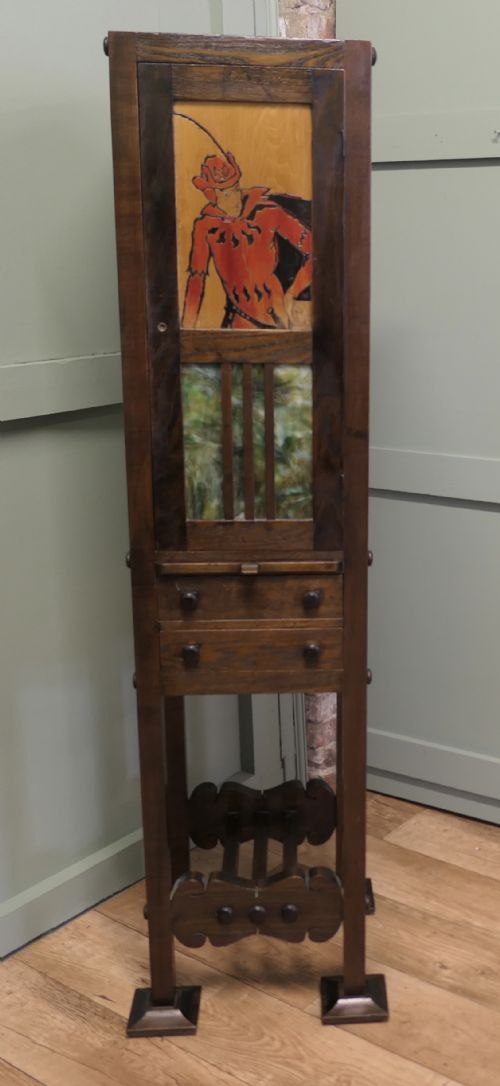

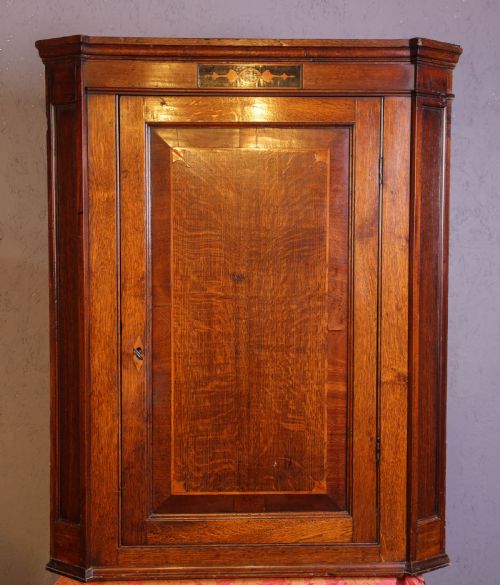


Marquetry Oak Cupboard
These marquetry oak cupboard examples bring together sturdy timber and detailed inlay to anchor a room.
Marquetry Oak Cupboard
A marquetry oak cupboard combines a robust timber structure with decorative wood inlay, appearing in forms such as corner cabinets, dresser bases, court cupboards, and hall cupboards.
The selections available range from 17th-century court pieces and Georgian dresser bases to 19th-century architectural bookcases, corner cabinets, and bedside units.
Buyers will most frequently encounter corner cabinets and dresser bases within these periods, spanning Georgian, Arts & Crafts, Carolean, and Victorian architectural revival styles.
Construction and materials
Craftsmen built the main bodies predominantly from solid oak, adding contrasting timber details such as fruitwood, burr elm, and satinwood for the inlay work.
Makers utilised brass and iron for functional hardware including hinges and locks, while decorative detailing incorporated intricate wood inlay and geometric marquetry patterns.
The inventory covers pieces spanning the 17th, 18th, and 19th centuries, including Georgian, Victorian, and Arts & Crafts styles.
Assessing quality
Quality rests upon the precision of the marquetry and fruitwood inlay work set against the grain of the primary oak framework.
Pieces differ through the complexity of their structural form, moving from simple corner cabinets to elaborate court cupboards and architectural bookcases.
The Marquetry Oak Cupboard Glossary
- Marquetry
- Decorative inlay work using various coloured woods to create pictorial or geometric patterns on a furniture surface. This technique distinguishes plain storage furniture from ornamental statement pieces.
- Court Cupboard
- A traditional two-tier storage piece originating in earlier centuries, often featuring carved woodwork and enclosed compartments. These items served prominent display and storage functions in domestic interiors.
- Dresser Base
- A low sideboard form equipped with drawers and cupboards below a flat top surface. They evolved from practical kitchen utility furniture into principal dining room pieces.
- Burr Elm
- A specialised wood growth yielding swirling, highly figured grain patterns utilised by makers for contrasting panels. It adds rich visual texture when paired with standard oak.
Marquetry Oak Cupboard: Frequently Asked Questions
What is a court cupboard?
A court cupboard is a traditional multi-tiered storage furniture piece designed for domestic utility and display during earlier centuries.
These items typically feature enclosed cabinet sections combined with open or closed shelving structures.
How do I place a corner cabinet?
A corner cabinet fits neatly into room junctions to maximise storage space without obstructing walking areas.
They function effectively in dining rooms or living spaces to house ceramics, books, or everyday items.
What is the difference between parquetry and marquetry?
Marquetry employs wood inlays to form pictorial or scrolling decorative patterns across a surface. Parquetry strictly uses geometric arrangements like cubes or stripes.
Both techniques enhance the visual depth of the primary timber.
How do I date an oak cupboard?
Dating relies on observing construction methods, hardware types, stylistic motifs, and the complexity of the inlay work. Pieces span from the seventeenth century through the Victorian revival eras.
Comparing structural joinery helps distinguish early Carolean items from later nineteenth-century interpretations.