

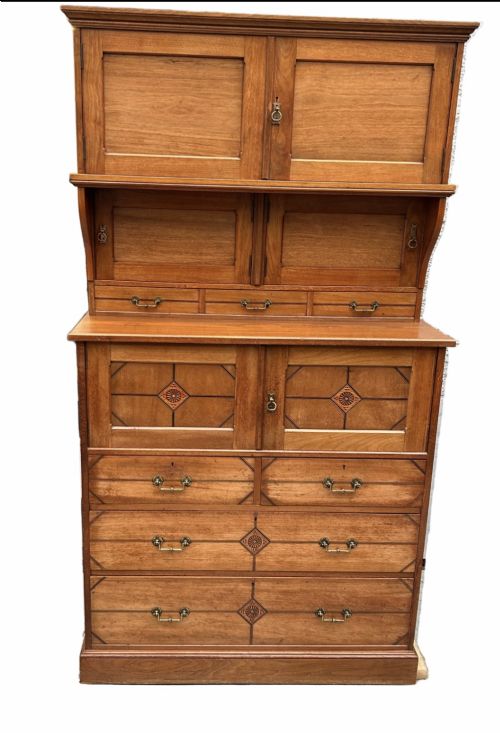
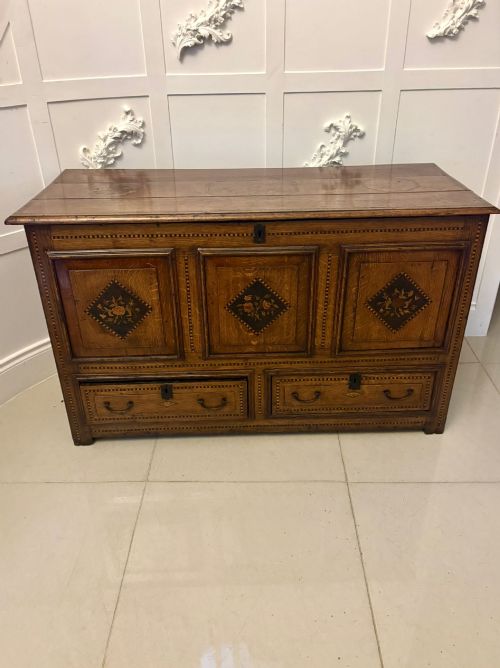
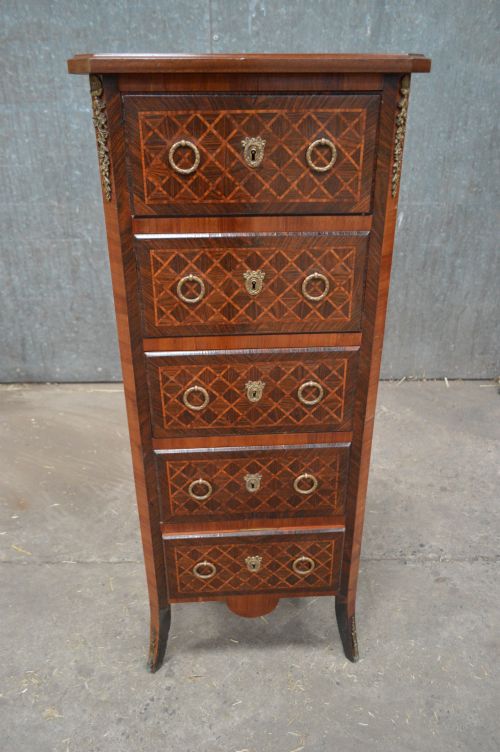
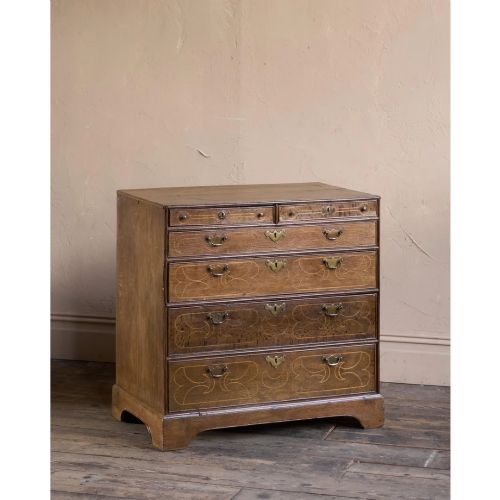


Marquetry Oak Chest Drawers
These marquetry oak chest drawers combine structural timber with intricate inlaid wood, offering practical storage and rich period decoration.
Marquetry Oak Chest Drawers
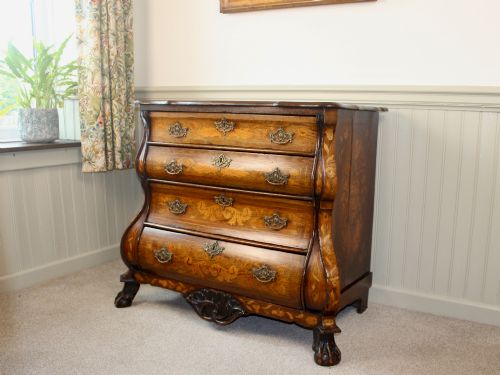
A marquetry oak chest drawers brings together robust timber carcases and decorative patterned inlay. Buyers searching for marquetry oak chest drawers encounter forms ranging from 17th century mule chests to 18th century Dutch bombe shapes and 19th century inlaid examples.
The selection includes regional variations such as French Wellington chests, Swedish pieces, and British styles spanning the William and Mary, Charles II, and Victorian eras. Alongside standard chests of drawers, the inventory accommodates larger bedroom suites and mule chests featuring multi-drawer configurations.
How they were made
Constructed primarily from solid oak, walnut, and fruitwood, these pieces utilise contrasting veneers to form detailed floral and geometric patterns. Inlayers cut fine slices of wood and embedded them into recessed channels within the primary carcase.
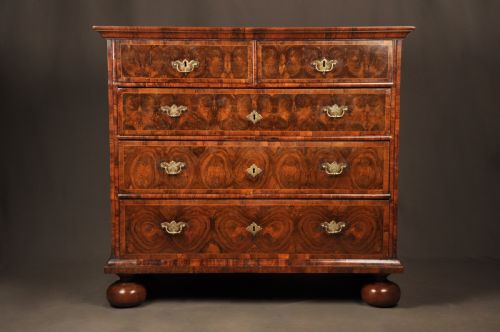
Metal components such as brass drop handles and iron locks provide functional hardware that complements the timber surfaces. Oyster veneering, another prominent technique, involves slicing branch wood transversely to create circular grain motifs across the drawer fronts.
Marquetry Oak Chest Drawers Retail Price Guide 2026
Typical asking prices for marquetry oak chest drawers among the pieces listed under this phrase on Sellingantiques today, from the lower quarter to the upper quarter. They describe what is for sale here now, not the wider market.
Listings feature oak, walnut, and fruitwood materials applied across seventeenth, eighteenth, and nineteenth century styles.
What varies in quality
The degree of refinement in the inlay work separates standard examples from exceptional pieces. Crisp botanical motifs and tightly fitted veneer sections indicate higher workshop proficiency.
The integrity of the primary timber carcase and the retention of original brass hardware heavily influence the character of each chest. Cohesive ageing between the oak substrate and the decorative marquetry surfaces determines the overall visual balance.
Gaylayde·B Cohen and Sons
The Marquetry Oak Chest Drawers Glossary
- Marquetry
- Decorative veneer work arranged in pictorial or geometric patterns across a timber surface. This technique requires precise cutting of various woods to fit together seamlessly.
- Oyster veneer
- Circular sections cut transversely from small branches to display concentric growth rings. Furniture makers arranged these disks closely together to produce patterned surfaces.
- Mule chest
- A storage chest featuring one or more drawers built into the base beneath the main lift-top compartment. This form bridges the traditional blanket chest and the modern drawer unit.
- Bombe
- A swollen or bulging convex contour characteristic of continental furniture design. This shaped profile adds visual weight and dynamic movement to the front and sides of a chest.
- Two-part chest
- A case furniture piece constructed in stacked upper and lower sections to ease transport. This modular format appeared frequently in seventeenth century British joinery.
Marquetry Oak Chest Drawers: Frequently Asked Questions
How do I date a marquetry oak chest drawers?
Dating relies on examining construction methods, timber species, and stylistic traits such as bracket feet or moulding profiles. Seventeenth century pieces often display joined frame construction, whereas nineteenth century examples reveal machine-sawn timbers.
The presence of specific inlay patterns and hardware types also helps align a piece with periods like William and Mary or the Victorian era. Comparing drawer linings and internal side panels provides further confirmation of the manufacturing date.
What is the difference between marquetry and parquetry?
Marquetry employs varied wood veneers to create intricate pictorial designs, including floral motifs and scrolling foliage. This method focuses on organic shapes and detailed artistic composition.
Parquetry uses geometric wood blocks arranged in regular tiling patterns such as cubes or chevrons. Both techniques decorate the exterior surfaces of quality furniture but produce distinct visual textures.
Where were Dutch marquetry chests made?
Dutch marquetry chests originated in urban workshops across the Netherlands during the seventeenth and eighteenth centuries. Master cabinetmakers in cities like Amsterdam and Rotterdam produced these elaborate pieces for affluent merchants.
These workshops frequently utilised walnut and exotic fruitwood veneers on oak carcases to achieve high-contrast floral imagery. Many pieces also incorporated serpentine or bombe contours influenced by broader European trade.
How should I care for oyster veneer surfaces?
Oyster veneer surfaces require stable indoor humidity levels and protection from direct sunlight to prevent timber shrinkage. Regular dusting with a dry, soft cloth maintains the finish without moisture damage.
Applying microcrystalline wax periodically feeds the old wood and preserves the sheen of the circular grain patterns. Avoid placing these chests near heat sources that might cause the tiny veneer disks to lift.