


Marquetry Inlay Mantel Clock
These marquetry inlay mantel clock examples combine precise timekeeping with intricate timber work, providing a practical focal point for a room.
Marquetry Inlay Mantel Clock
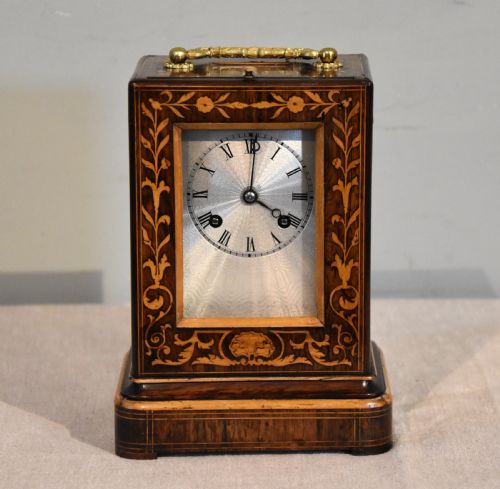
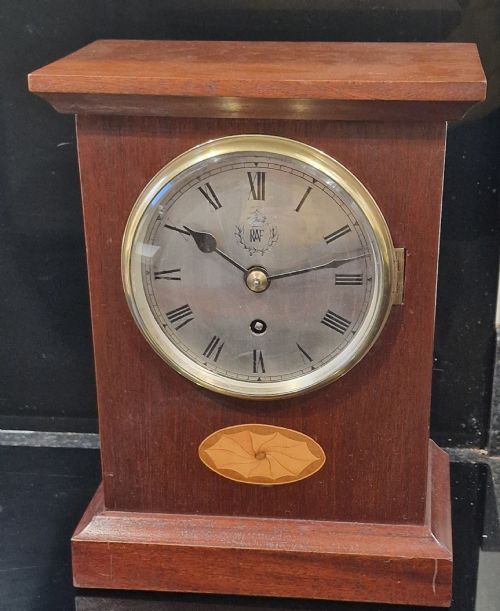
A marquetry inlay mantel clock sits on a shelf or sideboard, driven by mechanical movements housed in timber cases decorated with contrasting wood veneers. The selections here span the nineteenth century, the Edwardian period and the early twentieth century, showing both British and French origins.
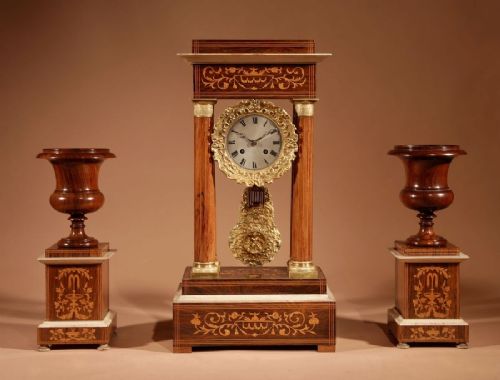
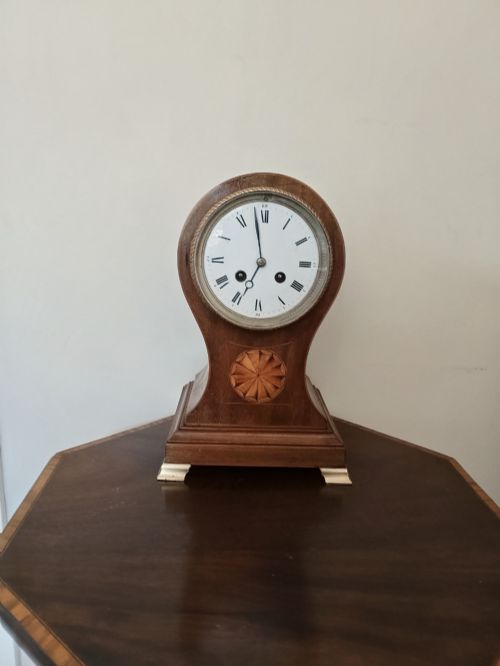
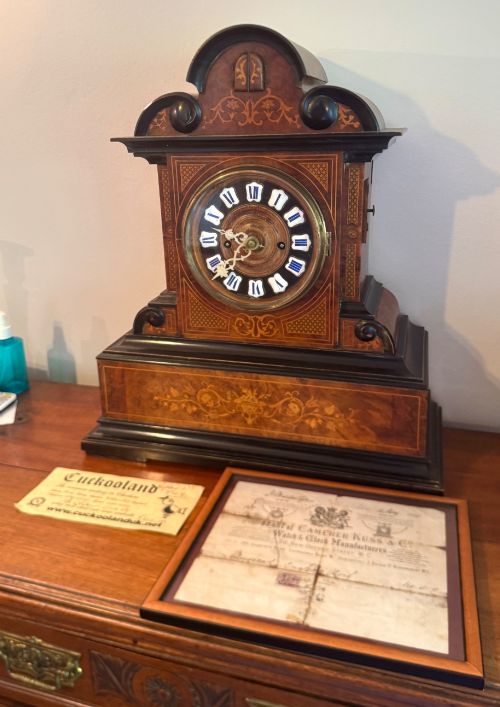
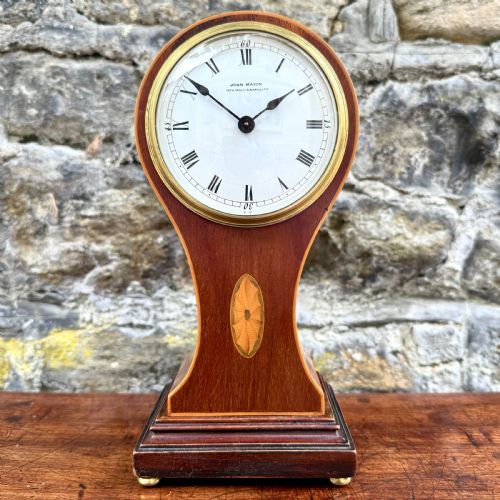
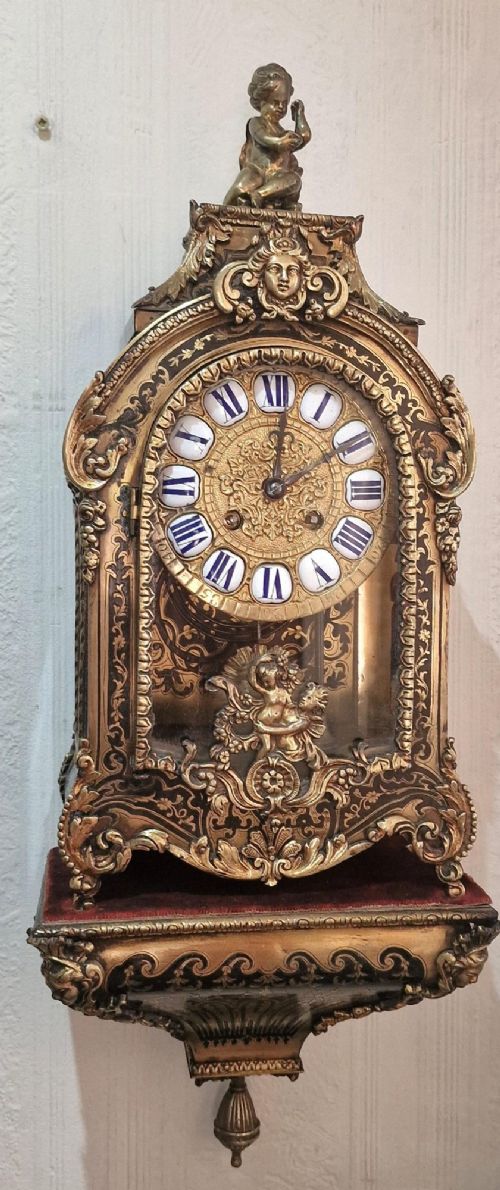
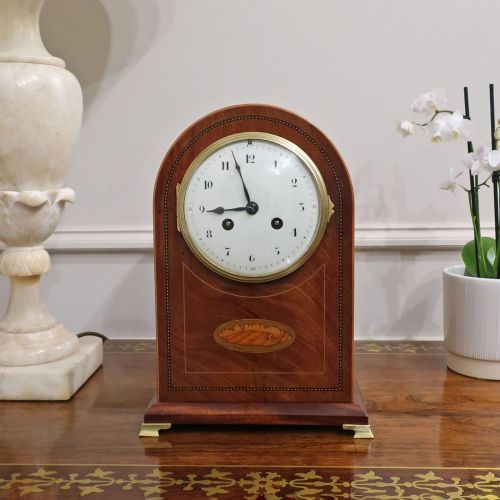
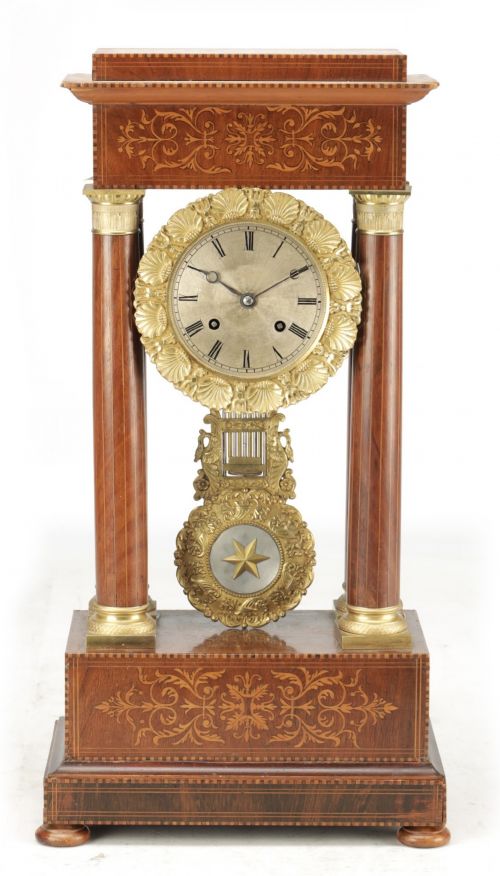
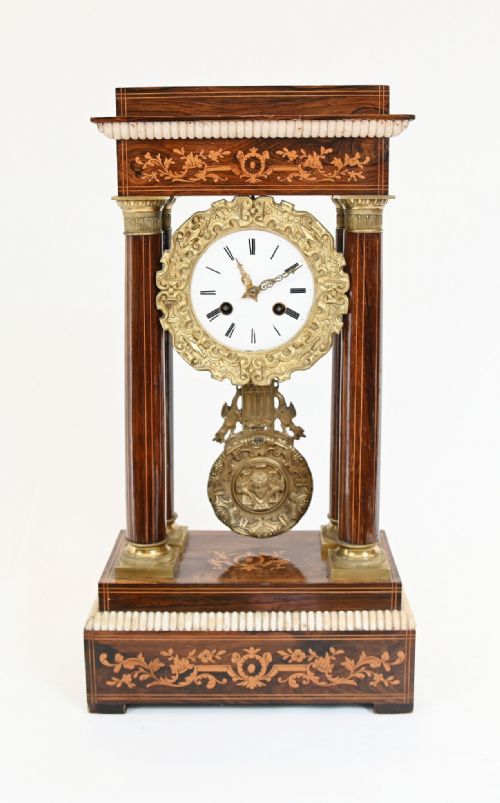
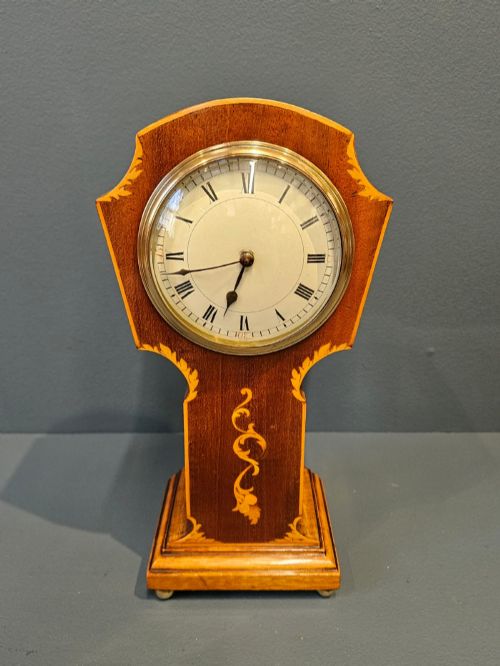
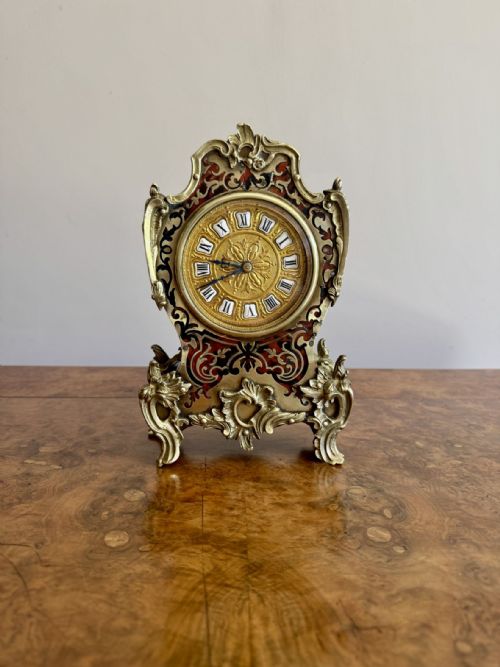
Most pieces encountered on this page take the form of upright mahogany, rosewood or walnut cases featuring decorative floral or geometric inlays. Alongside these standard mantel clocks, one finds portico designs, balloon shapes and architectural Boulle examples decorated with tortoiseshell and brass.
French workshops produced many of the ornate portico and Boulle pieces seen in the listings, while British makers favoured mahogany and rosewood balloon or arched cases. These items served a functional purpose in period homes while demonstrating the cabinetmaker's skill through detailed surface decoration.
What Varies in Quality
The precision and complexity of the timber cutting dictate the standard of the marquetry, where tighter joints and finer contrasts between woods show greater skill. Simpler geometric banding sits at one end of the scale, while elaborate floral arrangements or complex tortoiseshell and brass Boulle work represent higher levels of workshop labour.
The integration of the movement within the case also distinguishes the examples, as properly fitted dials, original hands and signed mechanical parts reflect higher standards of production. Cases featuring substantial bronze ormolu mounts and well-preserved French or British movements demonstrate superior manufacturing pedigree compared to plain production models.
A few whimsical clocks on this site wear unusual decorations, including inlaid depictions of poppies and a Dutch girl.
W. Burton·Henry Marc·Thomas A Paris·Samuel Marti
The Marquetry Inlay Mantel Clock Glossary
- Marquetry
- A decorative technique where small pieces of veneer are assembled into pictures or patterns on a wooden carcass. This differs from inlay by covering the entire surface rather than resting in carved recesses.
- Portico clock
- A distinct architectural clock style featuring a dial suspended within a frame supported by columns. These tall, symmetrical pieces often incorporate fine wood veneers and ormolu mounts.
- Fusee
- A conical pulley connected to the mainspring by a cord or chain, designed to equalise the power delivered to the gear train as the spring unwinds. This mechanism improves timekeeping accuracy across the running period.
- Boulle
- A method of marquetry using tortoiseshell and brass, popularised in France and seen on decorative clock cases. The contrasting materials create a striking reflective surface.
- Balloon clock
- A mantel clock housed in a curved, swelling wooden case resembling the profile of a hot air balloon. Edwardian and nineteenth-century makers favoured this rounded silhouette for mahogany designs.
Marquetry Inlay Mantel Clock: Frequently Asked Questions
How do I wind an antique clock?
Use the correct key on the winding arbors found on the dial face, turning gently until you feel resistance. Avoid over-winding to protect the internal mainspring.
Most mechanical examples run for eight days between windings, requiring a steady, measured turn to maintain tension without straining the gear train.
Where should I place a mantel clock?
Position the piece on a stable, level surface away from direct sunlight, draughts and damp areas. A sturdy shelf or sideboard prevents vibrations that can disrupt the pendulum.
Ensure the room temperature remains relatively stable, as sudden shifts can affect the wooden case and the expansion of internal metal components.
How do I date a wooden clock case?
Examine the timber species, the style of the dial, and the construction methods used inside the housing. Mahogany and rosewood popularity shifted across the nineteenth and early twentieth centuries.
Makers' signatures on the movement or dial backplate often provide a reliable production year or point to the active period of the workshop.
Why does a mechanical clock stop running?
Stopages often occur if the case is not level, which halts the even swing of the pendulum or the balance wheel. Adjusting the small feet or repositioning the clock usually restores the beat.
Internal dust accumulation or dried lubricants can also impede the gear train, meaning the movement requires professional cleaning to function properly.