
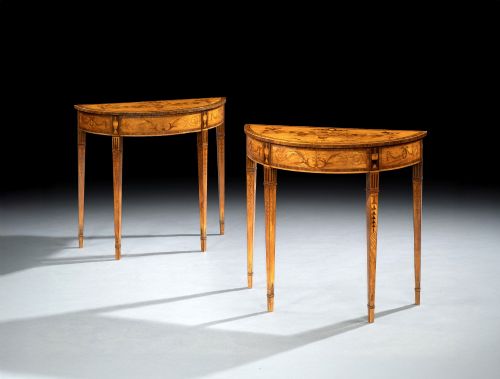
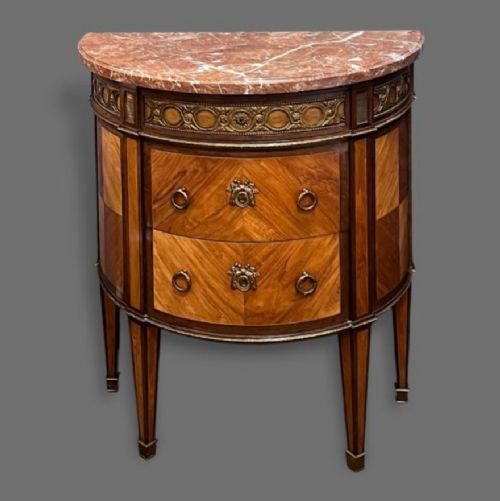
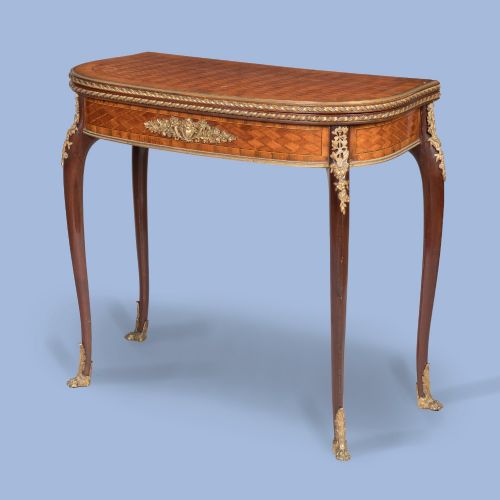
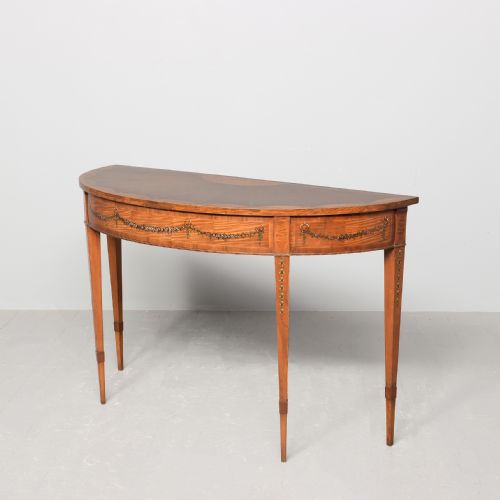


Marquetry Demi Lune Table
A marquetry demi lune table brings together half-circle design and intricate wood inlay to fit neatly against a wall.
Marquetry Demi Lune Table
When you search for a marquetry demi lune table, you encounter semi-circular furniture ranging from the eighteenth century to the twentieth century. These pieces appear most frequently as side tables, card tables, and console tables designed to stand flush against a wall in a hallway or drawing room.
The selection includes George III examples in mahogany and satinwood alongside nineteenth-century French console and games tables. Makers and workshops from London and the continent produced these half-moon shapes using contrasting timbers to create decorative surfaces.
Card tables and tea tables within this group feature fold-over tops supported on swinging legs, while static side tables and cabinets offer fixed marble tops or wooden surfaces. The forms span English neoclassical designs and continental revival styles.
Materials and construction
Cabinet makers built the carcase using structural timbers such as mahogany or walnut before applying veneers of satinwood, kingwood, or rosewood. Marquetry inlay was then cut by hand from various tinted and stained woods to form floral, urn, or classical motifs across the curved top.
Mounts in gilt bronze or ormolu appear on continental examples, framing the edge of marble tops or accentuating the apron and legs. Joinery relies on traditional techniques to curve the frieze rails and secure the tapering or cabriole legs beneath.
Card-playing enthusiasts of the Georgian era relied on hidden folding leaves to conceal gambling debts the moment an awkward guest entered the room.
Evaluating the craftsmanship
Quality rests in the precision of the marquetry cutting and the choice of timber figure. Finer examples display a seamless fit between contrasting wood veneers without excessive filler, maintaining crisp detail in the floral or architectural motifs.
The integrity of the curved carcase and the handling of the demi-lune shape distinguish standard production from exhibition pieces. Superior tables retain original brass mounts, polished marble inserts, and well-executed secondary timbers inside the frame.
François Linke·Pietro Ferrario·Edwards & Roberts·Hampton & Sons
The Marquetry Demi Lune Table Glossary
- Demi-lune
- A half-moon shape used for tables and cabinets designed to stand against a wall. This profile allowed furniture to occupy minimal floor space while providing a useful surface.
- Marquetry
- The art of applying pieces of veneer to a structure to form decorative patterns. Craftsmen utilised different coloured woods to create pictorial designs.
- Ormolu
- Gilt bronze mounts applied to furniture for decoration and edge protection. This technique was common on French and revival pieces.
- Satinwood
- A durable tropical timber with a lustrous yellow sheen. It was favoured by eighteenth-century makers for contrasting inlay work.
- Console table
- A table supported by wall brackets or console legs. These pieces were often placed beneath mirrors in formal rooms.
Marquetry Demi Lune Table: Frequently Asked Questions
How were demi lune tables used?
These tables served primarily as decorative side pieces in entrance halls, drawing rooms, and parlours. Fold-over versions provided functional surfaces for card games or tea service when entertaining guests.
When not in use, the flat side sat directly against the wall to save space while displaying decorative objects or lighting on top.
How do I identify George III examples?
George III pieces typically feature mahogany or satinwood construction with restrained neoclassical inlay patterns such as bellflowers, urns, and fans. The proportions remain slender, often supported by straight tapering legs.
English cabinet makers of this period favoured understated elegance over heavy ornamentation, distinguishing them from later continental revival furniture.
What is the difference between marquetry and parquetry?
Marquetry involves cutting various veneers to create pictorial or floral compositions across the furniture surface. It requires precise hand-cutting of different timber species to fit together like a jigsaw.
Parquetry uses geometric blocks of wood to form repeating patterns such as cubes, chequers, or herringbone designs rather than organic pictures.
Are marble top tables original?
Many nineteenth-century French console tables and cabinets were designed specifically to carry heavy marble slabs on their curved wooden frames. The stone provided a durable surface for displaying decorative items.
Checking the rebate and underside of the frame reveals whether the timber housing corresponds to the weight and thickness of the marble.