

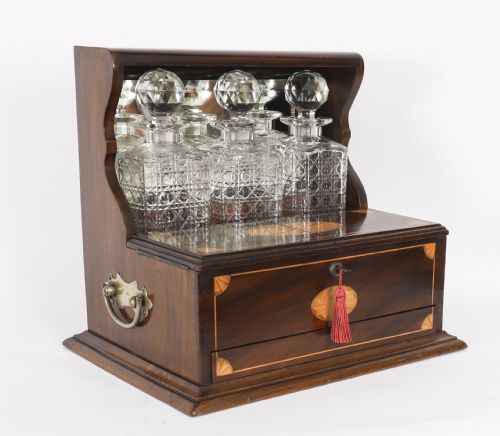


Marquetry Box Mirror
A marquetry box mirror brings intricate inlaid wood and adjustable glass to a dressing table.
Marquetry Box Mirror
When you search for a marquetry box mirror, you are looking at tabletop mirrors framed or mounted upon small wooden boxes decorated with detailed wood veneers. The examples appearing here span from the eighteenth century through the Edwardian era, taking the form of dressing table swing mirrors and folding travel pieces. These objects combine practical reflection with decorative cabinetwork.
Most pieces you meet on this page date from the nineteenth century, including Victorian and Edwardian interpretations alongside earlier Georgian forms. They range from large scale items down to compact folding travel mirrors housed in olive wood or mahogany. The supporting box often incorporates drawers or compartments beneath the pivoting glass.
Materials and construction
Cabinetmakers constructed these pieces using dense hardwoods like mahogany, walnut, oak, and rosewood, applying contrasting veneers to create pictorial or geometric marquetry. Lighter timbers such as satinwood and harewood provided the pale tones necessary for detailed floral or scrollwork inlay. Brass hinges and adjustment screws frequently secured the swinging mirror frame to the upright supports.
The glass itself is held within a wooden swing frame that tilts to the user's preference. Artisans fitted the surrounding box with precise joinery, occasionally incorporating marquetry stringing to accent the edges and lid surfaces.
Marquetry Box Mirror Retail Price Guide 2026
Typical asking prices for marquetry box mirror among the pieces listed under this phrase on Sellingantiques today, from the lower quarter to the upper quarter. They describe what is for sale here now, not the wider market.
Assessing quality and execution
Quality rests upon the precision of the marquetry cutting and the choice of timber contrasts within the veneer. Superior pieces display crisp, tight joints in the inlay work where various coloured woods fit together without visible gaps or excessive filler.
The sophistication of the overall cabinet form also distinguishes finer examples from simpler workshops. Well proportioned support arms, original mirror glass with appropriate ageing, and neatly fitted interior compartments indicate higher craftsmanship.
The Marquetry Box Mirror Glossary
- Marquetry
- Decorative veneer work assembled from various coloured woods to form pictorial patterns or designs on a surface. It differs from inlay by covering the entire background rather than being set into recesses.
- Swing mirror
- A looking glass mounted on pivoting side posts that allow the plate to tilt back and forth. This form became standard on dressing tables and tabletop cabinets during the Georgian and Victorian periods.
- Stringing
- A narrow, contrasting line of wood inlay used to outline panels, drawers, or box edges. Cabinetmakers utilised this technique to define geometric borders.
- Satinwood
- A durable, yellowish tropical timber prized for its lustrous grain and pale colour. It frequently appears in marquetry work to create bright highlights.
Marquetry Box Mirror: Frequently Asked Questions
What is a marquetry box mirror?
It is a tabletop looking glass attached to a wooden box decorated with inlaid wood veneers. The box often provides storage drawers or folds for travel.
These pieces served as functional dressing accessories in bedrooms and boudoirs across the eighteenth and nineteenth centuries.
How do I date a box mirror?
Dating relies on observing the timber choices, construction methods, and stylistic cues of the cabinetwork. Georgian versions often show simpler, elegant proportions while Victorian and Edwardian examples utilise diverse exotic woods.
Examining the fixings, such as brass thumbscrews and hinge types, also helps determine the period of manufacture.
Were these mirrors used for travel?
Some specialised examples, such as folding travel mirrors, were designed to pack down securely for journeys. The mirror glass folds flat into or over the box to protect the reflective surface.
Most standard dressing table models remained stationary on a table or chest of drawers rather than being packed away frequently.
How do I care for inlaid wood?
Inlaid wood requires stable room conditions away from direct sunlight and excessive moisture to prevent the veneer from lifting. Gentle dusting with a dry, soft cloth preserves the polished finish.
Applying specialised furniture wax occasionally helps nourish the hardwood and protect the delicate marquetry surface.