
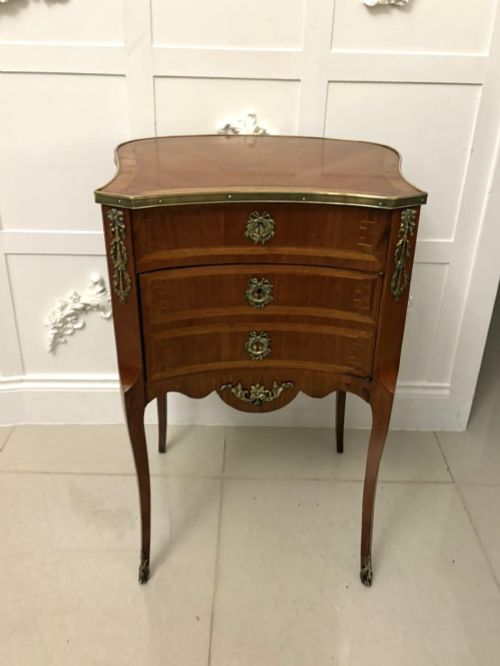
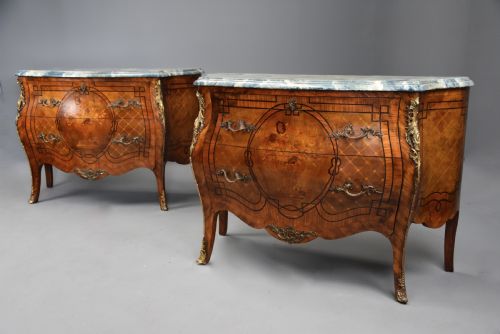
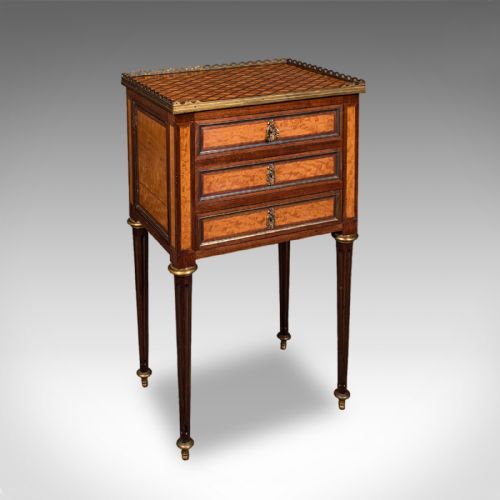
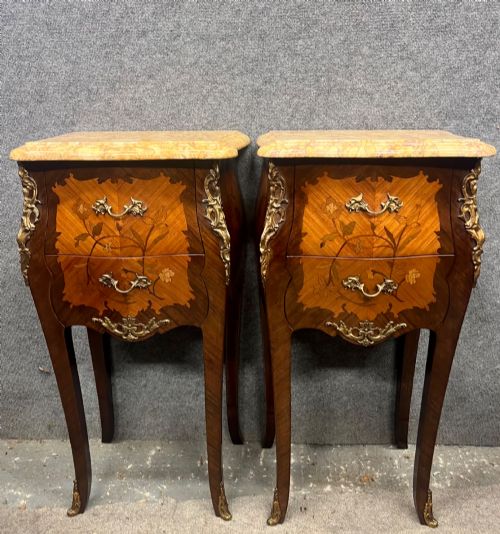
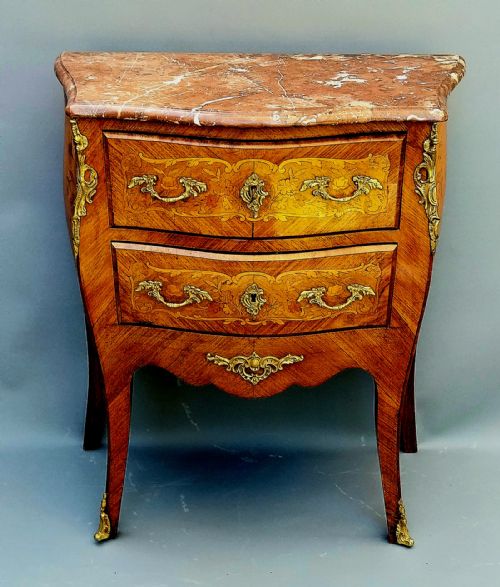


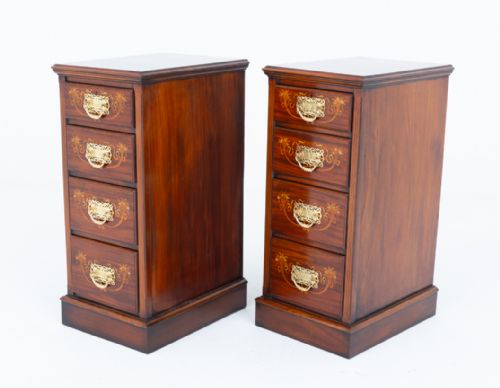
Marquetry Bedside Chest
When you want a marquetry bedside chest, you are looking at small scaled French and English tables built for the bedroom with patterned wood veneers.
Marquetry Bedside Chest
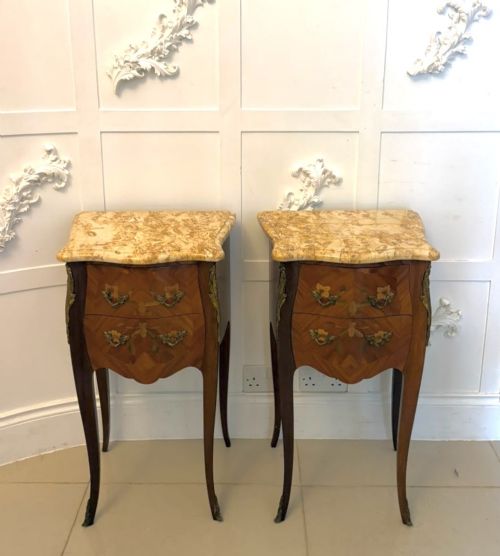
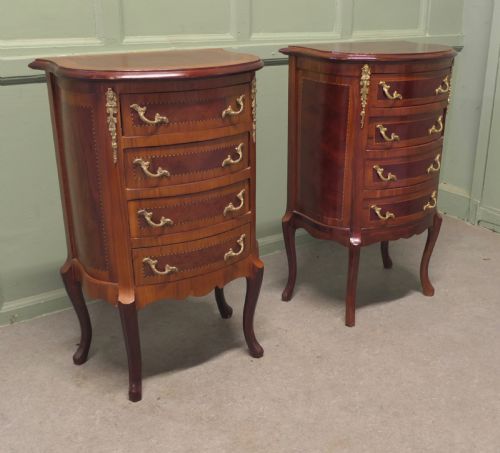
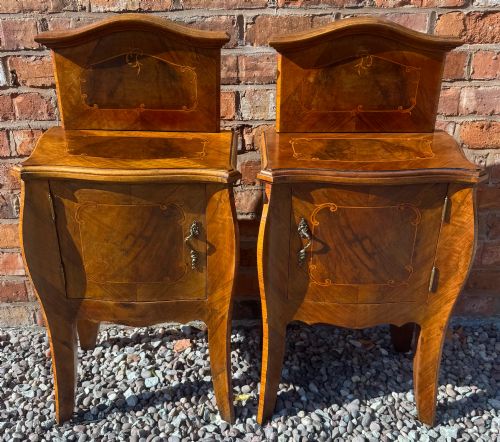
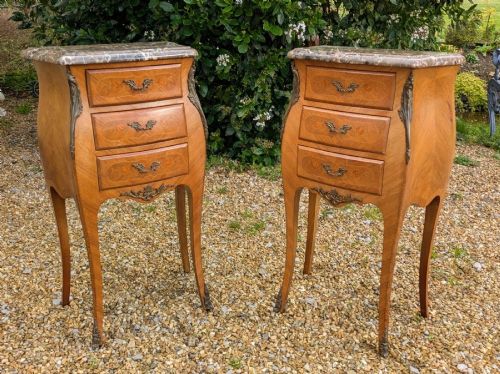
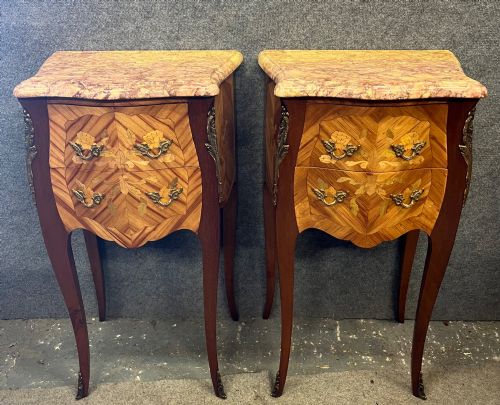
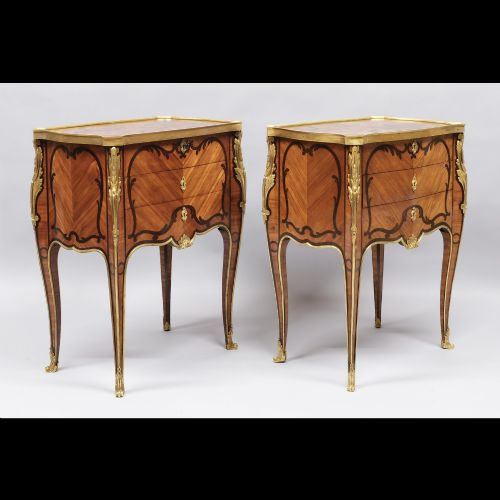
A marquetry bedside chest combines small storage with detailed wood picture work across the top, drawer fronts and sides. The pieces found here span the nineteenth century into the 1930s, heavily representing French Louis XV styles, Edwardian satinwood items and Victorian walnut or rosewood cabinets.
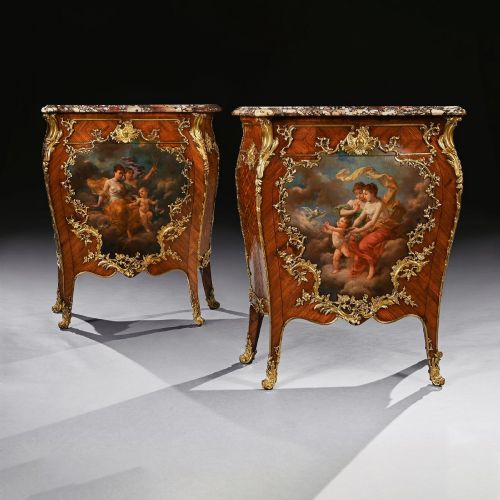
Most examples function as diminutive commodes, lamp tables or nightstands featuring marble slabs and cast metal mounts. Makers often constructed them in matching pairs to sit beside a bed, though single chests and near pairs frequently appear in the records.
How They Were Made
Cabinet makers laid thin veneers of kingwood, tulipwood, walnut, rosewood and satinwood onto solid carcases to create elaborate floral or geometric marquetry patterns. Brass, ormolu and gilt bronze mounts protect corners and frame drawers, while inset marble tops provide durable surfaces.
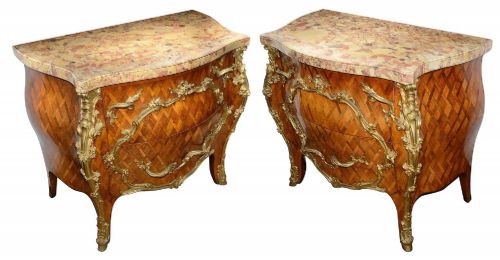
Curved bombe and serpentine shapes required skilled heat-bending of timber and careful hand-fitting of drawers. Marquetry cutters sliced different coloured wood veneers together using paper templates so the grain and tone locked precisely into place.
The listings show materials spanning marble, brass, walnut, kingwood, ormolu, rosewood, mahogany and satinwood across multiple decades.
What Varies in Quality
The standard of a marquetry bedside chest rests in the crispness of the veneer cutting and the natural variety of the woods utilised. Superior examples show intricate shading achieved by scorching veneer edges in hot sand before gluing them down.
Metal mountings separate standard production from the finest workshops, with chased ormolu and heavy brass handles indicating high tier execution. The quality of the marble top, particularly its thickness and the smoothness of its moulded edge, marks the difference in rank.
Edwards and Roberts·Sormani
The Marquetry Bedside Chest Glossary
- Marquetry
- The art of forming decorative patterns by fitting together thin slices of wood veneer on a carcase. It differs from parquetry by creating pictorial scenes rather than geometric grids.
- Ormolu
- Gilded bronze mounts applied to furniture edges and feet. This material adds weight and decorative contrast to the timber surfaces.
- Bombe
- A swollen or bulging convex shape found on the front and sides of commodes. This contour demands advanced woodworking skill to maintain structural integrity.
- Kingwood
- A dense, richly figured Brazilian timber heavily utilised in French cabinet making. It displays dark violet and brown stripes against a golden background.
- Vernis Martin
- A simulated Japanese lacquer technique used on eighteenth and nineteenth century furniture. It provides a glossy, translucent painted finish.
Marquetry Bedside Chest: Frequently Asked Questions
What is a marquetry bedside chest?
A marquetry bedside chest is a small storage cabinet featuring patterned wood veneer designs on its exterior surfaces. These tables typically include drawers or cupboards designed to sit beside a bed.
Originating largely from French and English cabinet traditions, they serve as both functional bedside storage and decorative art pieces. Many examples incorporate marble tops and gilt bronze mounts.
How do I care for a marble top?
Marble tops on antique chests require simple maintenance using soft cloths and warm water to remove dust. Avoid acidic cleaners and abrasive scrubbing pads that etch the polished stone surface.
Coasters should be placed beneath glasses to prevent ring marks from moisture or alcohol. Waxing the timber base separately helps protect the surrounding veneer work.
Are these chests always found in pairs?
Many bedside chests survive as matching pairs because bedrooms traditionally required symmetrical furnishings on either side of the bed. Single chests and near pairs also appear frequently in historical listings.
Near pairs share identical periods, woods and dimensions while exhibiting slight variations in their hand-cut marquetry patterns.