
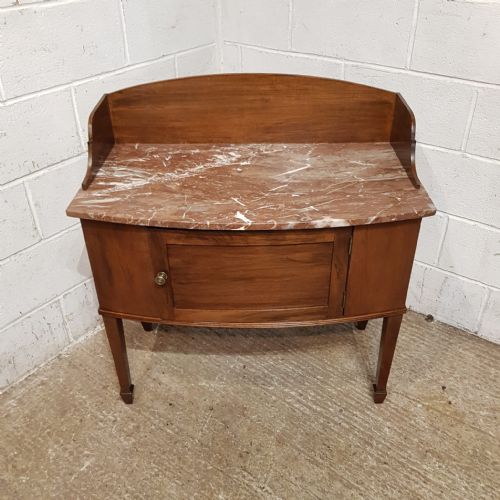
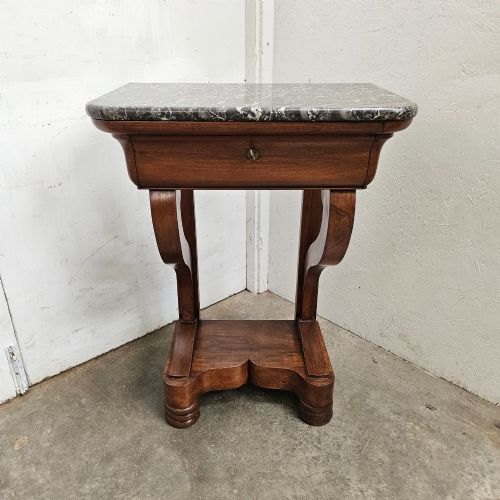


Marble Top Console Cabinet
These marble top console cabinets bring solid stone tops and fine timbers together to anchor a room.
Marble Top Console Cabinet
A marble top console cabinet sits against a wall, combining a heavy stone slab with timber framing to create a practical surface and enclosed storage. These items emerge in forms such as washstands, console tables, side cabinets, chiffoniers, side tables, credenzas, and buffets.
The versions met on this page span the nineteenth century, Edwardian era, Victorian period, Regency, and mid-twentieth century. Makers fashioned them in England, France, and Italy using woods like mahogany, walnut, rosewood, satinwood, and satinbirch.
Design styles range from French Empire and Louis Philippe to Louis XVI style, Arts and Crafts, and Regency. Buyers find both functional washstands with stone surfaces and decorative side cabinets intended for formal reception rooms.
How they were made
Cabinetmakers constructed the frames using native and exotic timbers including mahogany, walnut, rosewood, and satinwood. They applied techniques such as marquetry, parquetry, and parcel gilding to enrich the wooden surfaces of the cabinets and consoles.
Workers mounted heavy marble and fossil marble slabs onto the timber bases to create durable, waterproof tops. Brass and ormolu mounts, along with glass elements and ceramic details, complete the construction of these pieces.
Listings feature pieces from the 19th century, Edwardian era, Victorian period, and Regency, utilising mahogany, walnut, rosewood, and marble.
What varies in quality
Quality depends on the selection and matching of timber veneers, such as walnut, mahogany, and satinwood, across the cabinet doors and drawer fronts. Superior pieces display intricate marquetry or parquetry work executed with precision.
The grade of the stone top and the finesse of any brass, ormolu, or parcel gilt mounts distinguish standard examples from finer works. The structural integrity of the timber framing and the original alignment of the marble slab further separate the tiers of craftsmanship.
The Marble Top Console Cabinet Glossary
- Console table
- A table designed to stand against a wall, frequently supported by brackets or pillars. These pieces often feature decorative stone tops.
- Chiffonier
- A low cabinet with drawers and shelves, developed during the eighteenth century. They frequently incorporated marble tops in later nineteenth-century examples.
- Marquetry
- The art of applying pieces of veneer to a structure to form decorative patterns and pictures. Craftsmen utilised various coloured woods for this technique.
- Parquetry
- A geometric mosaic of wood pieces used for decorative floors and cabinet surfaces. This method creates repeating patterns across the timber.
- Ormolu
- Gilded bronze applications used for furniture mounts and decorative hardware. This material appears frequently on French Empire pieces.
Marble Top Console Cabinet: Frequently Asked Questions
What is a marble top console cabinet?
A marble top console cabinet is a piece of furniture featuring a stone slab fitted to a wooden base designed for wall placement. These items combine storage compartments with a durable, decorative top surface.
They appear across various periods including the Victorian era, Edwardian period, and Regency styles. The form includes console tables, side cabinets, and washstands.
How do I clean a marble top?
Cleaning a marble top requires mild soap and warm water applied with a soft cloth. Avoid acidic cleaners that can etch the polished stone surface.
Dry the stone thoroughly after wiping to maintain its finish. Proper care preserves the fossil marble and standard marble surfaces seen on these cabinets.
Are these cabinets waterproof?
The marble top provides a water-resistant surface suitable for washstands and serving areas. However, the wooden frames underneath require protection from standing water.
Timbers like mahogany, walnut, and rosewood can sustain damage if moisture is left on the wood joints. Wipe up spills promptly to protect the antique structure.
How do I identify the period?
Identifying the period involves examining the timber species, construction methods, and stylistic details. Pieces from the nineteenth century often feature mahogany or walnut, while Edwardian examples show lighter woods.
Styles such as French Empire, Regency, and Arts and Crafts provide distinct visual clues. Hardware like brass mounts and ormolu details also point to specific manufacturing eras.
Can these be used as washstands?
Original washstands with marble tops were built for bedroom use with washing basins in mind. Today, buyers repurpose them as bathroom vanities or hallway console tables.
The stone surface handles moisture well, making them practical for modern living spaces. Their diverse forms include bow-fronted designs and compact side cabinets.