
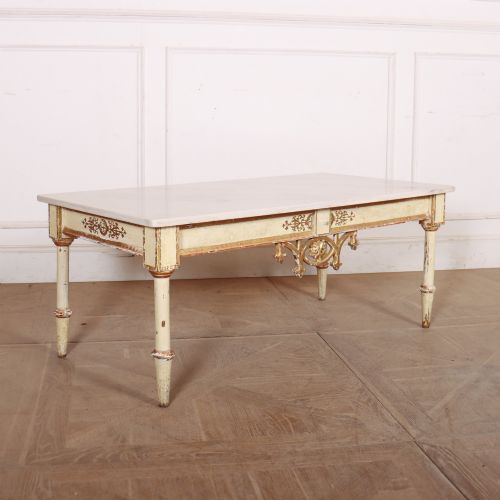


Marble Low Centre Table
A marble low centre table brings stone-topped surface utility and classic revival elegance directly into a reception room.
Marble Low Centre Table
A marble low centre table combines a solid stone slab surface with a low timber or metal frame designed for coffee table use. When you search for this phrase, you find low-slung surfaces adapted from larger salon or centre tables.
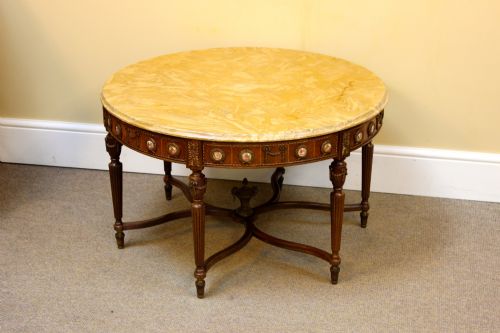
The pieces you meet on this page span the late nineteenth century through to the mid-twentieth century, with French and Italian origins appearing frequently. Forms include round, oval, and rectangular coffee tables alongside specific gueridon and console adaptations.
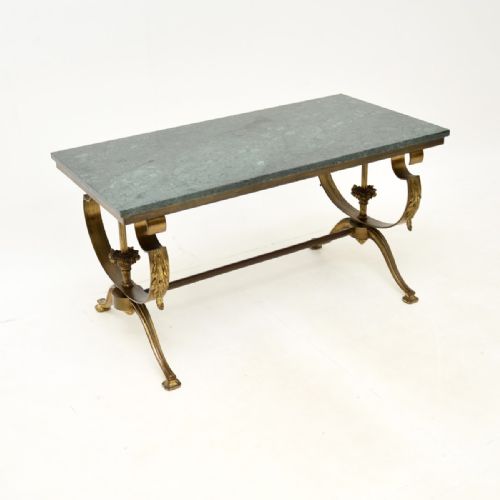
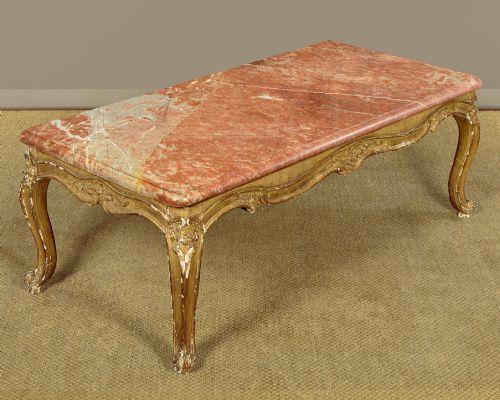
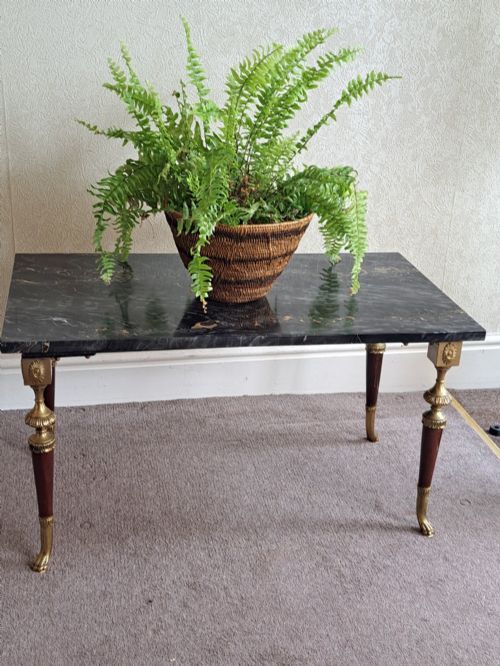
Stylistically, these tables draw heavily from Neoclassical, Louis XVI, and Rococo revival traditions. You encounter giltwood, brass, painted wood, mahogany, and walnut frames supporting fitted marble tops.
What varies in quality
The refinement of the frame carving and the choice of secondary materials separate standard production from superior examples. Finishes like hand-applied parcel-gilt and detailed giltwood or brass mounts demonstrate greater workshop investment.
At least one table pairs its marble top with gilt metal dolphins, proving that Victorian and mid-century designers thoroughly enjoyed aquatic themes.
Waring & Gillow of Paris·Gillows·B Battioli, Varese
The Marble Low Centre Table Glossary
- Gueridon
- A small round table, often with a central pillar or tripod base, originating in seventeenth-century France. These pieces frequently function as low display surfaces.
- Giltwood
- Timber that has been coated with a thin layer of gold leaf or gesso preparation. It appears widely on decorative revival frames.
- Specimen marble
- Piiethces of various coloured marbles cut and fitted together in geometric or pictorial patterns. This technique demands high precision from the stonemason.
- Parcel-gilt
- Partially gilded woodwork where only specific carved details receive gold leaf highlights against a painted ground. This creates a contrasting two-tone decorative effect.
- Neoclassical
- A style drawing inspiration from classical antiquity, featuring restrained symmetry, classical motifs, and balanced proportions. It dominates many nineteenth-century French and Italian designs.
Marble Low Centre Table: Frequently Asked Questions
What is a marble low centre table?
A marble low centre table is a low-height furnishing featuring a stone slab top supported by a wood, brass, or gilt metal frame. These pieces function primarily as coffee tables in living spaces.
They derive their forms from earlier nineteenth and twentieth-century salon tables, adapted to suit modern seating heights while retaining classical decorative details.
How do I clean the marble top?
Cleaning requires a soft damp cloth and mild, pH-neutral soap formulated for stone surfaces. Avoid acidic cleaners, vinegar, and abrasive pads that etch or scratch the polished marble.
Dry the surface thoroughly after wiping to prevent water spots from forming on older stone.
Are these tables heavy?
Yes, the inclusion of a solid stone slab makes these tables substantially heavier than standard wooden coffee tables. The weight helps keep the marble top stable within its frame without requiring permanent fixings.
Care should be taken when lifting or repositioning the furniture to protect both the stone top and the supporting base.
How do I identify French revival styles?
French revival styles such as Louis XVI or Rococo show characteristic decorative motifs including carved acanthus leaves, fluted legs, giltwood flourishes, and symmetrical or serpentine frames. These design elements mimic eighteenth-century aesthetics produced during later periods.
Examining the construction methods underneath the frame helps confirm whether a piece dates to the nineteenth-century revival era or earlier.