



Marble Garniture Set
A marble garniture set anchors a room with a central clock flanked by matching vases or candelabras.
Marble Garniture Set
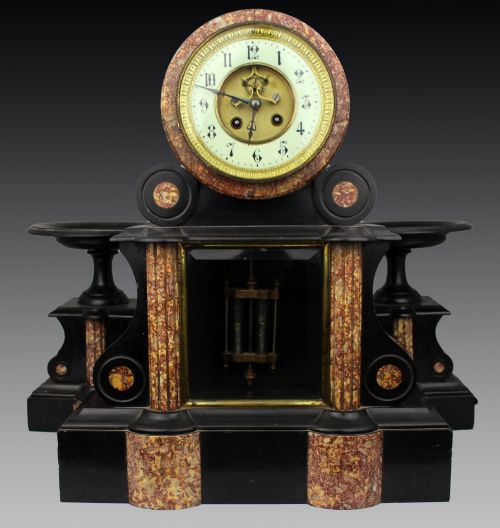
A marble garniture set comprises a central mantel clock paired with matching side pieces, designed to sit together on a fireplace or sideboard. When searching for a marble garniture set, buyers encounter nineteenth-century French designs alongside later Art Deco interpretations.
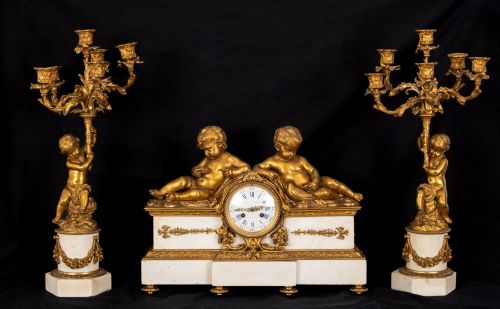
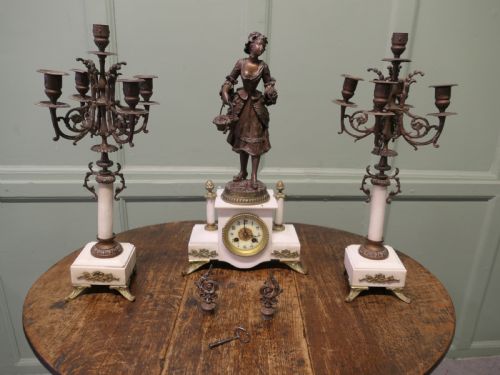
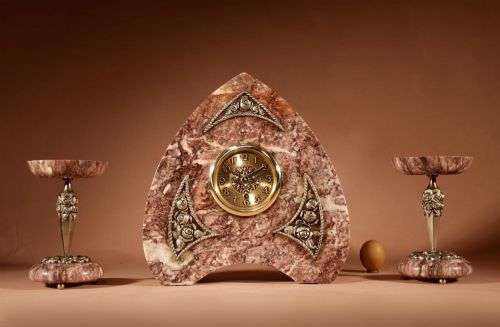
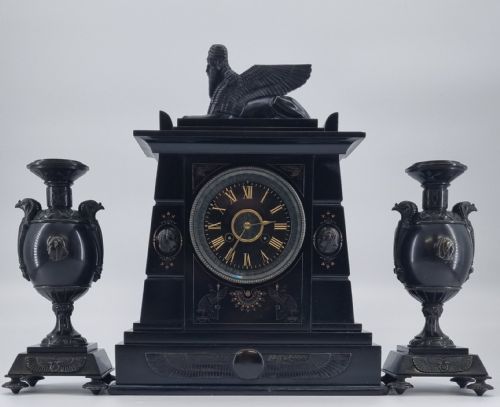
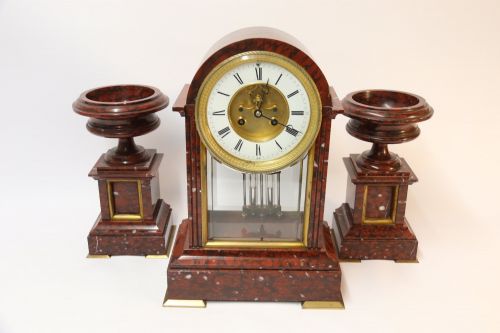
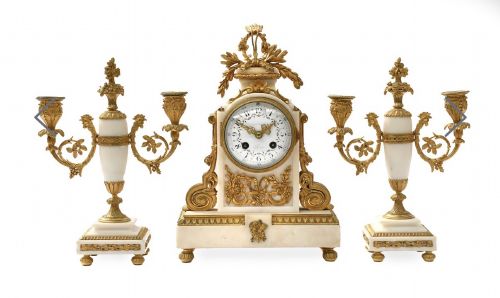
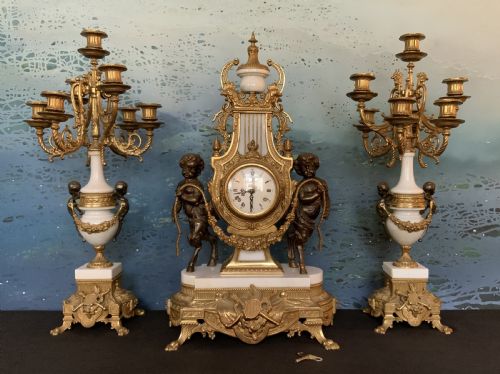
The most common configurations on this page pair a substantial stone clock with matching urns, vases or candelabras. These three-piece ensembles integrate heavy mineral bodies with decorative metalwork to create a unified domestic display.
Originating largely from French workshops during the Victorian era and the interwar period, these sets reflect shifting tastes from ornate classical revivals to streamlined geometric forms. The core components remain functional timepieces accompanied by ornamental counterparts that repeat the primary materials.
How they were made
Makers shaped dense mineral blocks into columns, porticos and architectural clock cases using specialised cutting and polishing tools. White marble, black marble, slate and sienna varieties provided the solid structural foundations for both the clocks and their matching side pieces.
Foundries cast bronze and brass components, applying ormolu gilding or patination to metal mounts, cherubs and bezel frames. Enamel dials fitted into the clock faces received painted numerals, while glass covers protected the internal eight-day striking movements.
Listings feature nineteenth-century French and Art Deco periods utilising marble, bronze, ormolu, and brass.
What varies in quality
The refinement of the cast bronze mounts and ormolu detailing dictates the upper tier of these ensembles, where chased ornamentation exhibits crisp depth and deliberate hand-finishing. Lesser examples rely on repetitive, shallow castings with minimal surface definition.
Stone selection and joinery also separate ordinary items from exceptional pieces, particularly where multi-coloured marble varieties or intricate portico architectures demand precise alignment. Clock movements signed by known makers indicate higher workshop standards than standard anonymous mechanisms.
Japy Frères·Samuel Marti·H Luppens Paris·Michel Decoux
The Marble Garniture Set Glossary
- Garniture set
- A central decorative object accompanied by matching side pieces designed as a unified display. These typically consist of a clock flanked by two urns, vases or candelabras.
- Ormolu
- Finely chopped gold applied to a bronze base using a mercury amalgamation technique, common in nineteenth-century French metalwork. This process produces a durable, rich golden surface finish.
- Portico clock
- A timepiece housed within an architectural frame supported by columns, frequently executed in marble. This classical form often anchors symmetrical garniture arrangements.
- Candelabra
- A branched candlestick designed to hold multiple tapers, often included as the matching side pieces in a garniture set. They mirror the materials of the central clock.
- Striking movement
- A mechanical clock interior that sounds the hours and half-hours on a bell or gong. Most period examples rely on an eight-day spring or weight-driven train.
Marble Garniture Set: Frequently Asked Questions
What is a marble garniture set?
A matching three-piece decorative arrangement consisting of a central clock and two companion vessels or candelabras made from stone.
These ensembles were designed to create symmetry when placed together on a mantelpiece or large shelf.
How do you wind the clock?
A specialised key is inserted into winding holes on the enamel dial to tension the internal springs.
Most period movements require a weekly winding to maintain accurate timekeeping.
Where were they made?
The majority of these decorative sets originated in France during the nineteenth and early twentieth centuries.
Parisian workshops produced both the mechanical movements and the decorative metal mounts.
How do I identify Art Deco sets?
Art Deco examples feature streamlined geometric forms, stepped marble blocks, and stylized animal sculptures such as greyhounds.
These twentieth-century pieces depart from the ornate scrolls of earlier Victorian revivals.