


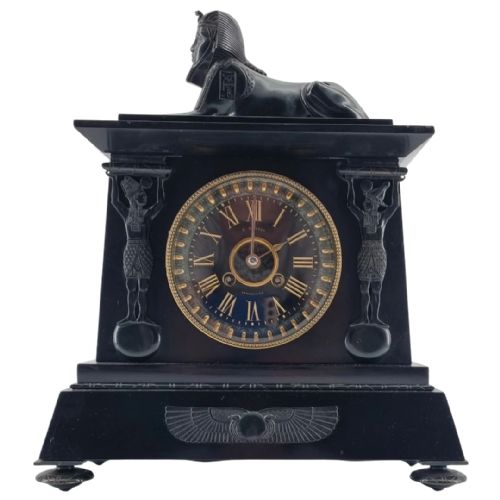
French Slate Table Clock
These heavy french slate table clock pieces bring architectural presence and mechanical precision to a room, driven by mid-to-late nineteenth-century European horology.
French Slate Table Clock
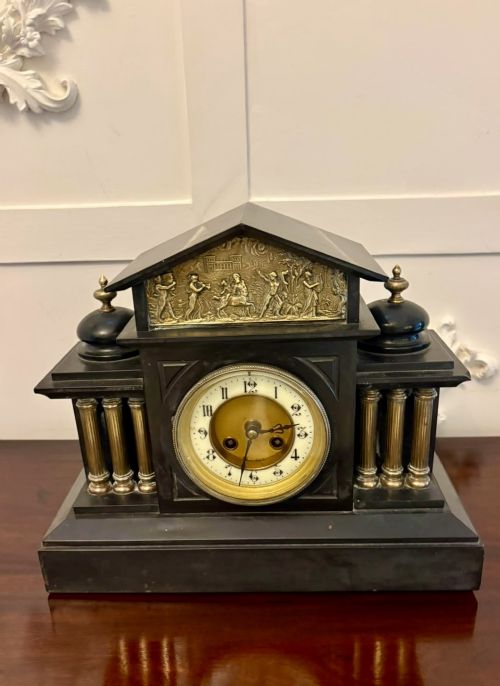
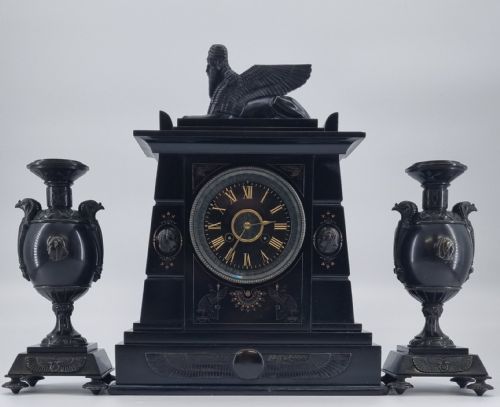
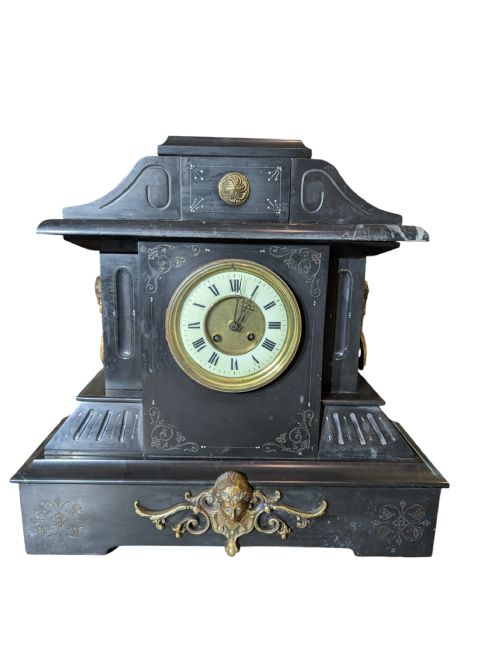
A french slate table clock typically presents as a substantial mantel timepiece, often accompanied by matching garnitures or urns. You will frequently encounter Victorian and nineteenth-century examples shaped by architectural revivals, including Egyptian Revival and Neoclassical styles.
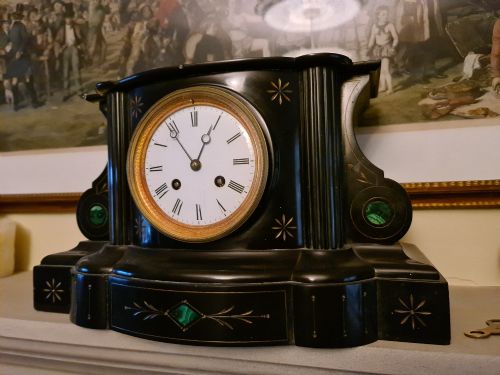
The forms range from severe temple-like architectural cases to inlaid marble pieces and grand garniture sets featuring visible dials. Many items on this page date from the 1860s through the 1880s, combining monumental weight with precise French mechanical movements.
Distinctions in craftsmanship and design
The distinction between standard production and superior examples lies in the ambition of the architectural detailing and the complexity of the dial work. Pieces featuring specialised complications, such as perpetual calendars or moon phase indicators, represent a higher tier of horological output.
Cases enriched with crisp gilt brass mounts, incised marble inlay, and fully integrated garniture sets demonstrate greater workshop investment than plain architectural boxes. The integration of named maker movements further elevates the standing of an individual clock.
Some models feature a tiny revolving moon painted on a penny-sized dial to track the lunar cycle right from your mantelpiece.
Philippes Paris·Sacre·Baby and Jannings·D. Munsey·Pinchon Fils Paris·Brocot
The French Slate Table Clock Glossary
- Garniture
- A set consisting of a central clock flanked by matching decorative ornaments such as urns or vases. These matched sets create a balanced symmetrical display on a mantelpiece.
- Slate
- A fine-grained metamorphic rock that takes a smooth matte or polished black finish. It serves as the heavy structural foundation for nineteenth-century architectural clock cases.
- Escapement
- The mechanical linkage that controls the release of power in a clock movement while maintaining the pendulum swing. It is the central regulatory mechanism of any mechanical timepiece.
- Bezel
- The metal ring that holds the glass protecting the dial face. It often opens on a hinge to allow hand adjustment.
- Complication
- Any mechanical function in a clock beyond the basic display of hours and minutes. Examples include calendar tracking and lunar phases.
French Slate Table Clock: Frequently Asked Questions
How heavy is a typical french slate table clock?
These clocks possess considerable mass due to the dense mineral content of the slate and marble cases. Many require two people to move safely and demand a sturdy mantelpiece or shelf for support.
The weight helps stabilise the heavy mechanical movements and contributes to the solid architectural presence characteristic of the Victorian period.
How do I identify an Egyptian Revival clock?
Egyptian Revival pieces incorporate distinct motifs drawn from ancient architecture, such as obelisk forms, lotus capitals, and hieroglyphic engravings. These elements were popular during the mid-nineteenth century following various archaeological discoveries.
The slate and black marble bodies provide a dark contrasting backdrop for gilt bronze or brass pharaonic details.
What does an eight-day movement mean?
An eight-day movement requires winding approximately once a week to maintain continuous operation. This mechanical standard freed owners from daily winding routines while utilising traditional spring or weight-driven trains.
Most quality nineteenth-century pieces recorded here rely on this standard for domestic convenience.