




Black Slate Desk Clock
These black slate desk clocks are heavy, architectural pieces of Victorian timekeeping that anchor a mantelpiece with industrial gravity.
Black Slate Desk Clock
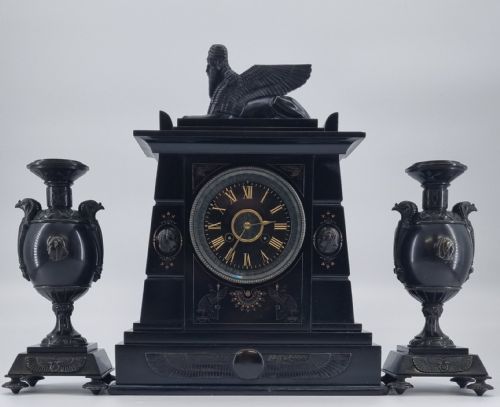
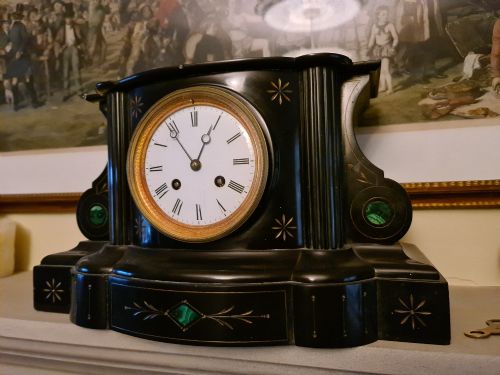
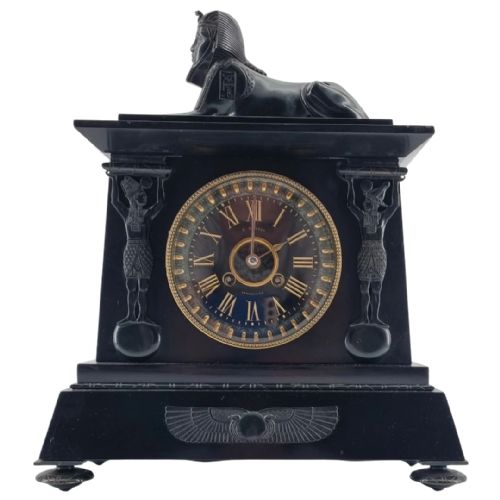
When you search for a black slate desk clock, you encounter substantial nineteenth-century timepieces shaped by Victorian architectural taste. Most examples originate from the latter half of the nineteenth century, often pairing dense black slate with contrasting marble, bronze mounts or enamel dials.
The dominant forms span standard drumhead shapes and elaborate garnitures accompanied by matching side urns. You will frequently find French movements driving these heavy cases, alongside specific regional adaptations from Victorian workshops and makers.
Stylistic influences range from austere classical revivals to ornate Egyptian motifs, reflecting the diverse decorative ambitions of the period. These clocks served as centrepieces for domestic interiors, combining mechanical utility with monumental presence.
What varies in quality
Quality reveals itself in the architectural ambition of the stone case and the crispness of the bronze or gilt mounts. Simpler drumhead designs sit at the accessible end, while monumental architectural garnitures with integrated side urns represent the finer tier.
The sophistication of the movement dictates the upper reaches of the tier, particularly when complex perpetual calendars or named makers are involved. Finer pieces demonstrate precise stone-fitting, integrated marble inlay work, and robust mechanical engineering that survives intact.
Certain nineteenth-century slate clocks commemorate maritime engineering, recording historical steamships alongside traditional classical garnitures.
Sacre·Baby and Jannings·D. Munsey·Achille Brocot·Pinchon, Fils, Paris·Brocot
The Black Slate Desk Clock Glossary
- Garniture
- A set consisting of a central clock flanked by matching decorative ornaments such as urns or vases. These matched sets were designed to sit harmoniously together on a mantelpiece.
- Drumhead clock
- A timepiece featuring a circular clock housing mounted upon a rectangular stone or marble base. This specific configuration resembles the shape of a drum.
- Perpetual calendar
- A complex clock mechanism that automatically adjusts for the varying lengths of months and leap years. This technical addition marks the higher standard of Victorian horology.
- Egyptian Revival
- A nineteenth-century decorative style drawing heavily on pharaonic motifs, obelisks, and hieroglyphic details. It appears on select slate clock cases of the period.
- Escapement
- The internal mechanical linkage that controls the release of power in a clock movement. It translates the drop of the weights or uncoiling of the spring into steady, measured beats.
Black Slate Desk Clock: Frequently Asked Questions
How do I wind an eight day slate clock?
Use the designated winding key on the dial face, turning it gently until resistance is felt.
Avoid overwinding the mainspring to prevent damage to the internal brass mechanism.
Why are these clocks so heavy?
The cases are carved from solid blocks of black slate and heavy marble.
This dense stone construction provided the necessary structural stability for large mechanical movements.
How do I distinguish French movements from others?
French movements often feature maker stamps or serial numbers engraved on the backplate.
They frequently employ superior escapements and finishing compared to standard domestic alternatives.
Where should I place a slate clock at home?
Position the clock on a sturdy mantelpiece or heavy sideboard capable of supporting substantial weight.
Ensure the surface is completely level to maintain the correct beat of the internal pendulum.