




Victorian Marble Mantelpiece Clock
A victorian marble mantelpiece clock brings heavy stone architecture and precise brass machinery together on the shelf.
Victorian Marble Mantelpiece Clock
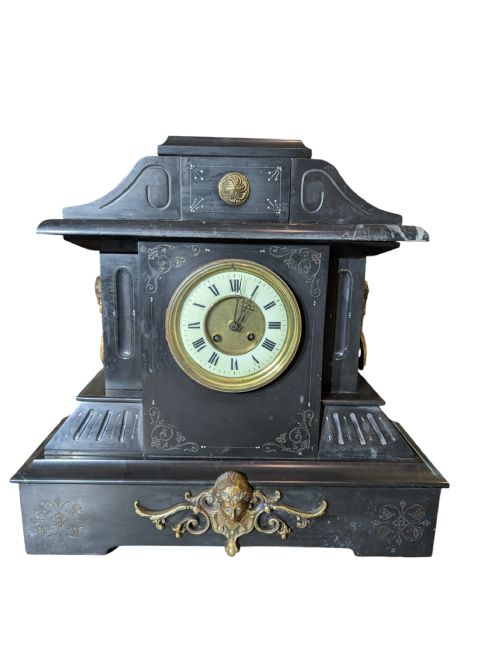
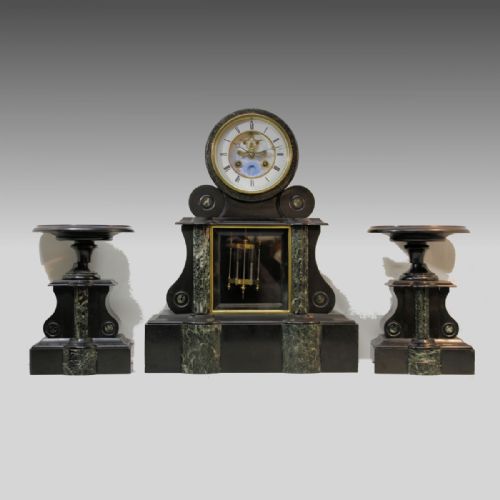
A victorian marble mantelpiece clock serves as a substantial timekeeper built from dense stone bodies and driven by mechanical movements. These pieces range from simple architectural forms to elaborate garniture sets featuring side ornaments.
Most examples found here date from the nineteenth century, spanning decades such as the 1860s, 1870s, and 1880s. Makers housed these eight day mechanisms inside heavy enclosures of black slate, sienna, green onyx, or pink marble.
Buyers encounter French influenced designs alongside traditional Victorian classical styles. Some incorporate bronze, ormolu, and glass components to frame the enamel dials.
How they were made
Craftsmen shaped heavy blocks of marble and slate into architectural shapes, often incorporating inlaid stone details and polished surfaces. Gilded bronze and ormolu mounts were cast and applied to accent the stone bodies.
Enamel dials with delicate numerals sat behind protective glass bezels, housing mechanical movements driven by springs. These eight day systems required careful assembly to run reliably within their stone housings.
Listings feature items from the 1860s through the 1890s, utilising marble, slate, brass, and ormolu.
What varies in quality
The sophistication of the stone selection and the intricacy of the metal mounts determine the standing of a piece. Finer examples display harmonious colour combinations in the marble and slate, paired with detailed cast bronze or ormolu garniture sets.
The complexity of the dial also alters the character of the object, with special complications like penny moon phases separating standard timepieces from more ambitious works.
Baby and Jannings
The Victorian Marble Mantelpiece Clock Glossary
- Garniture
- A set consisting of a central clock accompanied by matching side ornaments or vases. These decorative groups created a balanced display across a fireplace opening.
- Ormolu
- Gilded bronze used for decorative mounts and accents on nineteenth century pieces. This technique added bright metallic highlights against dark stone surfaces.
- Portico clock
- A distinct architectural clock style shaped like a classical building with supporting columns. These items often utilised coloured marble and glass elements.
- Eight day
- A mechanical movement requiring winding once a week to maintain operation. This practical duration was standard for quality domestic clocks of the period.
- Slate
- A fine grained grey or black stone frequently used as the primary structural body for heavy mantel clocks. It provided a stable base that could be polished or inlaid with contrasting marbles.
Victorian Marble Mantelpiece Clock: Frequently Asked Questions
How do I wind an eight day clock?
Insert the key into the winding holes on the enamel dial and turn it gently until resistance is felt. Take care not to overwind the mainspring.
Most nineteenth century movements run for approximately eight days before requiring another turn of the key.
Where should I place a marble clock?
Position the clock on a sturdy mantelpiece or heavy sideboard capable of supporting substantial stone weight. Ensure the surface is completely level so the pendulum beats evenly.
Keep the piece away from direct heat sources and damp walls to protect the internal metal and exterior stone.
How do I identify the period?
Examine the materials, dial typography, and overall architectural style to gauge the manufacturing era. Nineteenth century examples often feature visible date markers, distinct French movements, or characteristic Victorian classical revival details.
Consulting the specific decade assigned to the listing helps confirm whether the item originates from the 1860s, 1870s, or 1880s.
What is a clock garniture?
A clock garniture is a matching three piece set comprising a main mantel clock and two flanking ornamental pieces. These matched sets were designed to sit together on a fireplace mantel or large shelf.
The side pieces often mirror the marble, bronze, and architectural motifs of the central clock.