



Black Marble Garniture Clock
A black marble garniture clock brings architectural weight and striking presence to a mantelpiece, combining a central timepiece with matching garnitures.
Black Marble Garniture Clock
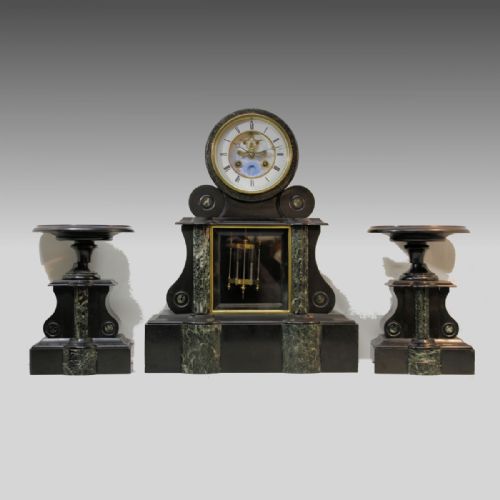
A black marble garniture clock ensemble consists of a substantial mantel clock accompanied by matching side ornaments, most frequently taking the form of urns or vases. These imposing sets originate predominantly from the nineteenth and early twentieth centuries, spanning Victorian, French Empire, and Art Deco aesthetics.
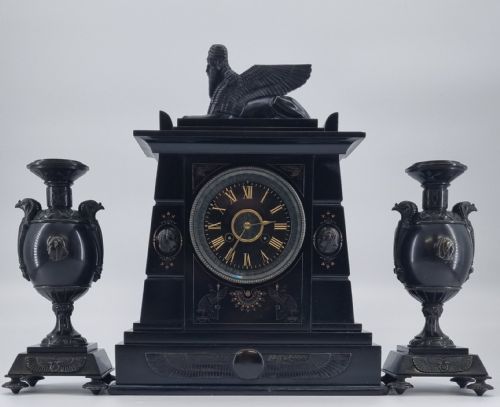
The version most commonly encountered on this page is the nineteenth-century French or Victorian mantel clock set, often styled with classical architectural details or Egyptian Revival motifs. They served as grand focal points in period drawing rooms, designed to command attention on the fireplace.
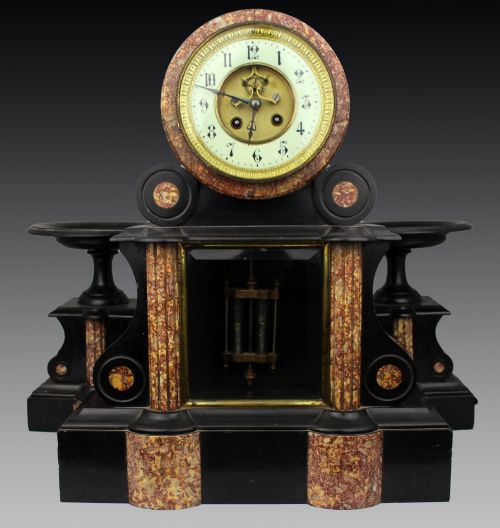
Makers utilised dark stone to achieve a solemn, monumental appearance, occasionally incorporating contrasting variegated marble or gilt bronze mounts. The matching garnitures complete a symmetrical arrangement that defines the traditional mantel display.
How they were made
Craftsmen shaped heavy blocks of black marble and slate into architectural cases, frequently employing sawing, turning, and polishing techniques to create smooth, reflective surfaces. These stone bodies house mechanical movements, often requiring skilled metalworking for cast bronze, brass, and spelter decorative elements.
The integration of mixed media is central to their construction, combining polished dark stone with cast metal figures, dials, and side garnitures. Artisans applied patination and gilding to the bronze and brass components to create tonal contrast against the dark marble.
What varies in quality
The standard of carving and the selection of secondary decorative materials dictate the distinction between ordinary and exceptional examples. Superior pieces feature intricate bronze or spelter mounts, crisply cast dial bezels, and harmonious pairings of variegated marble alongside the primary black stone.
The ambition of the design architecture also separates standard production from high-end works, particularly where Egyptian Revival motifs, figural garnitures such as elephants, or specialised complications like penny moon dials are present. The precision of the stone cutting and the architectural balance of the clock set determine its visual authority.
Japy Freres
The Black Marble Garniture Clock Glossary
- Garniture
- A set of ornamental objects designed to match a central piece such as a clock. These typically include a pair of urns or vases intended for symmetrical placement.
- Spelter
- An alloy of zinc used as a cheaper alternative to bronze for cast figures and ornaments. It is frequently finished with a bronze-look patination on nineteenth-century clock sets.
- Slate
- A fine-grained metamorphic rock often utilised as a dense, uniform base for black mantel clocks. It takes a high polish and mimics the appearance of black marble.
- Dial
- The face of the clock where the hours and minutes are displayed. On these sets, dials often feature enamel cartouches and protective glass bezels.
- Movement
- The internal mechanism that drives the clock hands and strikes the time. Many period examples house eight-day movements requiring periodic winding.
Black Marble Garniture Clock: Frequently Asked Questions
What is a garniture clock set?
A garniture clock set comprises a main mantel clock accompanied by matching decorative side pieces, such as urns. These items were manufactured to be displayed together as a unified centrepiece on a mantel.
Historically, the matching side ornaments balanced the visual weight of the room's fireplace arrangement. They create a formal, symmetrical display typical of Victorian and nineteenth-century interiors.
How do I wind an antique clock?
Antique clocks typically utilise a key inserted into winding holes on the dial to tension the springs. Most period movements require winding every eight days to maintain accurate timekeeping.
Care should be taken not to over-wind the mechanism. Consulting the specific movement type helps ensure the internal springs remain undamaged during regular maintenance.
How do I distinguish Victorian from Art Deco clocks?
Victorian clocks often feature classical architectural details, heavy bronze mounts, and ornate revival styles such as Egyptian or Neoclassical motifs. The stone is typically deep black marble or slate with formal symmetry.
Art Deco examples, emerging around the 1920s and 1930s, favour streamlined geometric forms, stylised animal figures like elephants, and contrasting variegated marbles. The overall silhouette shifts from ornate historical revival to modern abstraction.