
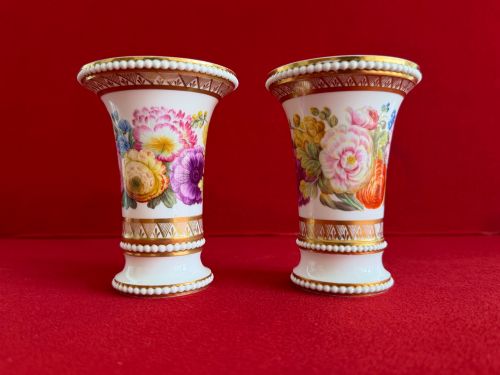
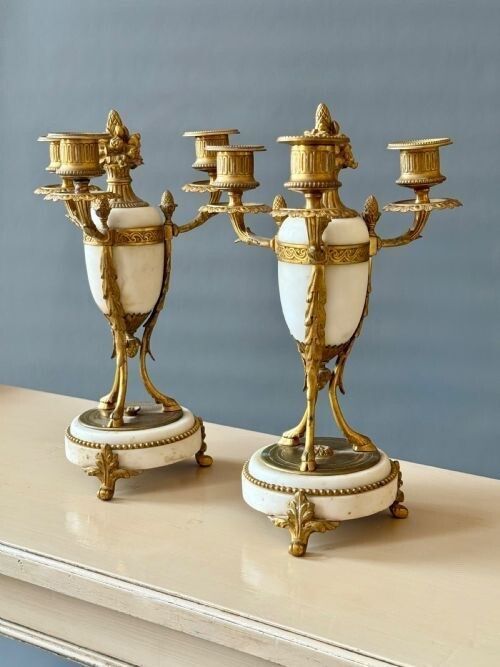
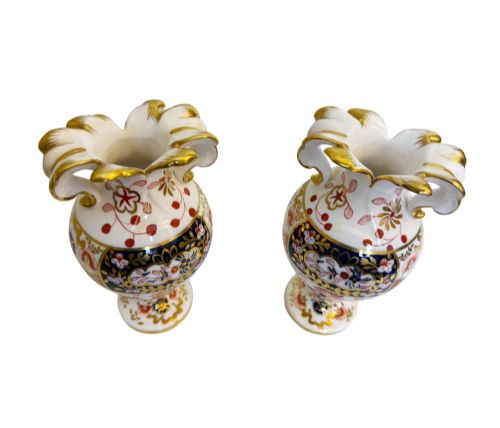

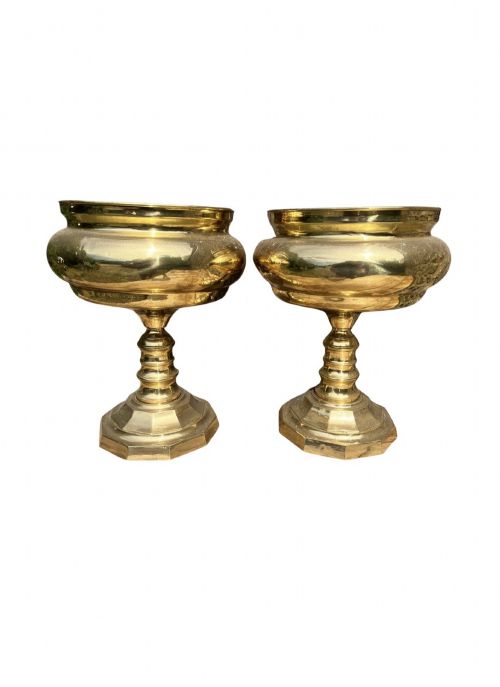




Mantelpiece Urn Pair
A mantelpiece urn pair brings classical symmetry and ornamental weight to a room, offering matched focal points designed for display.
Mantelpiece Urn Pair
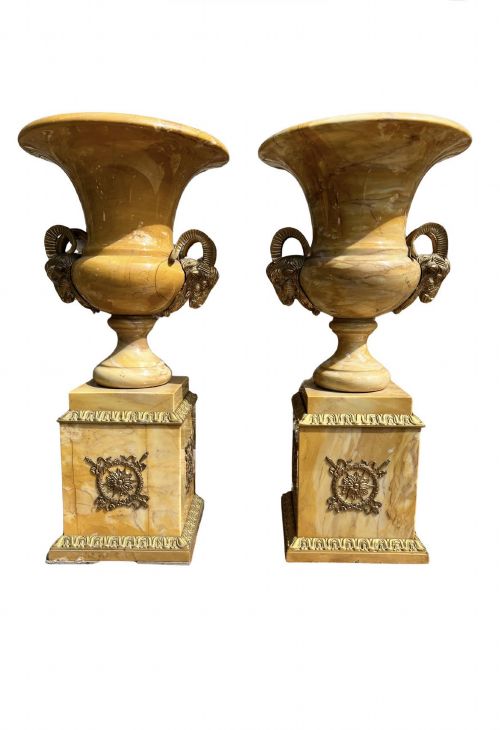
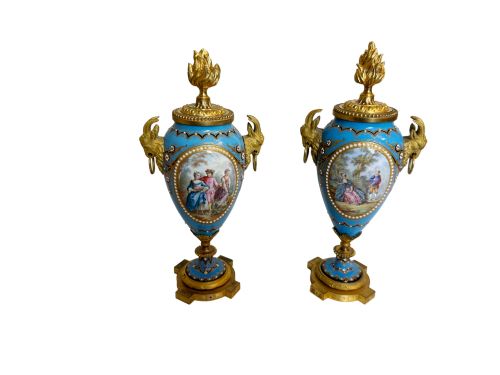
A mantelpiece urn pair consists of matching decorative vessels placed symmetrically on either side of a fireplace or shelf. These objects draw from nineteenth-century Neoclassical, French Empire, and Victorian design traditions, often taking the form of campana urns, cassolettes, or baluster vases.
The versions most commonly met on this page span the nineteenth century and incorporate continental influences such as Grand Tour souvenirs and Japanese Satsuma production. Makers and manufacturers range from European potteries like Royal Doulton and Mettlach to French and Italian metalworkers utilising bronze, marble, and brass.
Many examples function purely as decorative ornaments, while others incorporate reversible lids or cassolette mechanisms designed to transform a vase into a candleholder. Their primary role remains visual balance, anchoring a mantel with material richness and period character.
Materials and construction methods
Metals such as bronze, brass, ormolu, and gilt bronze provide structural definition, frequently cast in sections and chased by hand to sharpen classical motifs. Marble bases in siena, quartz, or white varieties anchor these metal components, providing substantial weight and stability.
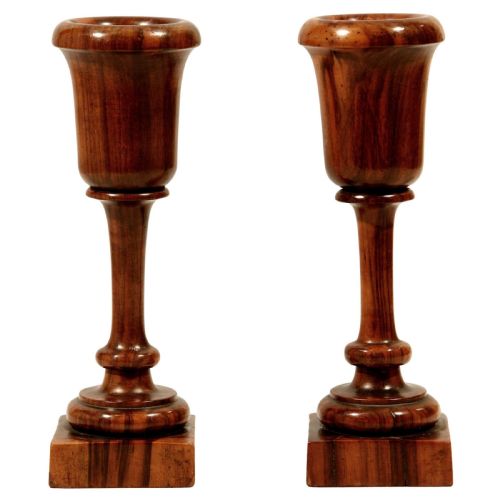
Ceramic and pottery examples utilise stoneware, porcelain, and earthenware bodies finished with enamel, glazes, or hand-painted details. Wood versions employ turned lignum vitae, showcasing the natural grain of the timber in spill stem vase formats.
Some wooden spill vases were turned from dense lignum vitae to hold thin tapers safely near the hearth.
Distinctions in manufacture and execution
The division between standard production and superior work rests on the crispness of the casting and the depth of the finishing. Metal urns with finely chased details and heavy fire-gilt surfaces demonstrate a higher standard of craftsmanship than simpler cast brass alternatives.
In ceramic and stone pieces, the quality appears in the precision of the turning, the purity of the marble veining, and the registration of painted enamel or glaze layers. Matched pairs that retain their original lids, plinths, and reversible cassolette components maintain greater integrity than modified or incomplete examples.
Royal Doulton Lambeth·Mettlach Pottery·Royal Doulton·Sevres
The Mantelpiece Urn Pair Glossary
- Cassolette
- A decorative vessel featuring a reversible lid that converts the piece from a covered vase into a candleholder. This dual function appears frequently in French Empire marble and bronze pieces.
- Campana urn
- A bell-shaped vessel with a flared rim and footed base modelled after ancient Roman pottery. This classical silhouette recurs throughout nineteenth-century metal and porcelain decorative arts.
- Grand Tour
- A term describing souvenir items purchased by wealthy travellers in Europe during the eighteenth and nineteenth centuries. These objects typically replicate classical antiquities in bronze, marble, and alabaster.
- Ormolu
- A method of applying finely ground high-carat gold to a bronze base using mercury amalgamation. This technique produces a rich golden finish characteristic of French decorative metalwork.
- Imari
- A style of Japanese porcelain decorated in underglaze blue and iron red with supplementary gold highlights. European factories frequently copied these vibrant palettes during the nineteenth century.
Mantelpiece Urn Pair: Frequently Asked Questions
How were cassolettes used?
Cassolettes served a dual purpose in nineteenth-century interiors through a reversible lid mechanism. One side presented a finished decorative stone or metal dome, while the reverse held a socket for a candle.
This allowed owners to transform their ornamental mantel pieces into functional lighting when required for evening entertaining.
How do I identify Grand Tour pieces?
Grand Tour pieces are identified by their classical subjects, such as miniature bronze copies of famous antiquities, architectural models, or excavated urn shapes. They often combine patinated bronze with coloured marbles like siena or quartz.
These souvenirs reflect nineteenth-century travel and education trends among collectors touring Italy and France.
What is the difference between spelter and bronze?
Spelter is a zinc-based alloy that is softer and lighter than bronze, making it easier to cast with ornate surface details. Bronze is a heavier copper and tin alloy with greater structural durability and a deeper resonance.
Objects cast in spelter typically require a painted or electroplated finish to simulate the appearance of genuine bronze.