


Mantelpiece Glass Lustres
Mantelpiece glass lustres are decorative twin candle-holders hung with glass prisms that catch and scatter firelight.
Mantelpiece Glass Lustres
When you search for mantelpiece glass lustres, you encounter ornamental candle fittings designed to stand on a fireplace mantel and reflect the ambient light of a room. The items on this page span the Regency and Victorian periods, extending into later twentieth-century examples.
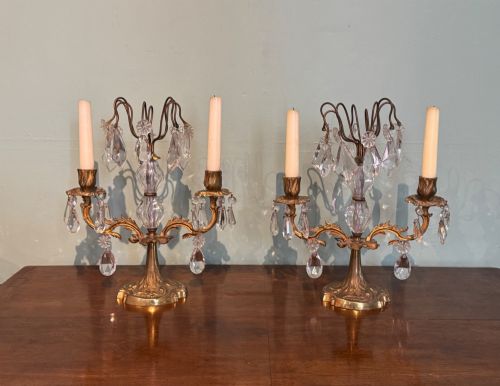
Most pieces appear in pairs, taking the form of table candlesticks or candelabras fitted with removable pendant prisms known as drops. You will find object types ranging from specific mantle lustres to broader categories of candlesticks and candelabras.
The styles recorded across these listings lean towards ornate European aesthetics, specifically French Rococo Revival, French Empire, and French Chateau designs alongside traditional English Victorian work. Their primary purpose was to double the perceived illumination by bouncing candlelight through cut crystal and coloured glass pendants.
How they were made
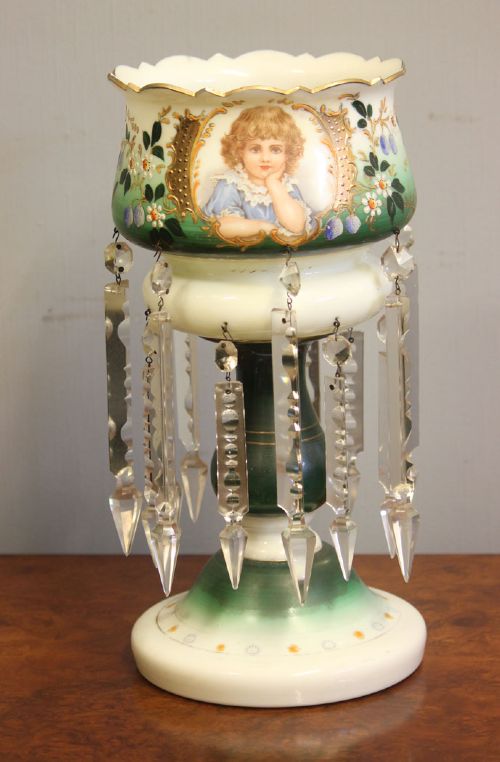
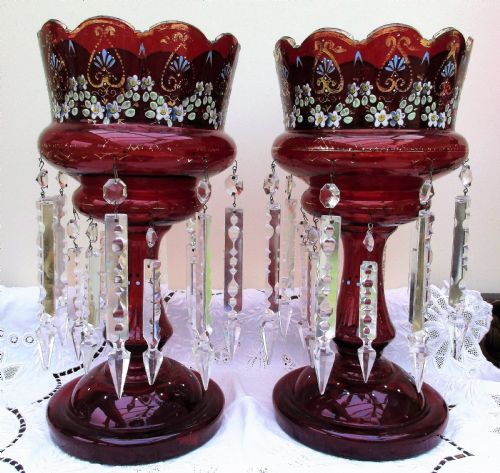
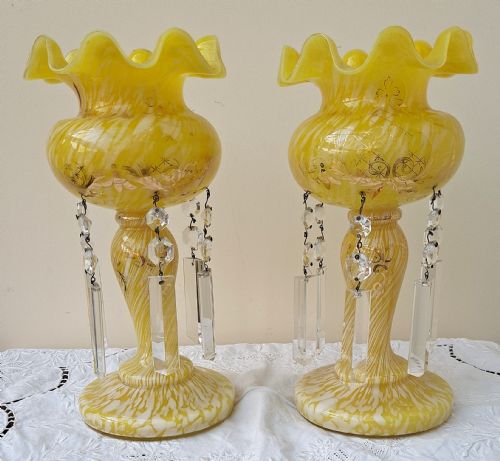
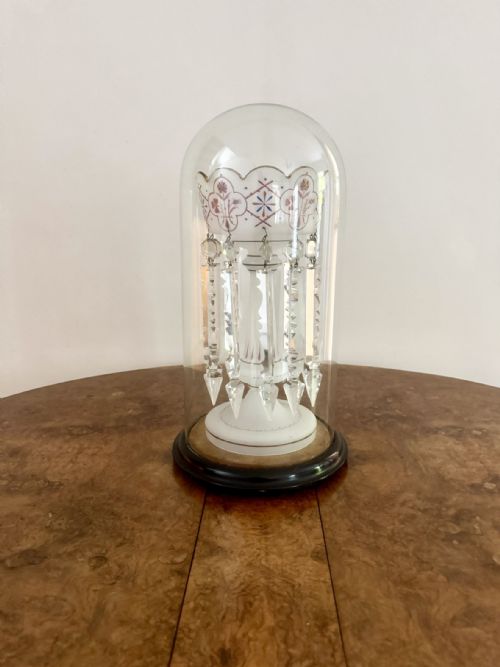
The physical structure relies heavily on glass-blowing and glass-cutting techniques, utilising ruby, cranberry, yellow, opaline, and clear crystal glass. Many bodies feature layered colour techniques such as Bohemian overlay glass, where a saturated exterior layer is cut through to reveal a clear or contrasting base underneath.
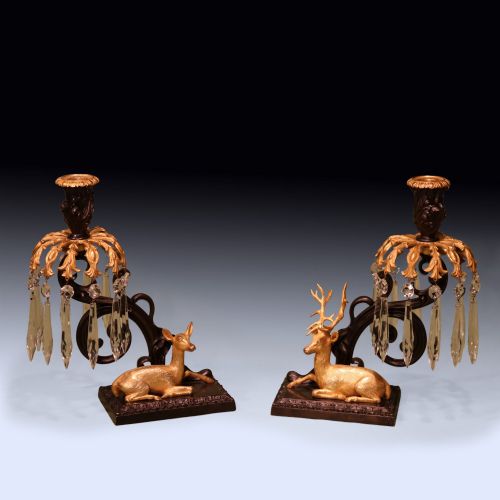
Metal components also feature in the construction, incorporating bronze, ormolu, and gold leaf gilt details to form the structural bases and branch supports. Enamel decoration often sits upon the glass bodies, adding painted floral or geometric motifs above the cut facets.
Prisms are hand-cut with flat facets to maximise light refraction and suspended from the sconces using delicate wire loops or metal pins. The combination of heavy moulded glass bases, metal mounts, and hanging crystal drops required precise balance so the fittings remained stable on a mantel.
Listings feature items from the Regency and Victorian eras, alongside pieces dated to nineteen hundred and nineteen thirty.
What varies in quality
Quality rests on the depth and clarity of the glass-cutting, with sharp, clean facets reflecting light far more crisply than soft or rounded edges. The richness of coloured glass bodies, such as deep ruby or layered overlay, dictates the visual weight and desirability of a pair.
The sophistication of the metalwork mounts, particularly where bronze and ormolu are employed, separates standard production items from finer decorative pieces. Complete sets of matching original hanging prisms with uniform cut patterns elevate an assemblage significantly compared to mismatched or replacement drops.
The Mantelpiece Glass Lustres Glossary
- Lustre
- An ornamental candlestick or candelabrum hung with cut glass pendants designed to refract light.
- Prism
- A cut glass drop suspended from the rim or sconce of a lustre to scatter light.
- Overlay glass
- Glass formed of two or more distinct layers of different colours, where sections of the outer layer are cut away to expose the colour beneath.
- Opaline glass
- An opaque or semi-translucent glass, frequently white or pale pastel in tone, popular in nineteenth-century decorative objects.
- Ormolu
- Finely ground high-carat gold applied to a bronze base, creating a rich metallic finish often seen on nineteenth-century mounts.
Mantelpiece Glass Lustres: Frequently Asked Questions
What is a mantelpiece glass lustre?
A mantelpiece glass lustre is a decorative candle-holder fitted with hanging glass prisms designed to stand on a mantel shelf.
These pieces combine functional lighting with ornamental glass and metalwork, utilising cut crystal drops to catch and multiply candlelight.
How do you use glass lustres?
Glass lustres sit upon mantelpieces, sideboards, or tables as decorative centrepieces, originally serving to illuminate rooms before electric lighting.
While they can hold burning candles, many modern owners display them unlit to let daylight or interior lamps activate the hanging crystal prisms.
Are glass lustres always found in pairs?
Most surviving lustres appear as matched pairs intended to sit symmetrically on either side of a fireplace clock or mirror.
Single examples do occur, but balanced pairs remain the standard format for mantelpiece decoration across the nineteenth-century styles represented here.
How do you clean glass lustres?
Cleaning requires gentle washing of the glass body and individual hanging drops in warm soapy water, avoiding harsh abrasives that might damage enamel or gilt.
Prisms are usually detachable, allowing each drop to be washed and dried separately before being re-hung on its wire loops.
What periods do these pieces come from?
The pieces span the nineteenth century, including Regency and Victorian eras, alongside later pieces from around nineteen hundred and nineteen thirty.
Victorian examples form the largest group, showcasing styles from ruby glass bodies to gilt bronze and ormolu mounts.