


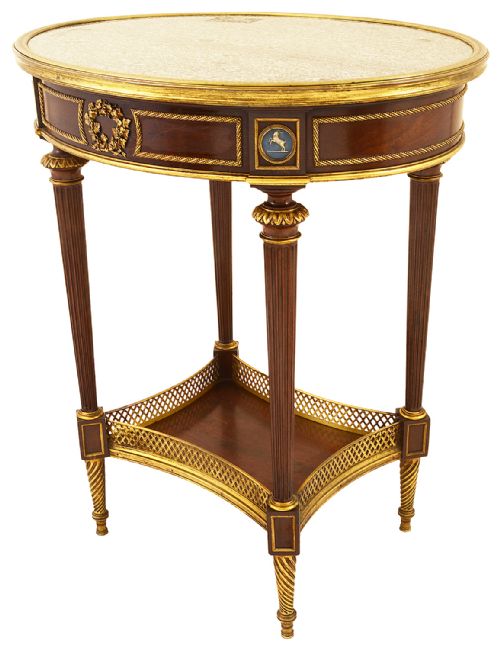


Mahogany Tiered Gueridon
A mahogany tiered gueridon brings French elegance and practical circular surface space into a room.
Mahogany Tiered Gueridon
When you search for a mahogany tiered gueridon, you are looking at small circular or multi-level occasional tables defined by warm timber tones. The versions you are most likely to meet on this page date from the nineteenth century and adopt French Louis styles or Regency revivals.
These pieces function primarily as plant stands, lamp tables, or wine centres rather than heavy dining furniture. Their forms range from simple occasional tables to folding dumbwaiters and tiered buffets.
Makers often drew inspiration from French design, incorporating marble tops, brass galleries, and gilt bronze mounts onto mahogany frames. The resulting tables sit comfortably beside seating in a drawing room or study.
Materials and construction
Makers built the primary structures using solid mahogany or applied exotic wood veneers and parquetry over a secondary timber. Tops frequently featured inset marble slabs secured by cast brass or ormolu galleries.
Metal mounts in gilt brass and bronze added decorative enrichment around the aprons and legs. Glass elements and brass hardware completed the construction of these multi-tiered occasional stands.
Object types seen include occasional tables, side tables, console tables, plant stands, and tiered buffets in French and English revival styles.
Judging quality in tiered tables
Quality rests in the crispness of the bronze or brass mounts and the selection of the mahogany grain. Hand-chased ormolu details and fine parquetry veneer separate standard workshop pieces from master productions.
The weight and thickness of the inset marble top, alongside the rigidity of the multi-tiered frame, indicate superior craftsmanship. Joinery that remains tight across multiple levels shows proper initial construction.
Henry Dasson
The Mahogany Tiered Gueridon Glossary
- Gueridon
- A small French occasional table, typically round and supported by a central pillar or multiple legs. These tables gained popularity in the seventeenth century and evolved through various revival periods.
- Ormolu
- Gilt bronze applied to furniture mounts and decorative hardware. The technique involves creating an amalgam of gold and mercury applied to bronze.
- Parquetry
- Geometric wood veneer patterns arranged in mosaic-like designs across a tabletop or surface. Craftsmen used contrasting exotic wood veneers to achieve this effect.
- Dumbwaiter
- A tiered serving stand with rotating or fixed circular shelves designed to hold dishes or wine. Eighteenth-century examples often featured folding mechanisms.
- Gallery
- A small raised metal or wooden rim fitted around the edge of a table top. This feature prevented items from sliding off marble surfaces.
Mahogany Tiered Gueridon: Frequently Asked Questions
What is a mahogany tiered gueridon used for?
These tables serve as decorative plant stands, lamp tables, or small side surfaces for drinks and books.
Their compact multi-tiered design allows them to fit beside armchairs or in corners without dominating a room.
How do I identify French revival styles?
Look for characteristic bronze mounts, marble tops with brass galleries, and kidney-shaped or circular tiers.
Nineteenth-century makers frequently borrowed motifs from Louis XV and Louis XVI designs.
Where should I place a gueridon?
A gueridon works well beside a sofa or in a hallway as an accent piece for holding small objects.
Ensure the marble or timber top remains clear of direct heat sources to protect the finish.
How do I care for mahogany and ormolu?
Dust the mahogany surfaces regularly with a soft cloth and avoid using silicone polishes.
Clean ormolu mounts gently without harsh chemical abrasives that might strip the original gilding.