


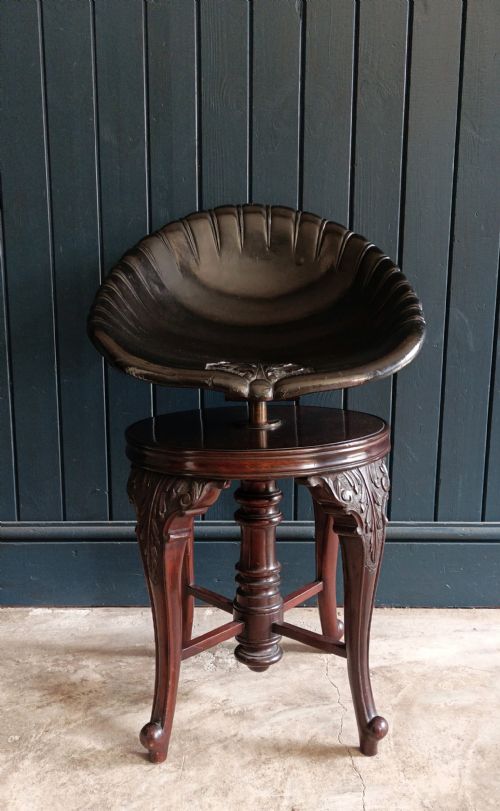

Mahogany Swivel Stool
A mahogany swivel stool is a practical music or dressing seat designed to turn and adjust in height, offering both stability and ease of movement at the piano or vanity.
Mahogany Swivel Stool
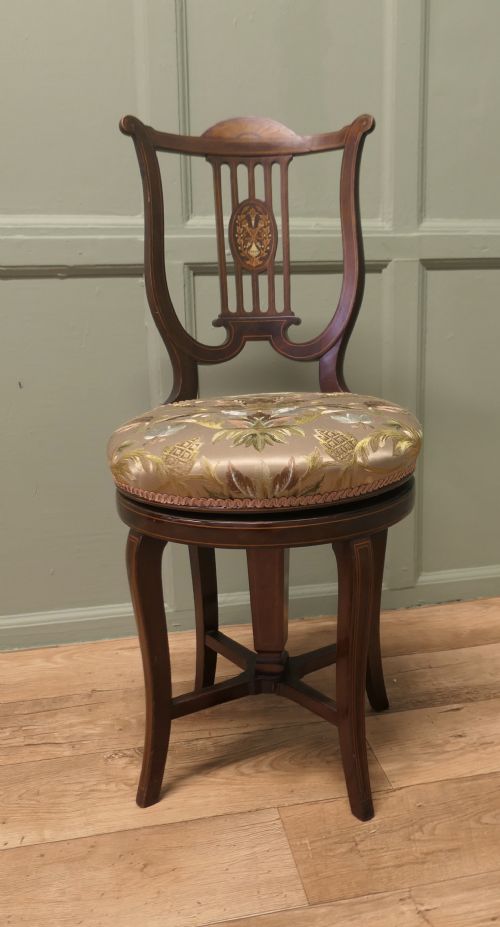
When searching for a mahogany swivel stool, buyers encounter a variety of nineteenth-century forms primarily designed for musicians and dressing rooms. These pieces appear as piano stools, music chairs, and dressing chairs originating from the Regency, William IV, and Victorian periods.
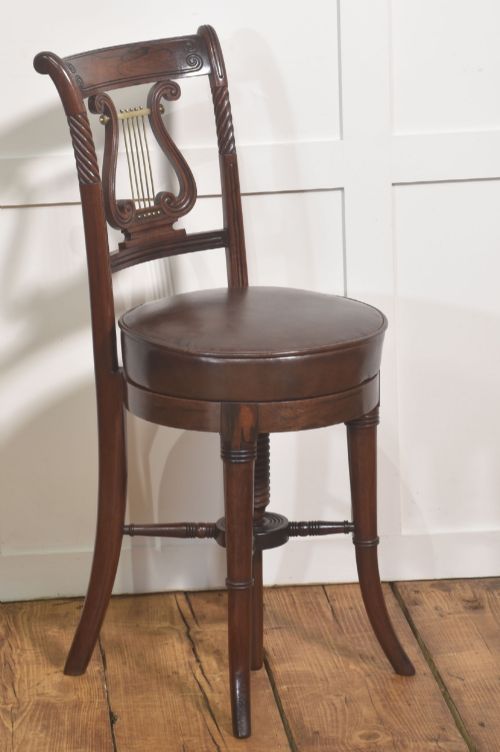
The most common examples on this page are revolving piano stools with adjustable mechanisms, often accompanied by lyre back designs or square upholstered tops. Surviving pieces trace their origins through the Georgian, Victorian, and Edwardian eras.
Makers and workshops of the nineteenth century produced these rotating seats to serve functional roles in the parlour and drawing room. Their primary purpose was to allow the player to turn comfortably while seated at an instrument.
What varies in quality
The sophistication of the turning and the crispness of the carved details separate standard examples from finer works. Master cabinet makers applied precise brass inlay and superior joinery that endure through centuries of turning.
The smoothness of the internal rotating mechanism and the integrity of the original upholstery materials dictate the standing of an individual piece. Maker attribution also elevates certain items above unbranded workshop production.
Cellists and harpists required specially designed revolving chairs so they could pivot gracefully during performance without tangling their instruments.
Jennens and Bettridge·Gillows·James Shoolbred·H Brooks and Co·Howe
The Mahogany Swivel Stool Glossary
- Swivel top
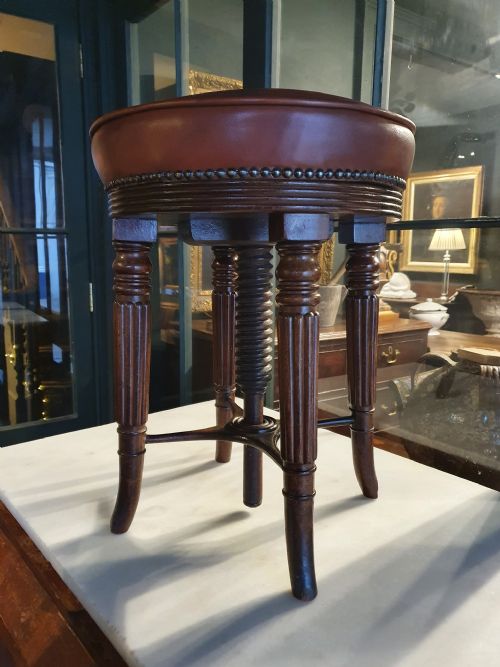
- A rotating seat platform that allows the user to turn freely in either direction. This mechanism relies on a central pivot screw or pin concealed beneath the upholstery.
- Rise and fall
- An adjustable height mechanism operated by rotating the seat top to raise or lower the platform. It permits the player to find a comfortable playing position.
- Lyre back
- A chair back shaped in the symmetrical outline of a classical musical instrument. This motif is frequently found on nineteenth-century music chairs.
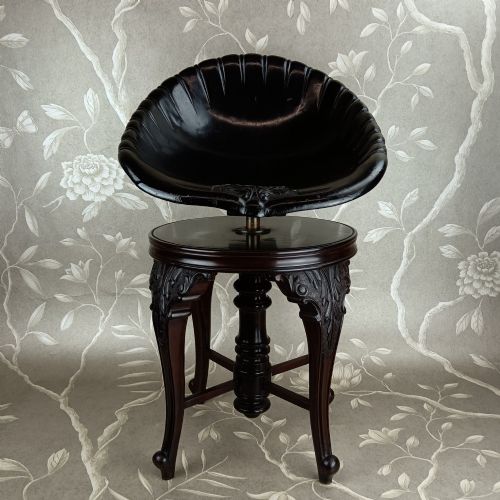
- Grotto revival
- A nineteenth-century decorative style incorporating naturalistic shell and rockwork motifs. Stools in this style feature elaborate carved decoration.
- Brass inlay
- Ornamental metalwork embedded flush into the timber surface to create linear patterns. Regency examples make frequent use of this decorative technique.
Mahogany Swivel Stool: Frequently Asked Questions
How do I adjust the height?
You raise or lower the seat by turning the top clockwise or anti-clockwise on its central wooden or metal screw thread.
This simple rise and fall action allows musicians to alter their seating position without tools.
Can I use it at a desk?
Many nineteenth-century music chairs and dressing stools serve effectively as small desk or vanity seats today.
Their compact footprints and turning action make them well suited to modern writing tables.
How do I date a Victorian piece?
Dating relies on observing the timber grain, the style of the turned legs, and the construction of the revolving mechanism.
Victorian pieces often display heavier proportions and machine-assisted turning compared to earlier Regency examples.
Are the upholstery fabrics original?
Most surviving stools have been recovered over their long lifespan to suit changing domestic interiors.
Finding completely original velvet, leather, or textile upholstery is uncommon, though older fabric layers sometimes remain beneath modern coverings.