




Mahogany Slope Front Box
A mahogany slope front box gives you a Georgian or Victorian desk or dining table storage piece designed to keep correspondence or cutlery orderly.
Mahogany Slope Front Box
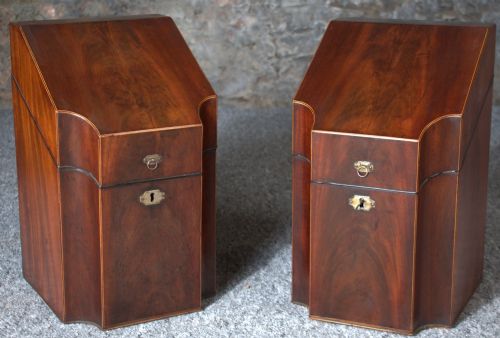
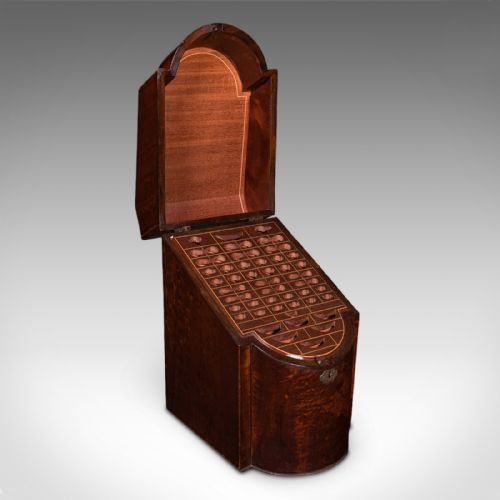
When you search for a mahogany slope front box, you are looking at practical containers built to sit on a desk, sideboard, or table. The pieces found here span the eighteenth century, the Georgian period, and the Victorian era, stretching up to nineteen hundred. Most examples take the form of knife boxes, cutlery boxes, stationery boxes, or letter holders, designed with angled lids that lift to reveal fitted compartments.
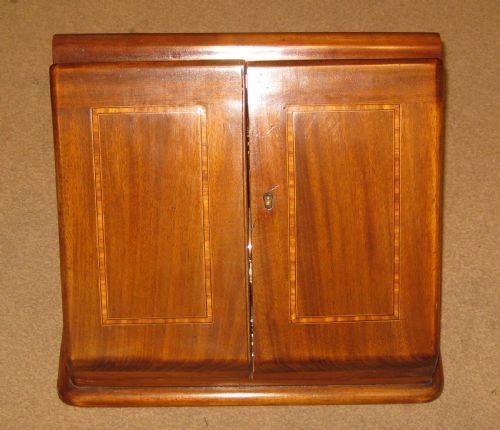
The versions you are most likely to meet on this page include George III knife boxes and Victorian stationery cabinets. These items often feature serpentine or straight fronts fashioned from rich timber. While some serve purely for paper storage, others are adapted for modern kitchen organisation or general storage while retaining their traditional profile.
How they were made
Cabinet makers constructed these boxes primarily using solid or veneered mahogany, often selecting figured boards for the main visible surfaces. Artisans incorporated secondary woods and applied decorative stringing or banding using lighter materials such as satinwood and boxwood to frame the lid and front panels.
Metalwork formed an integral part of the construction, with brass hinges, escutcheons, carrying handles, and occasionally gilt covered and painted elements fitted securely to the wood. Interior partitions were carefully jointed to create specific slots for letters, documents, or cutlery items.
Materials recorded across the inventory include mahogany, brass, satinwood inlay, boxwood, bone, and painted finishes.
What varies in quality
The grade of timber selected for the exterior surfaces dictates much of the visual appeal, with highly figured mahogany and crisp, symmetrical inlay separating finer pieces from plainer examples. Cabinet-making standards show in the tightness of the corner joints, the smoothness of the slope front action, and the retention of original brass fittings rather than later replacements.
Proportion and decorative detailing also define the upper tier of these pieces. Serpentine shaped fronts require greater skill from the maker than flat panels, while internal fittings that remain complete and unaltered add significantly to the integrity of the box.
The Mahogany Slope Front Box Glossary
- Serpentine front
- A furniture front curved with a convex centre flanked by concave sides. This shape requires advanced woodworking skill and appears frequently on finer Georgian knife boxes.
- Stringing
- Thin lines of contrasting wood inlay used to outline panels and edges. Satinwood and boxwood are commonly utilised for this decorative border work.
- Escutcheon
- A protective plate surrounding a keyhole, usually made of brass on these boxes. It prevents the wood from splitting around the lock.
- Purdonium
- A specific type of Victorian coal box with a sloping front and a hinged door or drop-down compartment. They often include a metal liner and a matching shovel.
- Figured mahogany
- Timber showing distinctive grain patterns such as flame, fiddleback, or curl. Cabinet makers reserved these boards for the most prominent exterior surfaces.
Mahogany Slope Front Box: Frequently Asked Questions
What were mahogany slope front boxes used for originally?
These boxes served primarily to store dining cutlery or important papers and letters. Knife boxes kept sharp steel blades protected and tidy in the dining room.
Stationery cabinets and letter holders provided a dedicated desktop space for correspondence and writing materials. The sloping lid kept contents private and dust-free.
How do I tell an 18th-century box from a Victorian one?
Eighteenth-century and Georgian pieces often rely on proportion, subtle string inlay, and classic serpentine shapes associated with George III furniture. They tend to have a lighter, more refined architectural presence.
Victorian examples frequently introduce bolder decorative elements, such as gilt covering, painted details, or heavier brass hardware. Their internal partitions also reflect changing nineteenth-century stationery needs.
Can I use a antique knife box for modern stationery?
Yes, many of these pieces function well on modern desks for holding envelopes, notepads, and pens. The internal dividers originally built for cutlery or letters suit modern desk organisation.
Care should be taken to place them where moisture and direct sunlight will not damage the antique wood polish. Using them practically allows you to enjoy eighteenth and nineteenth-century craftsmanship daily.
What is the difference between a knife box and a stationery cabinet?
Knife boxes typically feature a steep, sloping lid hinged at the back or side, designed to sit on a sideboard and hold upright cutlery. Their internal blocks are often slotted for knife blades.
Stationery cabinets generally open to reveal pigeonholes, small drawers, and vertical slots sized specifically for writing paper and envelopes. Some Victorian versions use a roll-top or fall-front mechanism instead of a simple slope.