


Mahogany Reclining Armchair
A mahogany reclining armchair offers mechanical comfort disguised as library dignity, moving smoothly from upright reading to a laid-back rest.
Mahogany Reclining Armchair
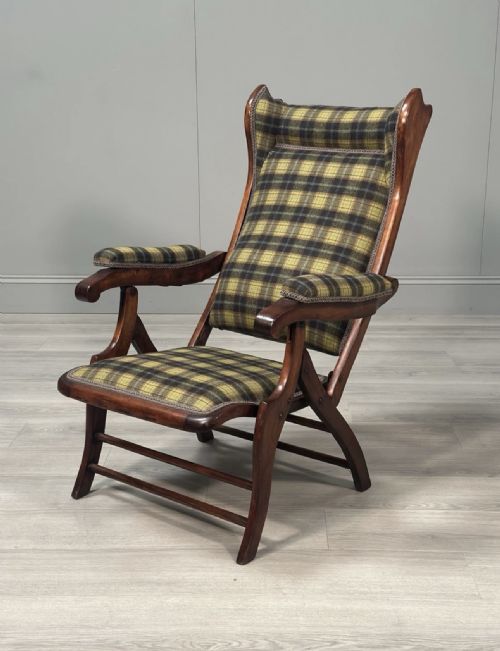
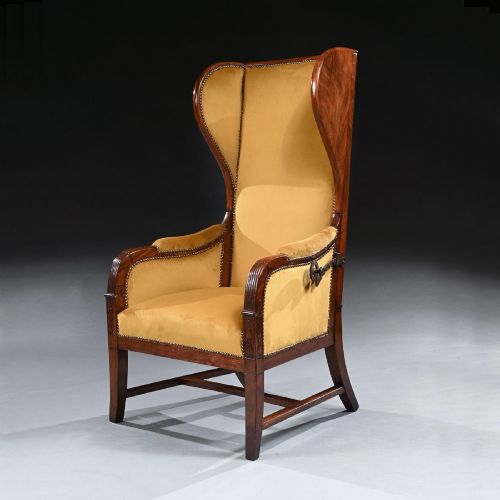
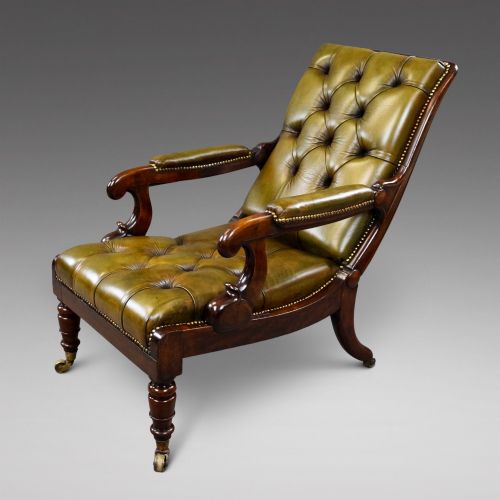
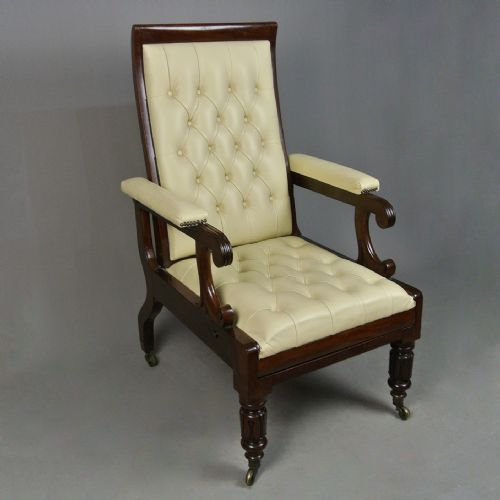
A mahogany reclining armchair is a sturdy timber seat built with adjustable mechanisms to alter the angle of the backrest or seat for reading, resting, or convalescing. These chairs appear most frequently in Regency, William IV, and Victorian incarnations, often taking the form of heavy library armchairs or portable campaign seating.
Makers from the nineteenth century such as Daws, Minter, Foot and Son, and John Ward patented ingenious rack-and-pinion or screw mechanisms to manage the movement. Survivors span heavy mahogany frames upholstered in buttoned leather, velvet, or hessian, sometimes accompanied by matching footstools or extending leg rests.
The style ranges from formal French Empire and British Colonial plantation chairs to folding campaign models designed for travel. Buyers encounter chairs intended for gentleman's studies, invalid care, and relaxed domestic reading rooms across the nineteenth and early twentieth centuries.
How they were made
Cabinet makers built the primary frames from solid mahogany and hardwood, jointed rigidly to withstand the mechanical strain of shifting weight and adjustable pivots. Brass fittings, castors, and iron ratchets concealed inside the arms or under the seat govern the reclining action without disrupting the timber silhouette.
Upholstery relies on traditional stuffing layers held by hessian webbing, finished with stitched leather, velvet, or fabric secured by brass tacks or deep buttoning. Complex metamorphic designs incorporate sliding footrests, reading desks, or folding X-frames that rely on precise carpentry to operate smoothly.
Several armchairs doubled as convalescing invalid chairs, allowing Victorian patients to recline in the library while pretending they were merely reading deeply.
What varies in quality
The sophistication of the mechanical patent marks the primary division in quality, distinguishing standard mass-produced seating from signed examples by innovators like Robert Daws or John Ward. Smooth operation of the ratchets, original brass hardware, and unaltered timber frames elevate certain pieces significantly above simpler workshop variations.
The integrity of the mahogany frame and the grade of the secondary hardwoods dictate long-term durability, alongside the retention of original leather or period upholstery materials. Pieces retaining their matching footstools, reading attachments, or legible maker stamps hold greater historical completeness.
Robert Daws·J Foot and Son·John Ward·Morris and Co
The Mahogany Reclining Armchair Glossary
- Mahogany
- A durable tropical hardwood prized for deep reddish-brown tones and dense grain, used extensively for nineteenth-century frame construction. It takes a fine polish and provides the structural strength needed for heavy mechanical seating.
- Metamorphic
- Describing furniture that transforms from one form into another, such as an armchair converting into a chaise longue or incorporating a reading slope. These pieces use hidden hinges and pull-out sections to alter their function.
- Ratchet mechanism
- A notched metal rack and pawl system concealed within the chair arms that locks the backrest at various reclining angles. It allows the user to shift positions securely.
- Campaign chair
- Portable folding furniture constructed for military officers or travellers, often fitted with brass corners and X-frames for easy dismantling. Mahogany examples combined field durability with domestic comfort.
- Buttoned leather
- An upholstery technique where leather is pulled tight over deep stuffing and secured with tufted buttons in a diamond pattern. This method keeps the internal padding evenly distributed during reclining.
Mahogany Reclining Armchair: Frequently Asked Questions
How do you operate the reclining mechanism?
Most period chairs use a side lever, a push-button ratchet, or manual pressure against an internal rack to release and lock the backrest. Users lean back to the desired angle and secure the catch into place.
Heavier library models from the Regency and Victorian eras rely on brass levers or screw mechanisms hidden beneath the arms to control the movement safely.
Are these chairs comfortable for daily use?
Deep padding, sprung seats, and adjustable angles make these chairs well-suited for reading and relaxing. The ergonomic support adapts easily to modern lounging habits.
Original horsehair stuffing and buttoned leather provide firm support rather than the soft sink of modern foam, offering a stable seating posture.
How do I identify a patent armchair?
Makers often stamped their names and patent numbers onto the brass adjustment fittings, hinges, or wooden underframes. Names like Daws, Minter, or Foot and Son usually appear on metal plates.
The presence of complex mechanical joints rather than simple wooden pivots points directly to patented nineteenth-century designs.
Did these chairs always include footstools?
Matching footstools accompanied specific metamorphic reading chairs and invalid loungers to extend the leg rest fully. Many survived as standalone items or were lost over time.
Chairs designed as chaise longues or steamer variants incorporated pull-out foot sections directly into the timber frame instead of separate stools.