

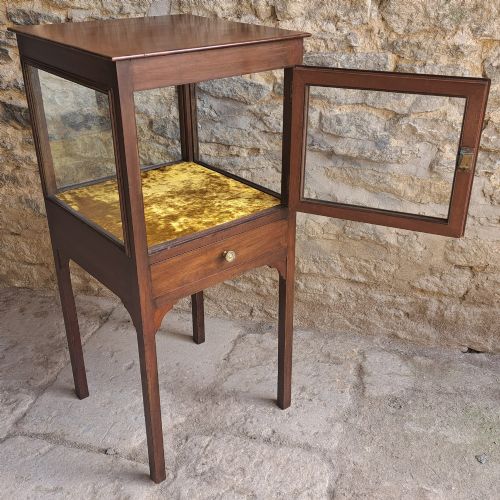


Mahogany Museum Case
These mahogany museum case examples are robust display vessels built from rich timber and clear glass to preserve precious objects.
Mahogany Museum Case
A mahogany museum case serves collectors and institutions as a secure enclosure for specimens, artefacts, and retail stock. The pieces gathered under this heading span large freestanding cabinets, low table top vessels, and pairs of display counters.
The specimens most frequently encountered here date from the eighteenth century through to the Edwardian era and the nineteen-twenties. Early Georgian examples sit alongside Victorian shop showcases and commercial haberdashery fittings.
Makers such as F. Sage and Co. and E. Pollard and Co. produced robust retail furniture alongside domestic vitrines and Adam style display counters. Buyers find both monumental twin pedestal cabinets and compact table top vessels designed for intimate viewings.
Materials and construction
Carpenters utilised dense mahogany for the structural frames, doors, and bases, ensuring a dark, stable timber foundation that resists warping. Glazing panels fitted into the timber framework provide all-round visibility while protecting contents from dust and handling.
Metal components in brass and ormolu form hinges, locks, and decorative mounts that accent the polished wood surfaces. Interior surfaces frequently incorporate linings of fabric, velvet, or felt to cushion delicate items and enhance the visual presentation.
Mahogany Museum Case Retail Price Guide 2026
Typical asking prices for mahogany museum case among the pieces listed under this phrase on Sellingantiques today, from the lower quarter to the upper quarter. They describe what is for sale here now, not the wider market.
Listings feature mahogany, glass, brass, fabric, velvet, felt, ormolu, and metal across Victorian, Georgian, and Edwardian periods.
Judging quality and craft
Excellence in these pieces lies in the proportion of the timber frame and the clarity of the large glass panes. Superior examples display refined joinery details such as slender glazing bars and balanced door construction.
The incorporation of maker plaques from firms like F. Sage and Co. or E. Pollard and Co. elevates a piece through documented provenance. Distinctive decorative flourishes, including Adam style carving or Louis XVI revival motifs, separate standard utility vitrines from high-status commissions.
F. Sage and Co.·E. Pollard and Co. Ltd.
The Mahogany Museum Case Glossary
- Vitrine
- A glass display cabinet designed primarily for the exhibition of porcelain, curiosities, or fine artefacts. These pieces often feature glazed sides and doors to maximise light penetration.
- Shop showcase
- A commercial display fixture constructed for retail environments to present merchandise securely. They range from counter-top units to large triple-bay cabinets.
- Adam style
- A neoclassical design vocabulary characterised by symmetrical geometry, delicate proportions, and classical ornamentation. Pieces in this style reflect eighteenth-century architectural principles.
- Pedestal cabinet
- A freestanding piece of furniture raised on one or more substantial columnar supports or bases. Twin pedestal variations distribute weight across dual structural columns.
- Ormolu
- Gilt bronze ornamentation applied to furniture and decorative objects for enrichment. The technique involves fusing gold onto a bronze base.
Mahogany Museum Case: Frequently Asked Questions
What fits inside a mahogany museum case?
These enclosures accommodate diverse collections, from natural history specimens and taxidermy birds to textiles and retail goods. Interior shelves and fabric linings support delicate objects safely.
Larger freestanding cabinets and twin pedestal forms suit substantial artefacts, while table top vessels hold smaller curiosities and flat items.
How do I date a mahogany display cabinet?
Dating relies upon structural characteristics, timber grain, and stylistic indicators such as Adam style carving or Louis XVI revival motifs. Eighteenth-century pieces exhibit different joinery standards compared to nineteen-twenties commercial fittings.
Maker stamps or metal plaques from firms like F. Sage and Co. provide specific production eras for later commercial showcases.
Where were shop display cases used?
Commercial showcases originated in retail establishments, haberdasheries, and early museums for secure customer viewing. Retailers utilised counter-top boxes and large triple shop display cabinets to protect valuable stock.
Domestic settings also received similar glazed vitrines for private collections and personal treasuries.
How do I maintain the glass and wood?
Maintenance involves dusting the mahogany surfaces gently and using appropriate glass cleaners on the panels without touching interior fabric linings. Keeping timber away from direct heat sources prevents the wood from drying out.
Brass hardware and ormolu mounts benefit from careful cleaning with soft cloths to preserve the metallic finish.