
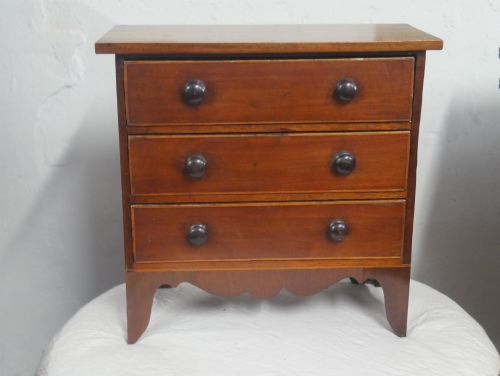
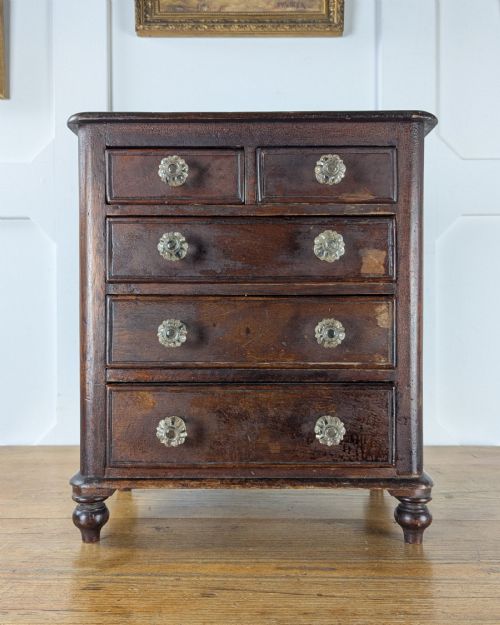
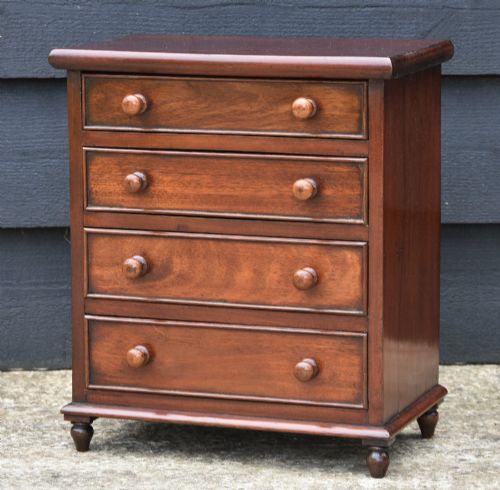
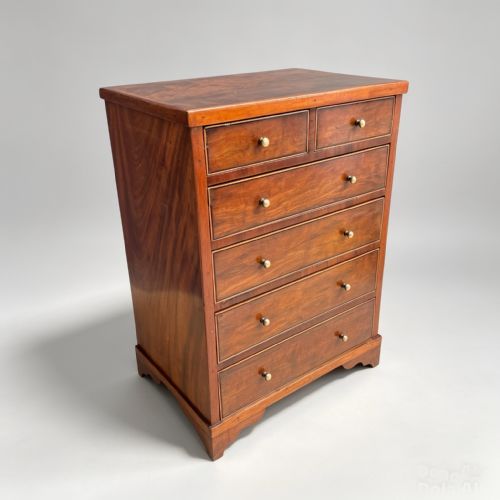
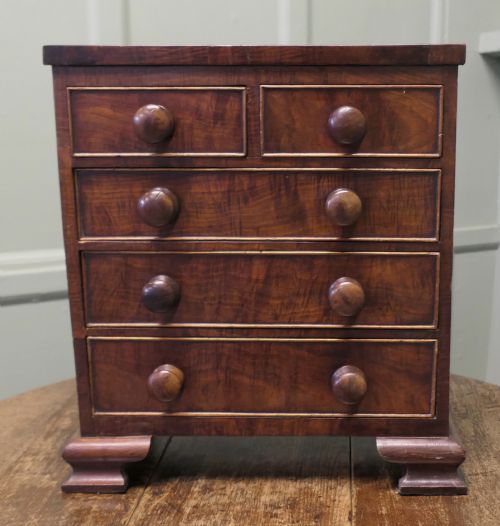
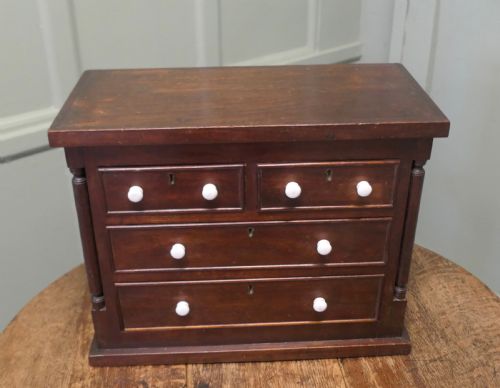
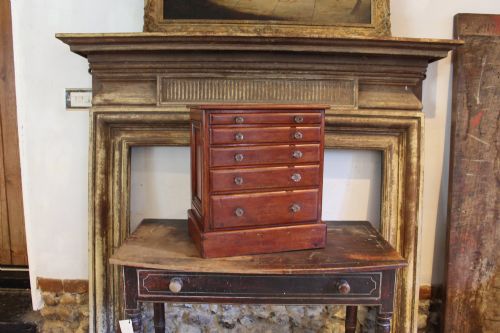


Mahogany Miniature Cupboard
These mahogany miniature cupboards and chests are small-scale demonstrations of master cabinet-making that bring precision woodworking into any room.
Mahogany Miniature Cupboard
The pieces appearing on this page span the Georgian, Victorian, and Edwardian periods, with nineteenth-century examples forming the majority of the selection. These take the shape of Scottish scotch chests, bow-fronted drawers, and tabletop cabinets built with the proportions of full-sized furniture.
Makers designed these miniature items using dense hardwoods and secondary timbers like pine, occasionally adding boxwood stringing or bone escutcheons. Originating across Britain, Scotland, and Anglo-Indian workshops, they reflect the prevailing stylistic shifts of their respective eras.
How they were made
Cabinet-makers constructed these miniature pieces using solid mahogany alongside secondary woods such as pine for internal framing and drawer linings. Craftsmen utilised traditional joinery methods, incorporating dovetailed drawer construction and turned wooden feet to support the miniature carcase.
Surface ornamentation involved decorative elements like wood inlay, mother of pearl accents, and boxwood stringing set into the primary mahogany grain. Hardware typically included miniature brass pull handles and tiny escutcheons secured around working keyholes.
Some miniature drawers are so small they could barely hold a button, yet their dovetails are cut as sharply as any wardrobe.
What varies in quality
Quality rests upon the fidelity of the scaling and the precision of the miniature joinery rather than the sheer age of the piece. Fine examples maintain correct architectural proportions and feature tight, hand-cut dovetails that mirror full-scale furniture standards.
The choice of materials and the restraint shown in decoration also distinguish the work, as superior pieces rely on well-figured mahogany grain rather than excessive inlay. Original brass hardware, intact turned feet, and clean internal drawer construction elevate the standing of a miniature cabinet.
The Mahogany Miniature Cupboard Glossary
- Apprentice piece
- A small-scale item created by a trainee woodworker to demonstrate mastery of joinery techniques before admission to a trade guild.
- Specimen cabinet
- A specialised tabletop case containing multiple shallow drawers intended for housing natural history collections or small artefacts.
- Scotch chest
- A regional furniture form featuring a deep upper frieze drawer above a central configuration flanked by smaller side drawers.
- Stringing
- A narrow strip of contrasting wood, such as boxwood, inlaid into the primary timber surface to create decorative geometric borders.
- Escutcheon
- A small protective plate fitted around a keyhole, frequently cast from brass or carved from bone in miniature pieces.
Mahogany Miniature Cupboard: Frequently Asked Questions
What were mahogany miniature cupboards used for?
These small cabinets served multiple purposes in historic households, functioning as salesmen's samples, apprentice qualification pieces, or refined storage for jewellery and small specimens.
Owners placed them upon larger tables or chests to keep precious trinkets secure within private rooms.
How do I date a miniature chest?
Dating relies on examining the secondary timbers, construction methods, and stylistic cues borrowed from full-sized furniture periods like the Georgian or Victorian eras.
Hand-cut dovetails, distinct mahogany grain patterns, and period-specific brass hardware provide the clearest chronological indicators.
Where should I place one at home?
Their compact scale makes these cabinets suitable for tabletops, sideboards, or dedicated display shelves where visitors can inspect the fine woodworking close up.
Keep them away from direct sunlight and strong heat sources to protect the polished mahogany finish and prevent timber shrinkage.
What is the difference between an apprentice piece and a collector cabinet?
Apprentice pieces were typically standalone tests of joinery skills created by trainees, often mimicking standard domestic chest designs on a reduced scale.
Collector cabinets were purpose-built storage units featuring multiple specialised drawers designed specifically to organise natural specimens or small valuables.