


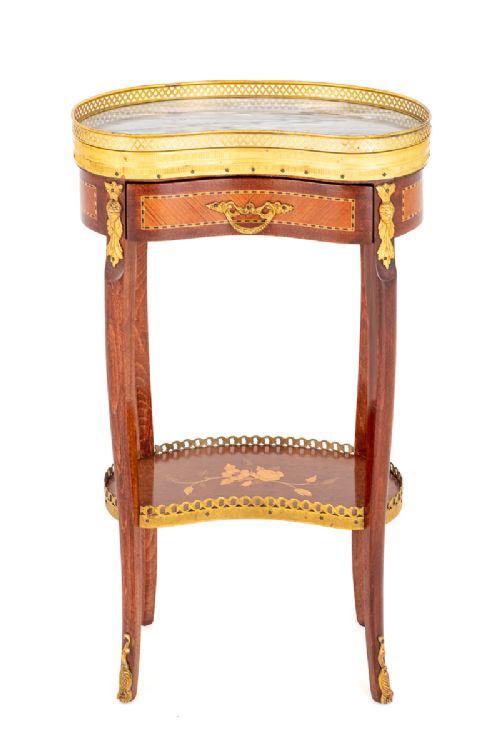


Mahogany Kidney Side Table
A mahogany kidney side table offers a sweeping curve that fits neatly against a chair or beside a bed.
Mahogany Kidney Side Table
A mahogany kidney side table takes its name from the distinctive concave curve of its front edge, designed to hug the torso of someone sitting at it. You will find these pieces largely originating from the Victorian and Edwardian eras, alongside Sheraton Revival and French revival interpretations.
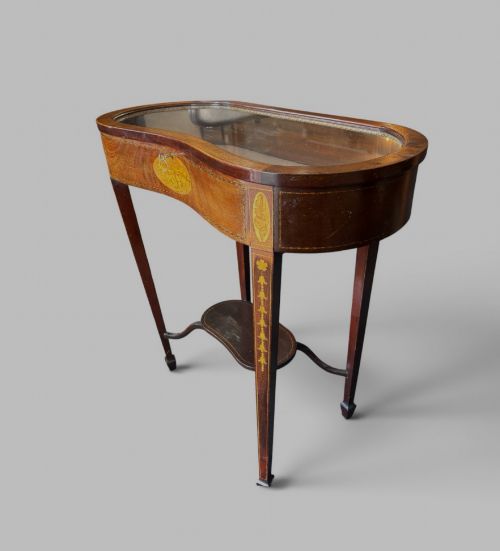
The form appears as occasional tables, writing desks, bedside tables, and display pieces. Most examples on offer date from the late nineteenth century through to the Edwardian period, often standing on slender legs connected by stretchers.
Makers utilised the curved top for utility in smaller drawing rooms or bedrooms where rectangular furniture would block a pathway. The surface gives you a compact writing or lamp station without dominating the floor space.
How they were made
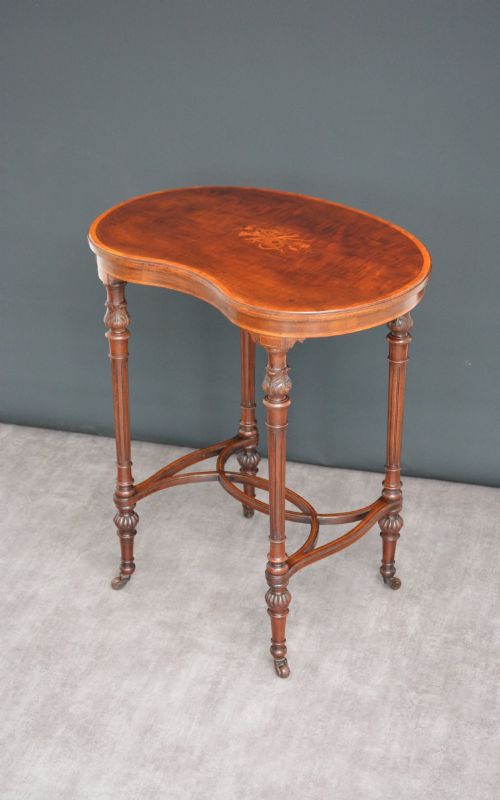
Cabinetmakers built the curved tops using solid mahogany or laid rich mahogany veneers over a stable secondary timber core. Marquetry and inlay using satinwood, boxwood, and darker woods traced the sweeping contours of the kidney shape.
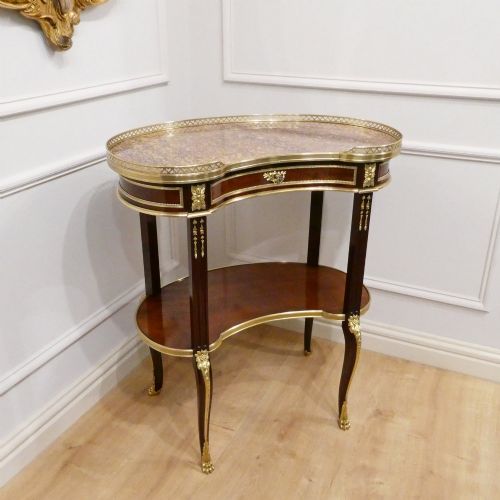
Many examples incorporate cast brass mounts, ormolu trims, and pierced brass galleries around the upper edge. French pieces often employed gilt bronze details and finer marquetry panels set into the polished mahogany ground.
Listings feature mahogany, satinwood, marble, ormolu, and glass across Victorian and Edwardian periods.
What varies in quality
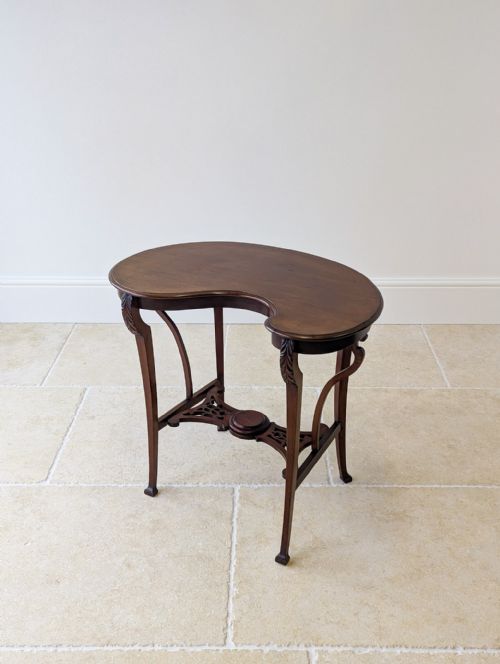
The fineness of the marquetry inlay dictates the upper tier of these pieces, where botanical and ribbon motifs show crisp cutting and shading in the woods. Simpler tables rely solely on the grain of the polished mahogany and clean lines rather than elaborate floral banding.
Underframing marks the distinction between standard production and exhibition work, seen in the proportion of the tapered legs and the neatness of the joinery. Heavier brass galleries and cast mounts likewise indicate a more ambitious workshop origin.
Maison Millet·Edwards And Roberts
The Mahogany Kidney Side Table Glossary
- Marquetry
- Decorative woodwork where pieces of contrasting veneer are assembled to form picture patterns. Craftsmen fitted satinwood and boxwood into the mahogany ground.
- Ormolu
- Gilt bronze ornamentation applied to furniture mounts and galleries. This technique appears frequently on French revival pieces.
- Sheraton Revival
- A late nineteenth-century design movement copying the light neoclassical styles of the eighteenth century. These pieces often feature delicate satinwood inlay on mahogany.
- Gallery
- A raised miniature railing around the edge of a table top to prevent items from sliding off. They are commonly cast in brass.
Mahogany Kidney Side Table: Frequently Asked Questions
Are mahogany kidney side tables sturdy?
The slender legs and curved rails are surprisingly stable when the frame joints remain tight and well-glued.
Most pieces were designed for holding lamps, books, or writing materials rather than heavy loads.
How do I distinguish Edwardian from Victorian tables?
Victorian examples often display heavier timbers and darker reddish polish with robust marquetry.
Edwardian pieces tend towards lighter satinwood contrasts and slenderer Sheraton Revival framing.
Can I use a kidney table for writing?
Many examples function perfectly as compact writing desks, particularly those with fitted drawers beneath the curved top.
The concave front lets you sit closer to the writing surface than a standard rectangular table allows.
How do I care for the mahogany surface?
Regular dusting with a soft, dry cloth preserves the polished finish without building up heavy wax layers.
Keep the timber away from direct sunlight and heat sources to prevent the mahogany veneer from drying out.