

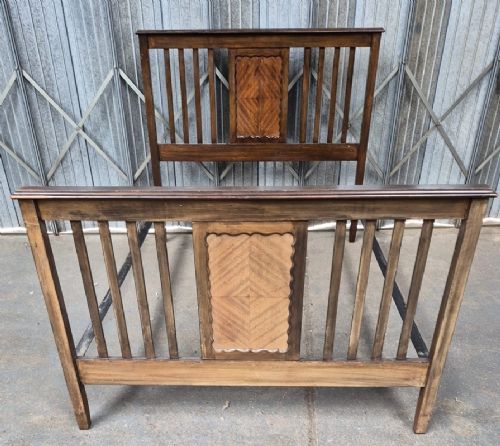
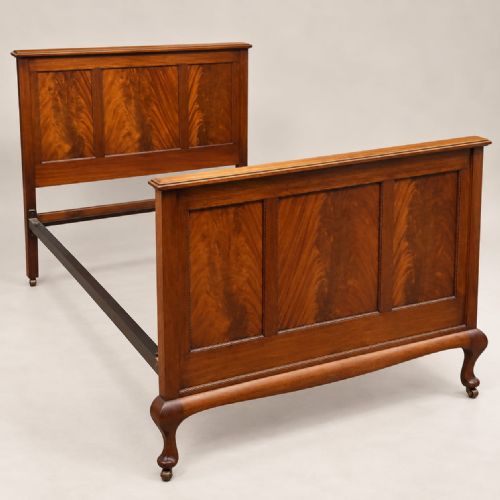
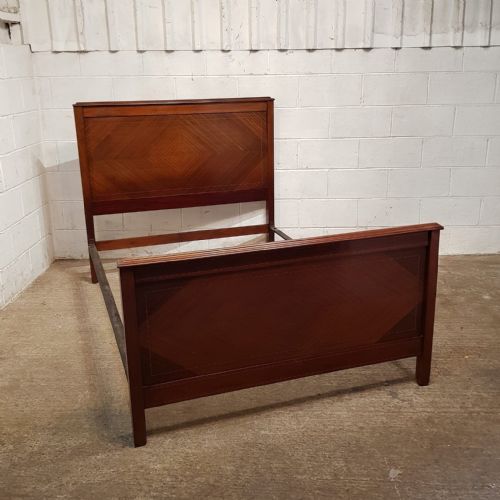


Mahogany Headboard and Footboard
A mahogany headboard and footboard brings substantial warmth and architectural presence to a bedroom, combining rich timbers with period craftsmanship.
Mahogany Headboard and Footboard
A search for a mahogany headboard and footboard leads directly to substantial bedsteads and bed frames spanning the nineteenth and early twentieth centuries. These large bedroom furnishings appear in Edwardian, Victorian, and nineteenth-century iterations, often taking the form of complete double or king size beds.
The pieces on this page reflect diverse stylistic influences, ranging from straightforward Edwardian slatted bedsteads to elaborate French Louis XVI style and Empire designs. Alongside standard mahogany, buyers encounter related forms incorporating burr and fruitwood timbers.
Makers of these beds focused heavily on prominent headboards and footboards to anchor the bedroom scheme. The forms draw on specific historical revivals, showing French chateau influences alongside simpler domestic British designs.
Materials and Construction
Construction relies upon solid mahogany and timber frames, frequently enhanced with contrasting fruitwood, boxwood inlay, and marquetry detailing. These decorative elements provide visual texture across the large expanses of wood on the headboard and footboard.
Metal components play a structural and decorative role, with brass detail and ormolu mounts appearing alongside timber elements. Artisans also utilised iron within the core bed frames to ensure structural stability for larger double and king size proportions.
Mahogany Headboard and Footboard Retail Price Guide 2026
Typical asking prices for mahogany headboard and footboard among the pieces listed under this phrase on Sellingantiques today, from the lower quarter to the upper quarter. They describe what is for sale here now, not the wider market.
French design influences appear frequently alongside British Edwardian forms in these bedstead selections.
Assessing Quality
Quality rests upon the selection of timber figures, where burr veneers and finely matched fruitwood parquetry elevate a piece beyond standard construction. The integration of intricate boxwood inlay and cast ormolu mounts distinguishes finer examples.
Proportion and carving depth dictate the visual success of the headboard and footboard. Superior pieces display confident carving and thoughtful scale rather than purely utilitarian assembly.
The Mahogany Headboard and Footboard Glossary
- Bedstead
- A framework of a bed upon which the mattress is supported. These nineteenth and early twentieth-century examples incorporate matched headboards and footboards.
- Parquetry
- Geometric mosaic woodwork used for decorative floors and furniture panels. Artisans apply this technique to create patterned surfaces on bed frames.
- Marquetry
- Decorative veneer applied to furniture in veneer patterns representing flowers or other objects. This detailed work adorns select Edwardian headboards.
- Ormolu
- Gilded bronze applications used for decorative mounts on furniture. It provides metallic contrast against dark mahogany surfaces.
- Boxwood Inlay
- Contrasting pale wood inserted into dark timber cavities to form linear decoration. This technique defines specific Edwardian border patterns.
Mahogany Headboard and Footboard: Frequently Asked Questions
How do I date a mahogany bedstead?
Dating relies upon stylistic markers such as Edwardian inlaid details or nineteenth-century Empire proportions.
Construction methods and timber selection also guide the approximate period of manufacture.
What sizes are these beds?
The listings encompass standard double sizes alongside king size proportions.
Larger formats often reflect French stylistic influences from the late nineteenth century.
Are these beds practical for daily use?
These historical bedsteads accommodate modern bedroom settings while providing strong architectural presence.
Buyers should verify internal dimensions to ensure standard mattress compatibility.
How do I care for mahogany furniture?
Maintenance involves regular dusting with a soft cloth and avoiding direct sunlight.
Preserving the polished timber finish protects both the inlay and the underlying wood.