
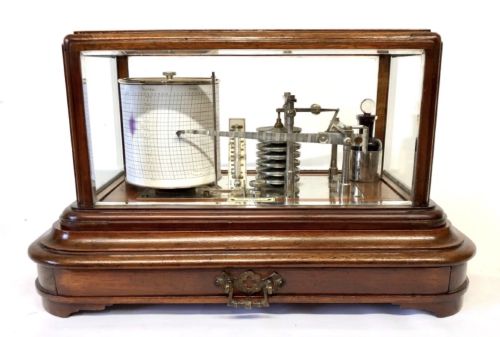


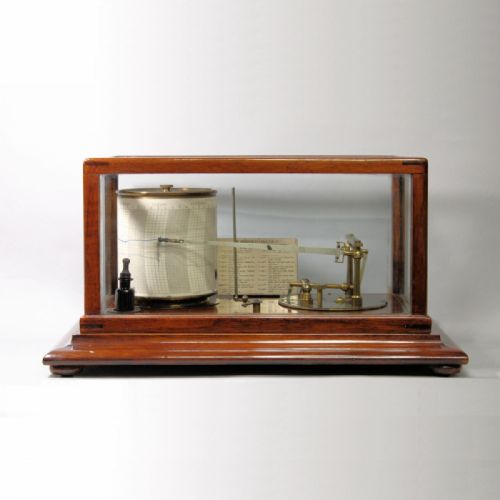


Mahogany Desk Barometer
A mahogany desk barometer brings precision and rich timber grain to a study, combining scientific utility with handsome period cabinetwork.
Mahogany Desk Barometer
When you search for a mahogany desk barometer, you are looking at scientific instruments housed in rich timber cases designed for tabletop or desktop placement. These pieces include barographs, mantel clocks with barometers, and marine barometers spanning the Victorian and Edwardian eras.
The versions you are most likely to meet on this page feature polished mahogany housings, frequently glass-fronted or constructed in five-glass cases to display the intricate mechanical drum movements inside. Some examples incorporate supplementary thermometers, dials, or small storage drawers.
Origins range from English makers to continental workshops, capturing a period when scientific recording instruments were built with ornamental appeal for the home or office. The forms vary from compact miniature barographs to substantial table-standing scientific pieces.
Materials and construction
Cases are primarily constructed from solid or veneered mahogany, occasionally accented with satinwood stringing or oak elements to enhance the timber's warm red-brown tones. Brass is utilised extensively for bezels, carrying handles, hinges, and inscribed instrument plates.
Internal mechanisms rely on delicate brass linkages, steel components, and paper recording charts driven by clockwork drum movements. Protective glass panels or multi-pane cases shield the sensitive aneroid barometers and barographs from dust while allowing clear observation.
Some travelling merchants needed instruments that recorded pressure across oceans while surviving the rolling decks of steamships.
Separating the ordinary from the exceptional
Quality in a mahogany desk barometer rests primarily on the crispness of the cabinetwork and the reputation of the maker inscribed on the dial or bedplate. Finer pieces display tight timber grain, precise dovetail or mitred joints, and heavy cast brass fittings rather than stamped sheet metal.
The sophistication of the mechanical movement also dictates worth, with signed drum barographs and multi-function desk instruments sitting above simpler domestic barometers. Retaining original paper charts, intact glass panes, and legible engraved faceplates elevates an instrument's standing.
GAUPP & CO HONGKONG & SINGAPORE·R Fuess·SHORT & MASON LIMITED·Robson of Newcastle·RICHARD FRERES
The Mahogany Desk Barometer Glossary
- Aneroid barometer
- An instrument that measures atmospheric pressure without using liquid, relying instead on a flexible sealed metal capsule. Changes in pressure cause the capsule to expand or contract, moving a pointer across a calibrated dial.
- Barograph
- A recording barometer that plots atmospheric pressure over time onto a revolving paper chart attached to a clockwork drum. This provides a continuous visual history of weather patterns across the week.
- Five-glass case
- A glazed housing that encloses a barograph or scientific instrument on the top and all four vertical sides. This design maximises light entry for reading the dials and observing the internal mechanism.
- Bezel
- The metal ring that holds the glass face in front of a dial or thermometer. In better pieces, this is cast brass with a hinged opening mechanism for resetting indicators.
- Bedplate
- The heavy metal baseplate upon which the mechanical movement of a barograph or barometer is mounted. It provides a stable foundation to keep the delicate linkages aligned.
Mahogany Desk Barometer: Frequently Asked Questions
How do I wind a barograph?
The clockwork drum inside a barograph is typically wound using a small key inserted into the top or side of the rotating cylinder. Care must be taken not to overwind the mainspring.
Ensure you do not touch the delicate bellows or recording arm while accessing the interior drum for winding or changing the paper chart.
Can I calibrate these barometers today?
Most aneroid barometers feature a small adjustment screw accessible from the back or underneath the case. You can match the reading to a known local meteorological measurement.
Turn the screw very gradually while tapping the glass lightly to settle the linkage until the needle points to the correct pressure.
Where should I place a desk barometer?
Select a stable, level surface away from direct sunlight, radiators, or draughts that might artificially influence the internal mechanism or dry out the timber case. A study or hallway table works well.
Keep the instrument away from areas of heavy vibration, as constant jarring can prematurely wear the delicate brass pivots and gears.
How do I tell Victorian from Edwardian pieces?
Victorian instruments frequently display heavier, more ornate mahogany timberwork and darker patination. Details tend to be robust and formal.
Edwardian and later pieces often lean towards lighter proportions, sometimes incorporating subtle Art Nouveau influences or refined stringing in the timber.