




Mahogany Canterbury Storage
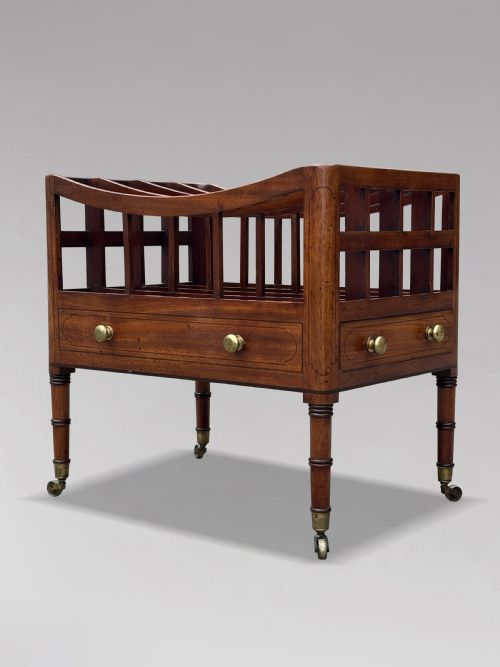
These mahogany canterbury storage pieces are practical timber furniture designed to keep sheets of music or periodicals close to hand by the hearth.
Mahogany Canterbury Storage
A mahogany canterbury storage piece is a traditional item of English furniture designed specifically for holding music scores and periodicals. When browsing these listings, a buyer will most frequently encounter nineteenth century and Georgian examples, often featuring distinct divisions for upright storage.
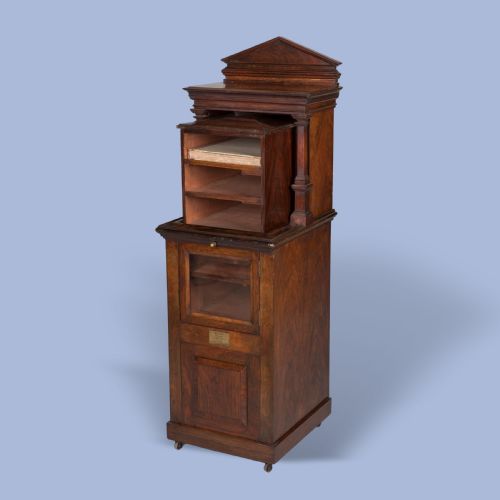
The selection ranges from early George III period forms through to late Victorian music cabinets and magazine racks. These items bridge the gap between open canterburys with slatted divisions and enclosed cabinets with fall fronts or glass doors.
Originating in the late eighteenth century, the classic form combines timber uprights with a low drawer and sometimes brass castors for mobility. They serve equally well in modern rooms for organising contemporary magazines and oversized books.
How they were made
Cabinet makers relied primarily on solid mahogany and rich Cuban mahogany, sometimes selecting figured timbers for the principal surfaces. Construction involved careful joinery for the slatted or solid divisions that support the contents upright.
Finer workshops introduced decorative details such as contrasting boxwood and ebony stringing, alongside polished brass hardware and castors. Enclosed music cabinets also incorporate glass panels and fall front mechanisms to secure sheet music.
Named after an archbishop who wanted his scores tidied, these stands quietly proofed that prelates also suffered from cluttered music rooms.
What varies in quality
Quality in a mahogany canterbury storage piece rests upon the choice of timber and the crispness of the cabinet work. Dense Cuban mahogany with rich figure and well-executed joinery marks out superior examples from simpler utilitarian pieces.
Refinement in secondary details elevates a piece, such as precise ebony banding, elegant turned supports, and original brass fittings. The integration of a smoothly operating drawer beneath the main compartment also distinguishes finer workshop production.
The Mahogany Canterbury Storage Glossary
- Canterbury
- A low stand with divisions for holding music or loose papers, often fitted with a small drawer below. The name supposedly derives from an Archbishop of Canterbury who requested such a piece for his music scores.
- Cuban Mahogany
- A dense, highly figured hardwood sourced from the Caribbean and prized for high-end Georgian and nineteenth century cabinet making. It yields a deep, warm patina with age.
- Music Cabinet
- An enclosed piece of furniture designed to store sheet music and scores, frequently featuring a fall front or glazed door. These emerged more prominently during the Victorian era.
- Stringing
- Inlay work consisting of very thin lines of contrasting wood, such as boxwood or ebony, set flush into the mahogany surface. This technique highlights the borders and panels of the furniture.
- Fall Front
- A hinged panel that drops down to form a writing surface or to provide access to interior shelves and compartments. It is commonly found on music cabinets from the later periods.
Mahogany Canterbury Storage: Frequently Asked Questions
What is a canterbury used for?
These pieces were originally built to hold sheet music, folios, and loose periodicals neatly beside a piano or seating area. Today, they serve the exact same function for organising modern magazines and large books.
The vertical divisions keep paper goods upright and prevent them from slumping or creeding, making selection straightforward and tidy.
How do I date a mahogany canterbury?
Dating relies on observing the prevailing style and construction methods, moving from the restrained elegance of George III pieces to more ornate Victorian designs. Georgian examples often feature lighter proportions and subtle boxwood or ebony banding.
Later nineteenth century pieces may adopt larger forms, including enclosed music cabinets with glass or fall front doors reflecting Art Nouveau influences.
How do I care for antique mahogany?
Maintain the timber by keeping the piece away from direct heat sources and strong sunlight, which can dry out and fade the mahogany. Regular dusting with a soft, dry cloth preserves the polished surface.
Applying a traditional beeswax polish occasionally helps nourish the wood and maintain its natural depth of colour without building up a heavy residue.