
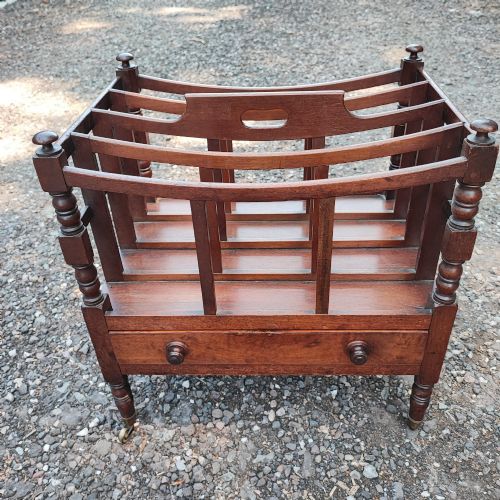


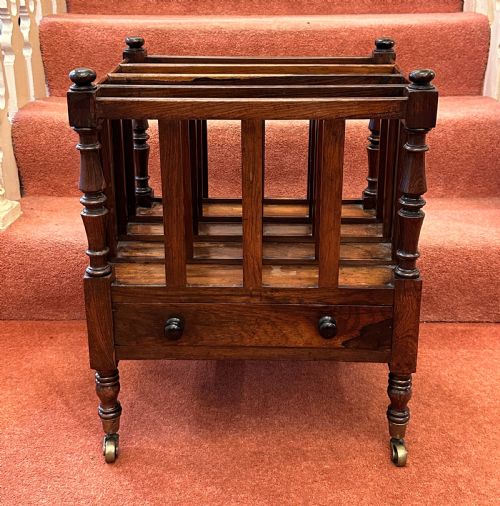
Turned Leg Magazine Stand
A turned leg magazine stand, known traditionally as a Canterbury, keeps periodicals orderly in timber with characteristic slender supports.

Turned Leg Magazine Stand
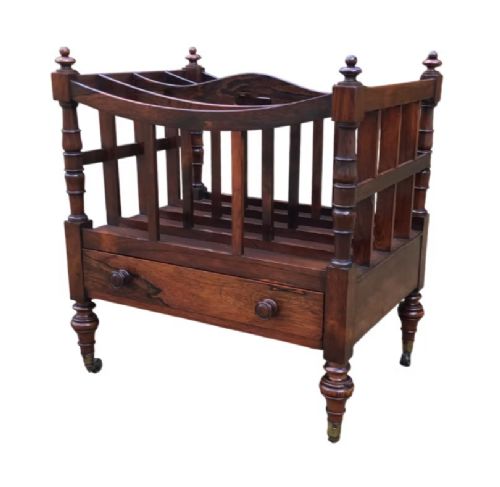
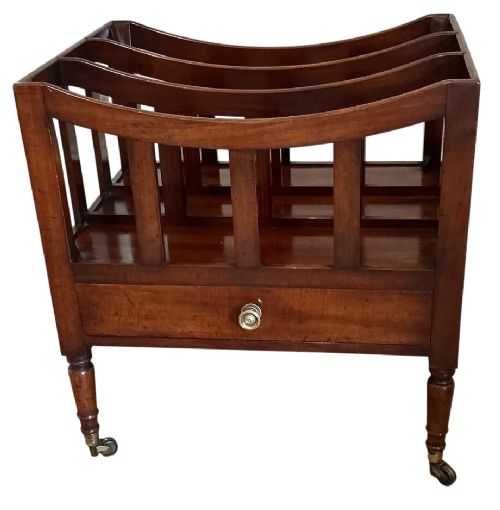
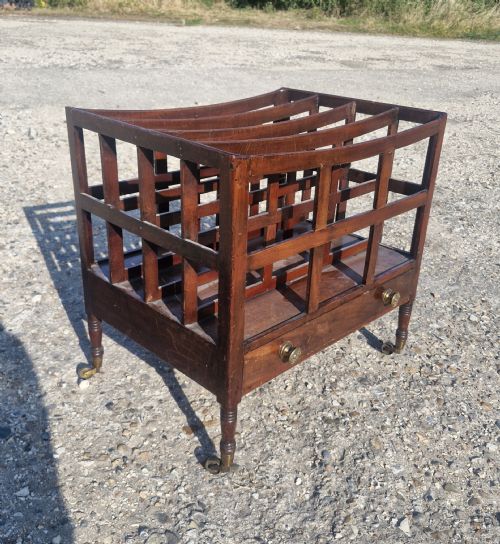
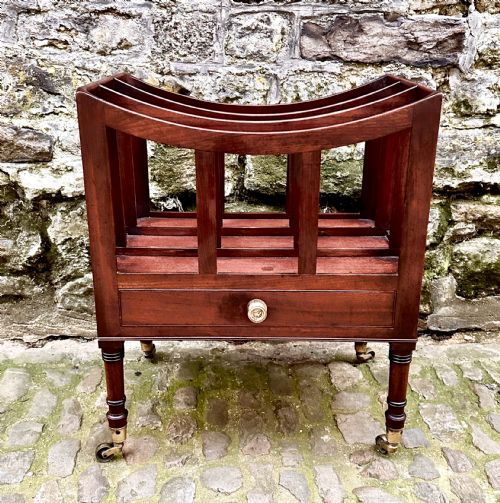
A turned leg magazine stand most frequently appears on this page as a nineteenth-century Canterbury or magazine rack. These pieces typically combine slatted or divided compartments above low platforms with neat, cylindrical supports.
The selections span Georgian, Regency, William IV and Victorian periods. Most examples follow traditional forms designed to hold newspapers, music sheets or journals near a sitting room chair.
Makers designed these items for everyday domestic convenience in formal reception rooms. The turning on the legs provides the primary decorative flourish beneath the main compartment.
Materials and construction
Cabinet makers relied heavily on mahogany, rosewood and burr walnut for these stands, utilising rich timber veneers and solid stock. Brass castors frequently finish the base of the turned legs for ease of movement across carpets.
Constructors divided the upper sections into multiple tiers or partitions using vertical slats and spindle work. Joinery techniques ensured the standing frames remained stable while bearing the weight of heavy periodicals.
Some nineteenth-century Canterburys doubled as breakfast trays, though dropping toast into the music section was discouraged.
Distinctions in quality
The standard of timber selection and figuring marks the main difference across these stands. Richly grained mahogany and burr walnut denote finer workshops than plain secondary woods.
Crispness in the woodturning and the presence of fine inlay work distinguish superior examples. Robust division construction without structural sagging also indicates better original manufacture.
The Turned Leg Magazine Stand Glossary
- Canterbury
- A low stand with partitions for holding books, music, or newspapers, usually fitted with legs and sometimes a drawer.
- Turned leg
- A support shaped on a lathe to create cylindrical, fluted, or spool profiles. This traditional woodworking method provides structural support and visual interest.
- Castor
- A small wheel mounted on a swivel assembly at the base of a leg. It allows heavy furniture to be rolled smoothly across floors.
- Boat shaped
- A curved, concave outline resembling a vessel hull, often seen on the upper partitions of Regency pieces.
- Whatnot
- A set of open shelves for displaying ornaments or holding books, sometimes combined with a Canterbury base.
Turned Leg Magazine Stand: Frequently Asked Questions
What is a Canterbury?
A Canterbury is a traditional compartmentalised stand designed to hold sheet music, newspapers and periodicals. Originating in the eighteenth century, it evolved into a standard domestic furnishing for the Victorian parlour.
The name supposedly derives from the Archbishop of Canterbury, who commissioned an early version of such a rack. On this page, the term is synonymous with the turned leg magazine stand.
How do I date a Canterbury?
Dating relies on timber choice, overall proportions and stylistic details like leg turning. Georgian and Regency pieces tend to show cleaner classical lines, whilst Victorian examples often feature heavier burr walnut or oak.
Hardware such as brass castors also offers clues to the period of manufacture. Cabinet makers adapted the turning styles to reflect prevailing interior design fashions across the nineteenth century.
Where should I place it?
These stands suit sitting rooms, studies or hallways where current reading material accumulates. Their compact footprints allow them to sit neatly beside armchairs or sofas.
Keep timber pieces away from direct heat sources and strong sunlight to protect the polish. Regular light dusting maintains the finish of the mahogany, rosewood or walnut surfaces.
Are these stands sturdy enough for daily use?
Most of these pieces were built for active domestic service, utilising robust timber framing and durable joinery. The vertical divisions and turned supports manage the weight of modern magazines quite effectively.
Lifting the stand rather than dragging it across the floor preserves the integrity of the leg joints and castors. Checking that the base remains firm ensures safe everyday functionality.