
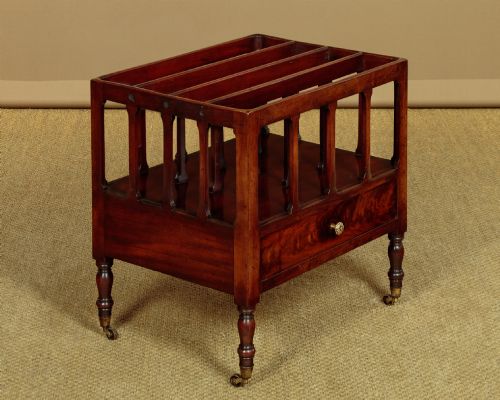
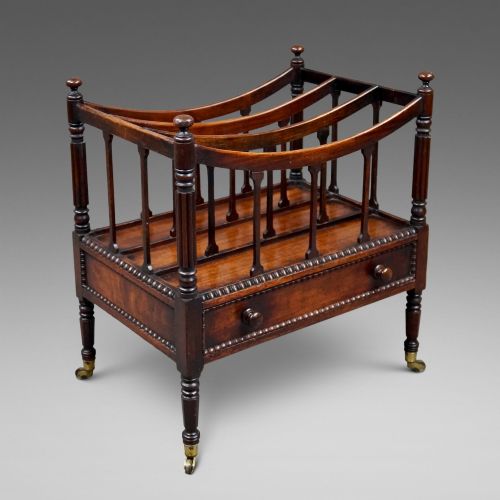


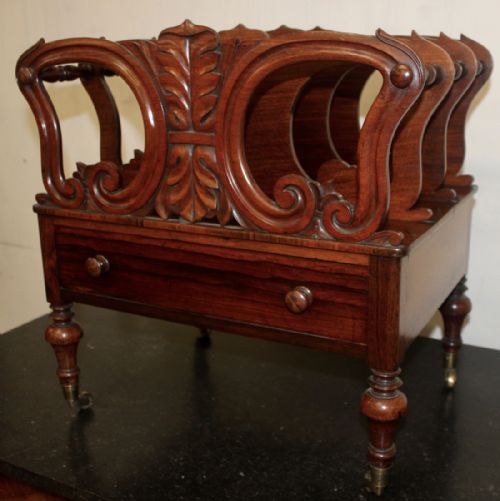

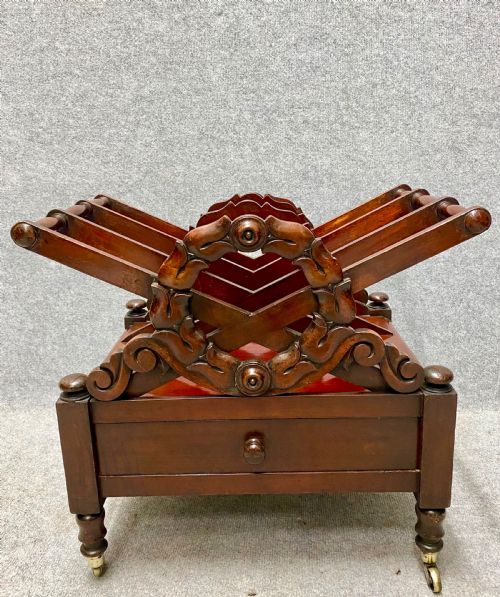


William IV Magazine Rack
A william iv magazine rack brings nineteenth-century elegance and partitioned practicality to a sitting room, offering a clever place to keep periodicals close at hand.

William IV Magazine Rack
When you search for a william iv magazine rack, you enter a field dominated by nineteenth-century canterburys designed to hold folios, newspapers, and music sheets. These low pieces typically feature upright divisions set above a slatted or solid base, often mounted on short turned legs with castors. While historical terminology varied between magazine racks, tidies, and music stands, the form remains instantly recognisable for its compact compartmentalised structure.
The versions you meet most frequently on this page belong to the William IV period and adjacent Regency or Victorian eras, dating from around eighteen hundred through to the middle of the nineteenth century. Mahogany and rosewood dominate the inventory, sometimes enhanced by inlay or carved details. They serve as both functional storage and decorative furniture, fitting neatly beside a fireside or armchair.
Makers and designers of the period, such as J.C. Loudon, recorded these items as versatile pieces for the modern home, intended to keep loose sheets and periodicals tidy. They appear under various descriptions including canterburys and music racks, yet all share the characteristic divisions that separate papers into manageable sections. Selecting one means choosing a specific nineteenth-century solution for domestic organisation.
How they were made
Cabinet makers constructed these pieces primarily using dense tropical hardwoods such as mahogany and rosewood, selected for both strength and rich grain patterns. Timber sections were shaped into slatted divisions, upright supports, and framed bases, occasionally incorporating subtle inlay work for decorative contrast. The structural rigidity relied on traditional joinery techniques appropriate for items subjected to daily handling.
Movable elements like castors were fitted to the base legs, allowing the rack to be repositioned easily across carpets and floorboards. Surfaces were finished to highlight the natural colour and figure of the mahogany or rosewood, preserving the warm tones characteristic of nineteenth-century furniture production.
Nineteenth-century designers intended these rolling racks to follow homeowners around the drawing-room like faithful, paper-toting hounds.
What varies in quality
The standard of a piece rests heavily on the choice of timber and the crispness of its execution, particularly in carved elements or turned legs. Richly figured rosewood and well-chosen mahogany distinguish finer examples from plain utilitarian versions, while subtle inlay adds a further layer of refinement. The integrity of the internal divisions and the smoothness of the overall construction determine how successfully the piece has survived decades of domestic use.
Proportion and detail separate standard workshop output from superior pieces designed for country houses or fashionable town residences. The presence of original castors, sound joints, and clean timber surfaces indicates a higher grade of craftsmanship that rewards close inspection.
J.C. Loudon
The William IV Magazine Rack Glossary
- Canterbury
- A low stand with partitioned uprights used for holding music sheets, books, or newspapers. This form originated in the late eighteenth century and remained popular throughout the nineteenth century.
- Mahogany
- A durable, reddish-brown tropical hardwood prized by cabinet makers for its stability and rich grain. It serves as one of the primary materials for nineteenth-century furniture.
- Rosewood
- A heavy, dark timber featuring pronounced dark grain figuring, frequently utilised in high-status nineteenth-century pieces. Its distinctive appearance makes it a hallmark of the William IV period.
- Inlay
- A decorative technique where contrasting materials are inserted into recesses cut into the wood surface. This adds visual detail to panels and tabletops.
- Castor
- A small wheel fitted to the base of a piece of furniture to allow easy movement across floors. Original brass or wooden castors contribute to the historical integrity of a rack.
William IV Magazine Rack: Frequently Asked Questions
What is a Canterbury?
A Canterbury is a low stand featuring partitioned sections designed to hold sheet music, newspapers, or periodicals. It combines portable storage with compact furniture design.
First appearing in the Georgian era, the form evolved through the Regency and William IV periods to become a staple of nineteenth-century domestic interiors.
How were they used?
These racks sat beside armchairs or fireplaces to keep current reading material, folios, and music sheets organised and within reach. The divided upper sections kept papers upright and sorted.
Their mobility allowed servants or family members to wheel them across the room as needed during evening gatherings or quiet study.
How do I live with one?
A William IV rack fits easily beside a modern sofa or writing desk to hold current magazines, art books, or newspapers. Its compact footprint brings historical character to a room without demanding excessive space.
Treat the polished wood with care, avoiding direct sunlight and excessive moisture to preserve the nineteenth-century finish and timber grain.
How do I tell periods apart?
Georgian pieces often display restrained classical lines, while William IV examples tend to feature bolder proportions, heavier turned legs, and rich rosewood or mahogany grains. Victorian items continue these traditions with varied decorative carving and robust construction.
Examining the turning styles, timber selection, and joinery details helps distinguish between the late eighteenth century and the mid nineteenth century.