



Mahogany Barograph Recorder
A mahogany barograph recorder is a scientific instrument designed to record atmospheric pressure mechanically over time, housed in timber and glass.
Mahogany Barograph Recorder
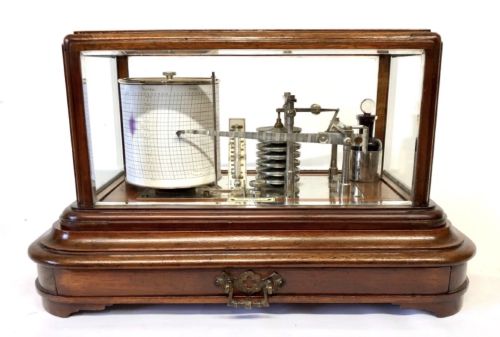
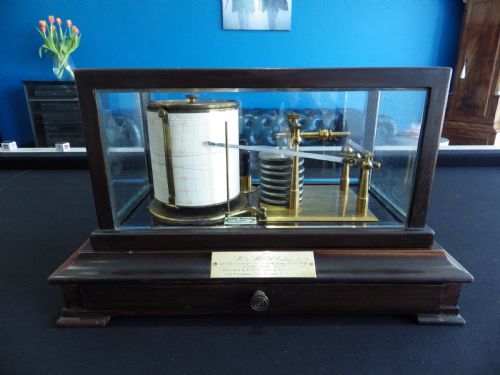
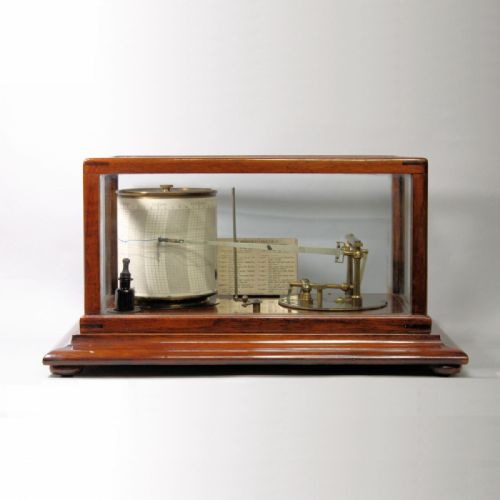
A mahogany barograph recorder sits beneath a five-glass cover, allowing the intricate movement of the barometer and rotating drum to remain visible while protected from dust. These scientific instruments record continuous barometric changes on paper charts, combining practical meteorology with handsome cabinet work.
Most examples found here date from the Victorian, Edwardian, and interwar periods, reflecting a time when domestic weather recording was both a serious hobby and a mark of status. Variations include models paired with thermometers or barometer dials, as well as those featuring fitted chart drawers in the base.
The predominant wood is mahogany, occasionally accented with inlay or accompanied by oak variants, housing brass mechanisms and steel components. Makers range from renowned London scientific instrument firms to retailers who supplied these domestic barometers to affluent households.
Materials and construction
The cabinetry relies on solid and veneered mahogany, often constructed with a five-glass lift-off or hinged cover that rests upon a moulded base, sometimes incorporating a drawer to store spare paper charts. Cabinet makers shaped the timber to house the delicate metallic machinery securely while maintaining clear sightlines from all angles.
Internal mechanisms utilise brass for the levers, pivots, and the rotating clockwork drum, alongside steel parts and stacked aneroid metal capsules that expand and contract with atmospheric pressure. A pen arm tipped with ink traces these movements onto paper affixed to the rotating cylinder.
Mahogany Barograph Recorder Retail Price Guide 2026
Typical asking prices for mahogany barograph recorder among the pieces listed under this phrase on Sellingantiques today, from the lower quarter to the upper quarter. They describe what is for sale here now, not the wider market.
Several examples include fitted chart drawers beneath the main recording mechanism for storing spare paper sheets.
Distinctions in quality
The distinction between standard commercial output and superior execution lies in the precision of the brass clockwork movement and the crispness of the cabinetry joints. Signed instruments by established makers command attention for their finely engraved scales and reliable recording mechanisms.
Finer examples often integrate thoughtful conveniences such as integrated chart drawers, additional thermometer dials, or beautifully figured timber grains. The clarity of the bevelled glass panels and the substantial weight of the brass fittings further distinguish the better workshops.
GAUPP & CO HONGKONG & SINGAPORE·Negretti & Zambra·SHORT & MASON, LONDON·CASELLA LONDON·R Fuess·HARRODS OF LONDON·SHORT & MASON LIMITED
The Mahogany Barograph Recorder Glossary
- Barograph
- A recording barometer that graphs atmospheric pressure over a set period onto a paper chart. It relies on an aneroid mechanism connected to an ink-tipped arm.
- Aneroid capsule
- A sealed, flexible metal box that expands or contracts with changes in atmospheric pressure. This movement drives the recording arm.
- Chart drum
- The rotating cylinder driven by a clockwork movement that holds the calibrated paper recording sheet. It typically completes one rotation per week.
- Five-glass case
- The typical protective wooden enclosure featuring a top panel and four vertical sides made of glass. This design ensures maximum visibility of the internal mechanics.
Mahogany Barograph Recorder: Frequently Asked Questions
What is a barograph recorder?
A barograph recorder is a mechanical instrument that continuously measures and graphs atmospheric pressure onto a rotating paper chart.
Enclosed in a glass and timber case, it uses stacked metal capsules to detect pressure shifts and translates them via an ink arm.
How do you set the clockwork?
The brass drum contains a clockwork mechanism that must be wound periodically using a small key to ensure steady rotation.
Care should be taken not to overwind the movement, as this can damage the internal spring.
Where were they placed?
These instruments typically sat on mahogany tables, desks, or shelves in domestic hallways, libraries, or offices where guests could observe them.
They served as both functional meteorological tools and decorative conversation pieces for the household.
How do I date an instrument?
Dating relies on maker signatures, style markers such as Edwardian inlay or Victorian proportions, and trade labels inside the case.
Patent dates or retailer stamps inscribed on the brass bedplate or paper charts also help narrow down the period.