
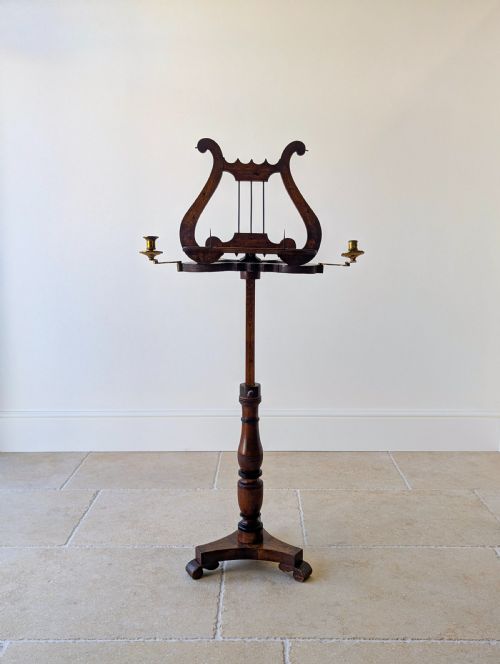


Lyre Sheet Music Holder
These pieces for a lyre sheet music holder bring domestic music rooms to life with distinctive openwork frames.
Lyre Sheet Music Holder
A buyer investigating a lyre sheet music holder encounters specialised furniture designed to support folios and scores during performance. These items appear across the Georgian, Regency, William IV, Victorian, and Edwardian eras.
The dominant forms on this page include adjustable music stands, lecterns, duet stands, and canterburys. Most examples incorporate the characteristic lyre motif within their primary framework or reading desk.
Makers adapted these stands for solo recitals and shared practice sessions in period drawing rooms. Walnut, mahogany, and rosewood constructions predominate among the surviving examples.
Materials and construction methods
Cabinetmakers utilised dense timbers including mahogany, walnut, and rosewood to build stable frames capable of supporting heavy bound folios. Satinwood inlay frequently provides decorative contrast on later Victorian and Edwardian surfaces.
Brass fittings allow for height adjustment and tilting desks on the freestanding recital stands. Carved wooden elements define the scrollwork and the central lyre shapes on the music racks.
Current listings feature items executed in mahogany, walnut, rosewood, oak, and satinwood inlay across multiple periods.
Assessing craftsmanship and condition
Quality separates simple utility items from pieces showing refined cabinet work and clever mechanical action. The crispness of the carved lyre details and the smooth operation of the adjustable stems indicate superior workshop standards.
Intricate timber selection, such as burr walnut or figured mahogany, distinguishes higher-grade examples from plain utilitarian furniture. Inlaid satinwood decoration adds another layer of refinement to the finished piece.
The Lyre Sheet Music Holder Glossary
- Lyre
- A stringed musical instrument shape used extensively as an ornament in furniture design. It forms the openwork wooden or brass centrepiece of the reading desk.
- Duet stand
- A wider music stand designed to hold scores for two performers simultaneously. These pieces often feature double desks or larger reading ledges.
- Canterbury
- A low stand with vertical partitions used for holding sheet music and folios. Some examples incorporate a lyre motif in their upright divisions.
- Lectern
- A reading desk supported by a pillar or pedestal, adjusted for standing or seated use. They appear in oak and mahogany across the nineteenth century.
- Padbury’s Patent
- A specific mechanical device associated with nineteenth-century page turning inventions. It assists musicians in managing scores during performance.
Lyre Sheet Music Holder: Frequently Asked Questions
What periods do these stands come from?
The pieces span the Georgian, Regency, William IV, Victorian, and Edwardian eras. Cabinetmakers produced them across the nineteenth and early twentieth centuries.
Specific dates within the listings range from the early decades of the eighteen hundreds up to nineteen ten. Each era introduces subtle shifts in timber choice and decorative carving style.
How were duet stands used?
Duet stands provided a shared reading surface for two musicians playing instruments together in a parlour or drawing room. Their wider desks accommodated larger bound volumes or paired sheet music.
Performers positioned them between seats to allow both players a clear view of the notes. They represent a more sociable form of domestic music making.
What woods appear most often?
Mahogany, walnut, and rosewood form the primary structural timbers for these music stands. Cabinetmakers selected them for their strength and rich natural grain.
Some examples also feature satinwood inlay or burr walnut surfaces. Oak appears in less common lectern formats from the nineteenth century.
Are the reading desks adjustable?
Many of the freestanding music recital stands include mechanical adjustment for height and angle. Brass fittings and sliding stems allowed players to set the score precisely where needed.
Fixed-height canterburys and simpler stands served a different purpose for storing folios nearby. The adjustable versions catered directly to active players and performers.