
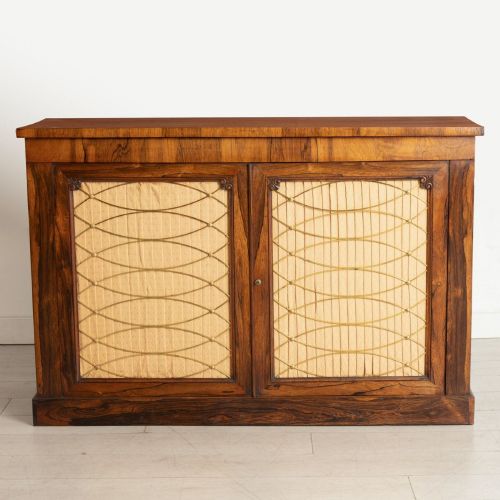
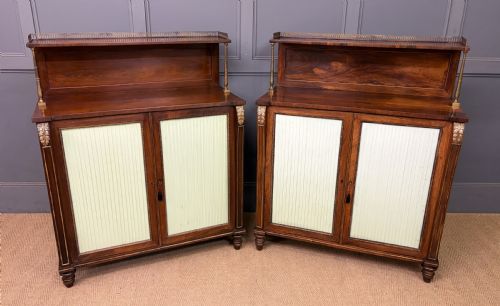


Low Rosewood Storage Cabinet
A low rosewood storage cabinet brings rich timber and refined proportion to a room, offering practical concealment with exceptional presence.

Low Rosewood Storage Cabinet
A low rosewood storage cabinet encompasses low-slung sideboards, chiffoniers, pier cabinets, and bookcases designed to hold belongings while keeping surfaces free for display. These pieces span periods from the Regency era through the Victorian period and into the early twentieth century, showing substantial variety in outline and function.
The Regency examples dominate the selection, featuring clean architectural lines, brass details, and occasional bookcase tops or chiffonier backs. Victorian and mid-nineteenth-century pieces appear frequently too, often incorporating French Rococo Revival influences, ebony details, or fabric panels behind grilles.
Buyers encounter forms ranging from two-door cupboards and breakfront sideboards to open bookcases configured as side cabinets. Each variation offers a distinct way to introduce dense, figured timber into an interior scheme without dominating the wall space.
Distinctions in quality
Quality rests upon the selection and matching of the rosewood veneers, where grain movement flows naturally across doors and panels rather than appearing disjointed. Superior pieces display thoughtful integration of brass mounts, parcel gilt work, and secondary woods that speak to careful workshop practices.
Proportion and structural integrity define the upper tier of these cabinets, distinguishing pieces built with clean lines and balanced forms from heavier, less resolved examples. The retention of original fittings, such as grilles, fabric panels, and interior shelving, further separates standard production from finer cabinet work.
Listings feature rosewood alongside brass, marble, silk, and gilding across nineteenth-century styles.
The Low Rosewood Storage Cabinet Glossary
- Chiffonier
- A low sideboard or cabinet, typically featuring a shelved superstructure or mirror at the back above enclosed cupboard doors. These pieces became particularly popular during the Regency and Victorian periods for dining and drawing rooms.
- Pier cabinet
- A low cabinet designed specifically to stand against the wall space between windows, known as the pier. They frequently incorporate glazed doors or decorative mounts.
- Goncalo alves
- A dense exotic hardwood with striking contrasting dark brown and golden-brown markings. Makers utilised this timber for furniture requiring strong visual grain patterns.
- Breakfront
- A piece of furniture whose central section projects forward from the flanking outer sections. This architectural arrangement creates depth and shadow across the facade of sideboards and large cabinets.
Low Rosewood Storage Cabinet: Frequently Asked Questions
What is a chiffonier?
A chiffonier is a low storage cabinet featuring enclosed cupboards below, sometimes accompanied by a raised shelf or back structure. They were designed for holding dining accessories and household items.
In period interiors, they provided surface space for decorative objects while keeping everyday items out of sight.
How do I date a rosewood cabinet?
Dating relies on observing stylistic markers such as Regency architectural restraint, Victorian ornamentation, or later revival influences. Construction methods and secondary woods also offer clues to the decade of manufacture.
Cabinet hardware, timber preparation, and framing techniques evolved across the nineteenth century, helping to narrow the period of origin.
Where should I place a low cabinet?
These cabinets suit living rooms, dining spaces, and hallways where height needs to be kept low to preserve wall art or windows. Their shallow profile allows them to sit comfortably against walls without obstructing movement.
They function well beneath mirrors, paintings, or windows, providing surface display space alongside enclosed storage.
What is parcel gilding?
Parcel gilding is the application of gold leaf to specific carved or architectural portions of a wooden object. It highlights particular details against the dark background of the timber.
This technique draws the eye to decorative mouldings and mounts, adding contrast to the natural grain of the wood.