
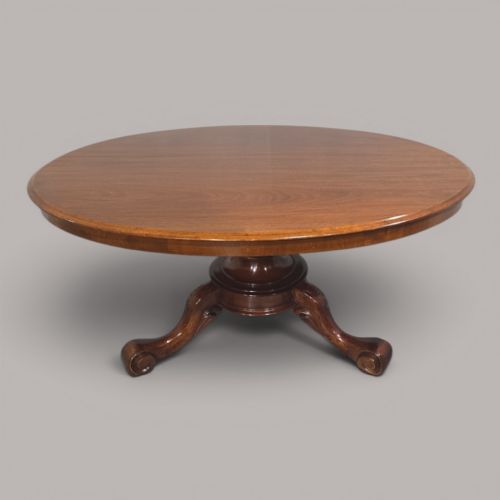


Low Mahogany Pedestal Table
A low mahogany pedestal table brings compact warmth and architectural presence to a sitting room, offering a sturdy central base beneath a figured timber top.
Low Mahogany Pedestal Table
A low mahogany pedestal table is typically encountered as a coffee table or a plant stand, repurposed from earlier dining forms or made directly in low proportions during the nineteenth and twentieth centuries. These pieces combine a central column with tripod or pillar supports, keeping floor space clear while presenting a solid timber surface.
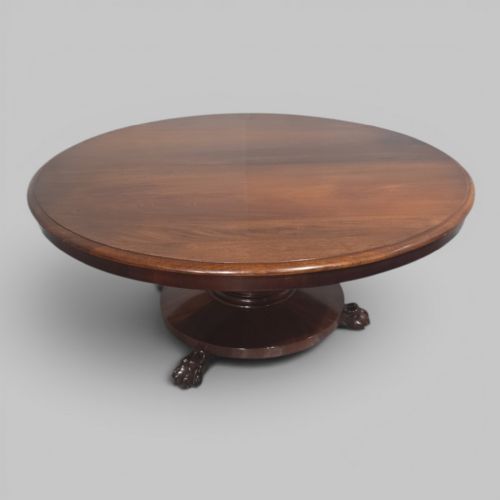
The selection on this page centres on oval, round, and drum shapes, spanning from the Georgian and Regency eras through Victorian revivals and into the nineteen-twenties. Buyers will find both traditional pedestal dining tables adapted to lower heights and purpose-built low coffee tables featuring classical revival details.
How they were made
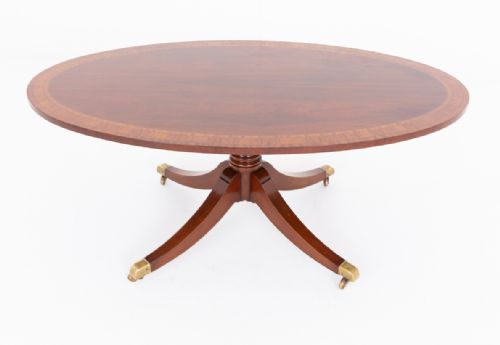
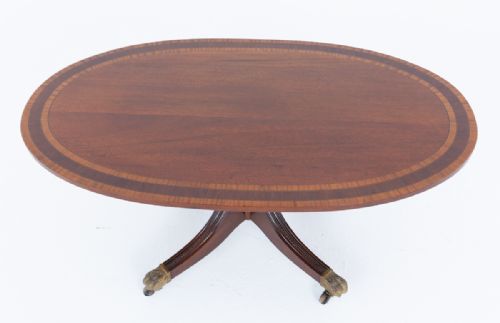
Cabinetmakers utilised solid mahogany and rich flame mahogany veneers laid over secondary timbers, often accentuating the tops with satinwood inlay or brass fittings. The timber was selected for its deep grain patterns, then polished to a warm sheen.
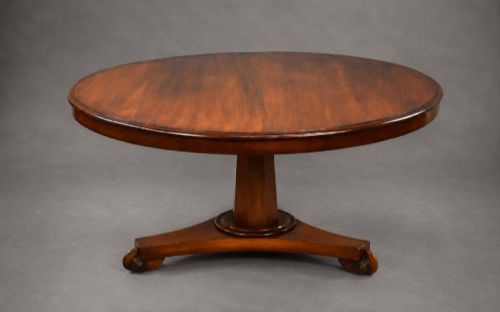
Support structures rely on sturdy central pillars rising from splayed tripod legs or heavy platform bases, sometimes fitted with brass castors to allow smooth movement across the floor.
Mahogany and brass predominate across these listings, alongside decorative satinwood inlay and rich flame mahogany veneers.
What varies in quality
Quality rests principally in the depth of the timber's grain, the crispness of any inlaid satinwood, and the proportional harmony between the central pedestal and the top. Finer examples display carefully matched flame veneers and substantial brass elements rather than flat, plain boards.
Construction methods also separate standard production from superior cabinetwork, seen in the stability of the central pillar joint and the weight of the base required to balance a low coffee table properly.
Gillows
The Low Mahogany Pedestal Table Glossary
- Flame mahogany
- A veneer cut from the fork of the mahogany tree where the branch meets the trunk, producing a distinctive flickering flame pattern across the surface.
- Pedestal
- A single central support column carrying the weight of the table top, typically resting on three or four splayed legs.
- Satinwood inlay
- Contrasting pale timber inserted into the darker mahogany surface to create decorative borders or geometric motifs.
- Dish top
- A table top with a raised, concave rim carved directly from the solid mahogany board to prevent items from sliding off.
Low Mahogany Pedestal Table: Frequently Asked Questions
How were these tables used originally?
Many examples began life as full-height dining tables, console stands, or vase supports before being adapted to lower coffee table proportions for modern sitting rooms.
Purpose-built lower versions served as plant stands or central display pieces in nineteenth-century interiors.
How do I distinguish Regency from revival pieces?
Authentic Regency pieces display the timber ageing, construction methods, and brass detailing characteristic of the early nineteenth century.
Revival pieces, such as those from the Sheraton Revival or nineteen-twenties, often employ cleaner internal machine joints while imitating earlier aesthetic styles.
How do I care for mahogany surfaces?
Maintain the timber by dusting with a dry cloth and applying natural beeswax periodically to nourish the grain and preserve the warm colour.
Keep these tables away from direct heat sources and strong sunlight to prevent the mahogany veneer from drying out or fading.
Will a pedestal base fit on a rug?
A central pedestal distributes weight through three or four feet, which can leave indentations in thick carpets over time.
Placing the table on a flat floor or using supportive caster cups helps distribute the weight evenly.