
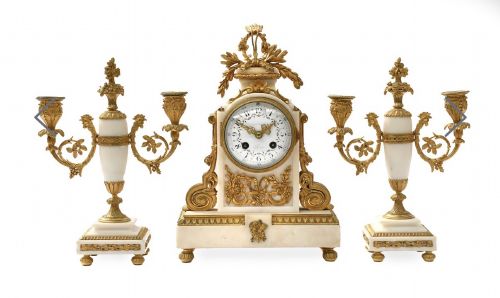


Louis XVI Bronze Garniture
These pieces of louis xvi bronze garniture bring classic French symmetry and gleaming ormolu into a room.
Louis XVI Bronze Garniture
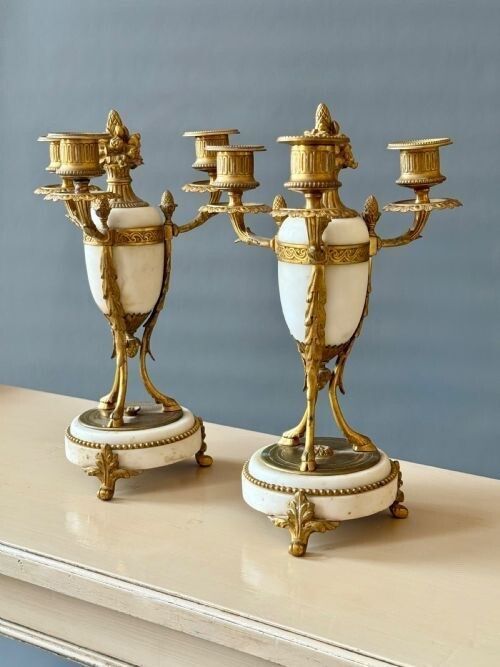
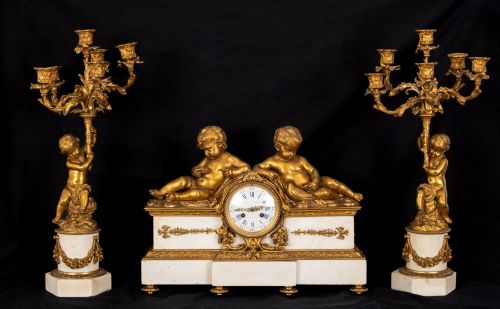
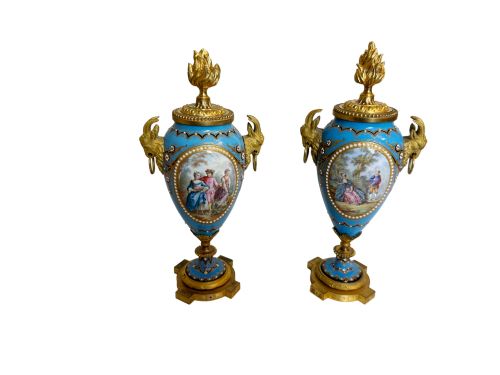
A louis xvi bronze garniture comprises a central mantel clock paired with matching side pieces such as candelabras, urns or cassolettes. Most examples found here date from the nineteenth century, reflecting the widespread revival of French neoclassical taste during that era.
The form draws heavily on eighteenth-century design principles, pairing architectural marble bodies with cast metal mounts. These sets were originally manufactured to adorn the grand mantelpieces of European drawing rooms.
Buyers will encounter various configurations, from simple three-piece clock sets involving twin urns to larger assemblages accompanied by massive candelabras. White and coloured marbles frequently form the structural core of these decorative ensembles.
Materials and construction
Gilt bronze and ormolu provide the brilliant metallic ornamentation that defines the aesthetic, often cast with crisp foliage, ribbons and cherubs. This bronze work is frequently paired with turned white, red or black marble and occasionally onyx.
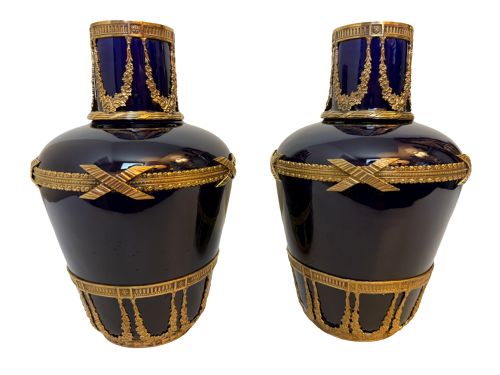
Many items incorporate glazed porcelain panels, such as Sevres-style plates, or detailed enamel dials set within the clock faces. Glass components and brass elements also appear regularly across the surviving nineteenth-century examples.
Listings feature items spanning the nineteenth century, incorporating materials such as gilt bronze, ormolu, marble, porcelain and glass.
Judging the execution
The sharpness of the bronze chasing separates standard decorative items from exceptional works of art. Finer sets display deep, hand-chiseled detail in the acanthus leaves and figural mounts rather than soft, rounded casting edges.
The integration between the stone and metal components indicates the original maker's skill. High-end ensembles maintain tight, flush joints where the ormolu mounts meet the marble or porcelain bodies without visible gaps.
Henry Dasson·H Luppens Paris·AD Mougin Paris·Ferdinand Berthoud·Vincenti
The Louis XVI Bronze Garniture Glossary
- Garniture
- A matching set of ornamental objects designed to display together on a mantelpiece or sideboard, typically comprising a clock flanked by two vases or candelabras.
- Ormolu
- Gilding technique involving the application of finely ground, high-carat gold to a bronze object. It gives the metal a warm, enduring golden lustre.
- Cassolette
- A decorative vase or urn with a reversible lid that transforms from a closed vessel into a candleholder. They form a frequent component of classical garnitures.
- Bleu de Roi
- A deep, rich royal blue ceramic glaze often seen on porcelain elements within French clock sets. This colour provides a strong contrast against golden ormolu mounts.
- Lyre clock
- A mantel clock shaped in the form of a classical stringed musical instrument. The case is typically decorated with gilt bronze mounts and set upon a marble base.
Louis XVI Bronze Garniture: Frequently Asked Questions
How do I display a garniture set?
Place the central clock in the exact middle of the mantelpiece with the matching candelabras or urns positioned symmetrically on either side.
Maintain adequate space around each object to let the gilt bronze mounts and marble bases stand out visually against the wall.
Are these clocks still in working order?
Many nineteenth-century movements retain their original mechanisms, but performance varies across individual items.
Professional servicing by a horologist is often recommended to ensure reliable timekeeping and proper care for antique clockworks.
What is the difference between ormolu and gilt bronze?
Ormolu specifically refers to the historical mercury gilding process used on decorative bronze objects during the eighteenth and nineteenth centuries.
Gilt bronze is a broader term that simply describes bronze metal coated with a layer of gold, which applies to many items in this category.
How do I clean marble and ormolu?
Dust the surfaces gently with a dry, soft cloth to prevent the accumulation of dirt within the fine chasing of the bronze.
Avoid using harsh chemical polishes or water on the ormolu and marble, as moisture can damage the antique gilding and porous stone.