



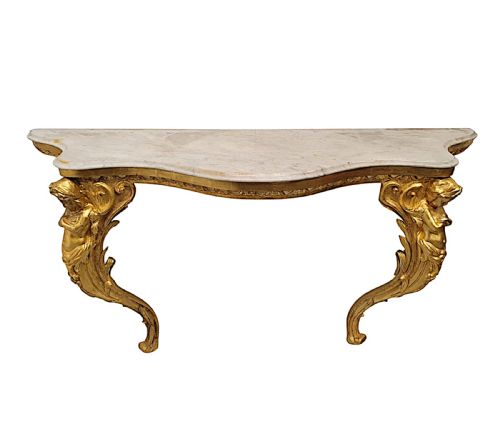
Louis Revival Console Table
A louis revival console table brings the sculptural curves and gilt flourish of French royal courts straight into a nineteenth-century interior.
Louis Revival Console Table
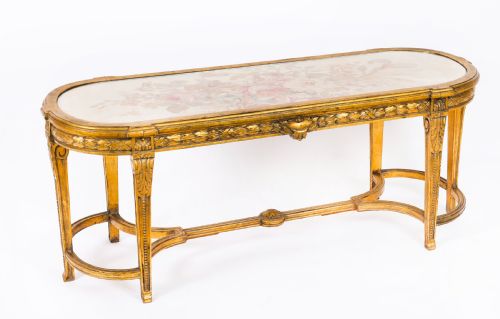
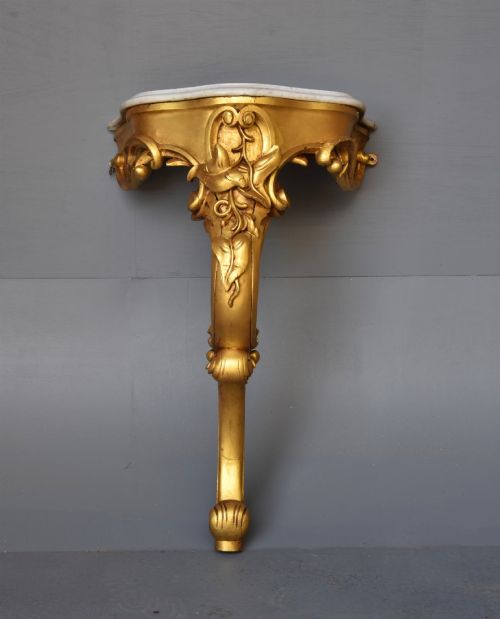
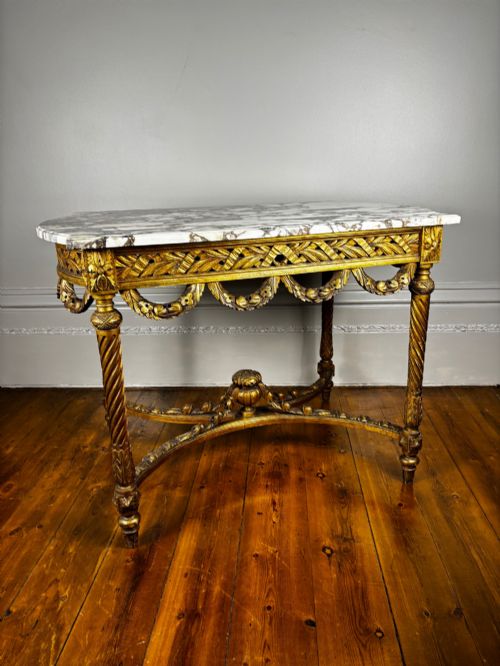
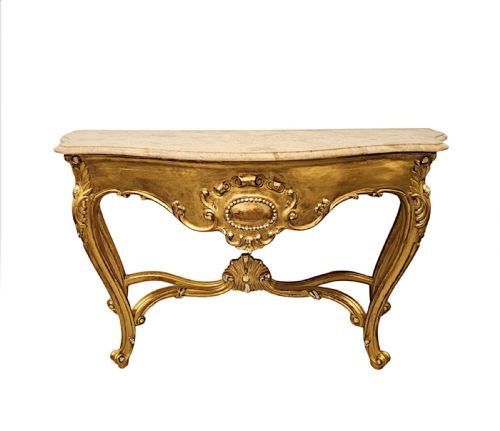
When you examine a louis revival console table, you are looking at nineteenth-century British and French interpretations of earlier Rococo and neoclassical court furniture. These wall-mounted or freestanding pier tables replicate the sweeping lines and ornamental vocabulary associated with the reigns of Louis the fifteenth and Louis the sixteenth.
The versions you meet most frequently on this page date from the Victorian era and the early twentieth century, spanning decades from eighteen thirty to nineteen thirty. Alongside dedicated console tables, the selection includes adaptable card tables, games tables, and centre tables that share the same revival aesthetic.
Originating largely from French workshops and prominent London cabinet makers, these pieces served both decorative and practical functions in grand reception rooms. They range from compact low coffee tables to large pairs designed to anchor architectural mirrors.
How they were made
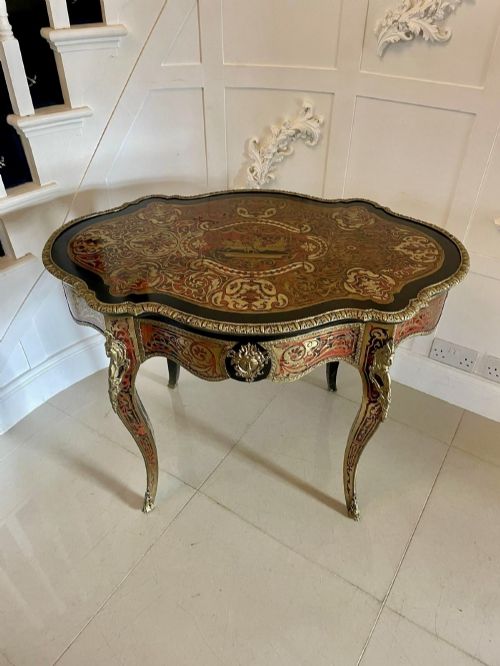
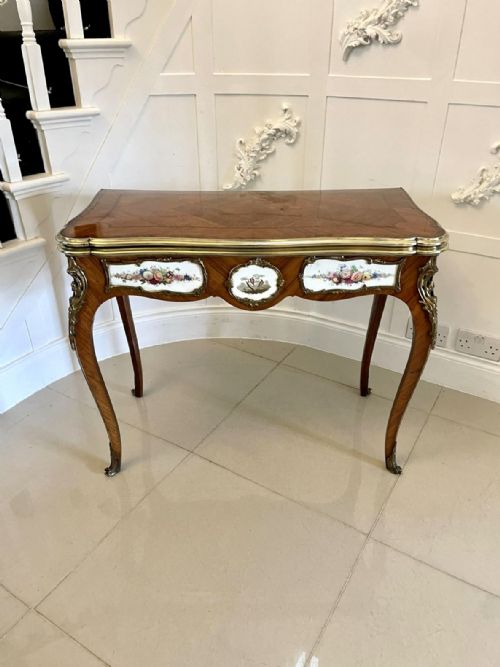
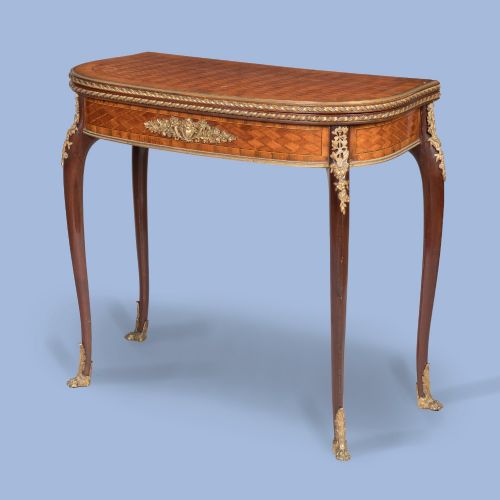
Cabinet makers built the foundational carcase from timbers such as walnut, mahogany, kingwood, and rosewood, often applying intricate floral marquetry and parquetry patterns across the surfaces. Boullework incorporating tortoiseshell and brass inlay also appears on select card and centre tables.
Carved giltwood and gesso frames provide the opulent structural support for many examples, finished with layers of gold leaf to catch the light. Heavy polished marble slabs form the tops on numerous console tables, resting directly upon the ornate wooden bases.
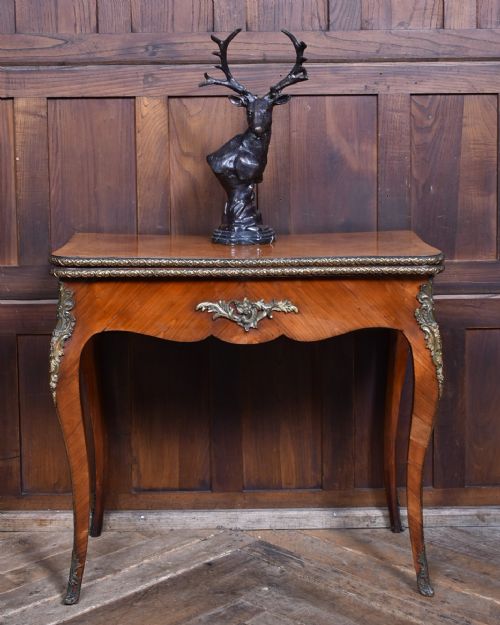
Ormolu mounts, cast in bronze and fire-gilded, embellish the corners, aprons, and legs of finer pieces. These metal ornaments are secured with brass pins, adding sharp metallic highlights to the warm timber veneers and gilded carvings.
Some nineteenth-century card tables hide clever pivoting mechanisms so guests could transition smoothly from polite conversation to an evening of cards.
What varies in quality
The depth and crispness of the hand-carving separate standard production from exceptional work, particularly on giltwood frames where undercut foliage and smooth scrollwork require skilled hands. Cast ormolu mounts display varying degrees of chasing detail, with superior examples showing sharp chiselling after casting rather than soft, muddy edges.
Timber selection and veneer matching dictate the sophistication of marquetry surfaces, where subtle grain contrasts and precise cutting elevate a card table or writing desk. Structural integrity also differs, notably in the weight of the marble tops and the engineering of folding mechanisms on convertible tables.
G T Morant·François Linke·Edwards & Roberts·H & L Epstein
The Louis Revival Console Table Glossary
- Console table
- A table designed to stand against a wall, frequently fixed with brackets or supported by two front legs beneath a mirror. These pieces prioritize decorative presence over independent stability.
- Ormolu
- Gilded bronze mounts applied to furniture for ornamentation. The technique involves mercury amalgamation, producing a durable metallic lustre.
- Marquetry
- Inlay work using various coloured veneers to create pictorial or geometric designs on furniture surfaces. Craftsmen meticulously fit thin pieces of wood into a pre-cut ground.
- Boullework
- A type of marquetry using tortoiseshell and brass inlay, named after the famous French cabinet maker André-Charles Boulle. It creates a striking contrast between dark shell and polished metal.
- Giltwood
- Wood that has been coated with gold leaf or gesso and gold paint. It provides a brilliant metallic finish common in revival court furniture.
Louis Revival Console Table: Frequently Asked Questions
What is a louis revival console table?
A louis revival console table is a nineteenth-century decorative furnishing modelled on eighteenth-century French court designs. These tables feature characteristic motifs like cabriole legs, giltwood carving, and marble tops.
Cabinet makers in Britain and France produced them to satisfy Victorian demand for continental opulence. They function primarily as decorative wall furniture in reception rooms and hallways.
How do I style a console table?
Place a louis revival console table against a prominent wall, ideally beneath a matching mirror or painting. Keep the surface uncluttered to showcase the marble top and intricate apron carvings.
Because many examples are shallow or secured to the wall, they suit entrance halls and drawing rooms where floor space is limited. Pair them with complementary seating to create a balanced focal point.
How can I tell Louis XV from Louis XVI?
Louis XV furniture relies on asymmetrical curves, C-scrolls, and flowing naturalistic forms. The ornamentation feels fluid and dynamic.
Louis XVI style shifts toward symmetry, straight lines, and classical geometry, featuring fluted legs and rectangular proportions. Look at the leg shape and stretcher design to identify which monarch's aesthetic the piece revives.
Are these tables sturdy enough for daily use?
Many console tables rely on wall brackets for total stability because of their heavy marble tops. Card tables and centre tables stand independently but require gentle handling of their folding mechanisms.
Treat antique veneered and gilded surfaces with care, avoiding excessive weight or moisture. Everyday placement in low-traffic areas helps preserve the delicate joinery and gilt finish.