

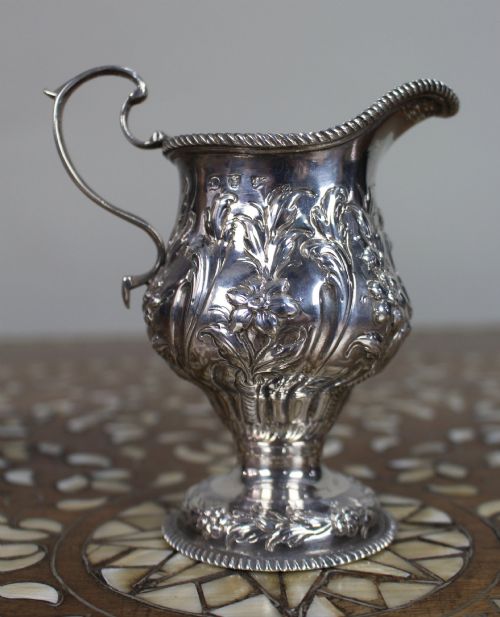


London Sterling Silver Jug
These london sterling silver jug examples bring Georgian elegance and Victorian craftsmanship straight to the table.
London Sterling Silver Jug
A london sterling silver jug encompasses everything from Georgian cream jugs and ewers to late Victorian claret jugs and water pitchers. Most pieces encountered on this page date from the Georgian and Victorian eras, reflecting centuries of silversmithing heritage in the capital.
Buyers look for these items to serve cream, wine, water or hot liquid with traditional weight and brightness. Functional forms range from pedestal creamers and sauce boats to large cut glass bodies mounted in solid silver.
Materials and construction
Makers fashioned these vessels primarily from solid sterling silver, occasionally pairing the metal with cut crystal glass or adding silver-gilt interiors. Wood components appear selectively, alongside intricate cast and chased motifs such as acorns and grapevines.
Techniques combine traditional smithing, mounting, and naturalistic repoussé work to achieve both sturdy domestic utensils and highly decorative display pieces.
London Sterling Silver Jug Retail Price Guide 2026
Typical asking prices for london sterling silver jug among the pieces listed under this phrase on Sellingantiques today, from the lower quarter to the upper quarter. They describe what is for sale here now, not the wider market.
Acorns and grapevines carved in silver ensure these jugs bring a touch of the English countryside directly to the dining table.
Distinguishing quality across the range
Quality rests on the crispness of chased or embossed details, such as naturalistic foliage and vine decoration, compared to simpler stamped surfaces. The weight of the solid silver and the integration of secondary materials like cut glass define the standing of each piece.
The clarity of hallmarks stamped by the London assay office and the reputation of recorded silversmiths further separate standard domestic wares from exceptional masterwork.
John Emes·John Rawlings·John Scofield·George Fox·Robert Hennell·John Angell·George Angell
The London Sterling Silver Jug Glossary
- Sterling silver
- A standard alloy consisting of ninety-two point five percent silver and seven point five percent other metals, chosen for durability and lustre. It forms the primary material for the majority of these hollowware vessels.
- Hallmark
- A series of official marks stamped on precious metals to guarantee the purity, the assay office origin, and the year of production. London pieces typically feature the leopard's head symbol.
- Claret jug
- A pouring vessel designed specifically for serving red wine at the dining table, frequently combining a glass body with a silver handle, mount, and hinged lid.
- Sauce boat
- An open boat-shaped vessel with a lip and handle, used for serving sauces or gravies, often raised on three feet or a pedestal base.
London Sterling Silver Jug: Frequently Asked Questions
How do I date a silver jug?
Dating relies heavily on the stamped hallmarks, which include a specific date letter corresponding to the year the piece was assayed in London. Stylistic clues like Neoclassical shapes or Victorian naturalism also help narrow down the decade.
Maker's marks further assist by pointing to the active working years of the silversmith responsible for the creation.
Are these jugs safe to use for serving?
Most solid sterling silver and glass vessels remain entirely functional for serving water, cream, or wine provided they receive proper gentle cleaning. The sturdy construction and traditional materials are built for practical daily use.
Owners should wash them by hand using mild soap and warm water, avoiding harsh abrasive materials that could scratch the antique surface.
What styles are most common?
Georgian and Victorian designs dominate the selection, ranging from restrained Neoclassical lines to ornate Victorian naturalism featuring acorns and grapevines. Simpler pedestal creamers represent the earlier eighteenth-century aesthetic.
Later nineteenth-century items frequently exhibit heavier ornamentation, textured surfaces, and mixed media such as cut glass.